• The move to the new server is done. There are some software and database maintenance updates in process. This has us passing the hat around to help out. We appreciate any donations. Seriously, even a dollar helps. The payment page may be found here - https://www.audiokarma.org/support.html

Characteristic impedance of speaker cables

High rise/fall time square waves, even at a low rep rate, have lots of HF content in the edges, and these can generate anomalous behavior in an audio cable that would never show up with signals bandlimited to just audio frequencies.
 
High rise/fall time square waves, even at a low rep rate, have lots of HF content in the edges, and these can generate anomalous behavior in an audio cable that would never show up with signals bandlimited to just audio frequencies.
That, is exactly the point, and the use of such signals is highly deceptive.
 
Absolutely. All one has to do is listen to the effects. ;)
Having the modeling ability offers some predictive and corrective capability that listening may not offer, or may offer with reduced convenience.
At the very least it often suggests an explanation for some of the differences that people may perceive and which may not be due to observer bias or the placebo effect.
It also allows you to view the endless marketing, pseudo scientific, nonsense that is put out by audiophile companies with a fair level of justified skepticism.
 
I’ll leave that to you. I’ve been enjoying the improved transparency with my low EDC cables in the main system for twenty years. ;)
 
It would all be a great revelation if transmission line effects were the only signal propagation phenomenon that affected the audible characteristics of audio cabling ..
But they aren't ..
Be a lot cheaper if any old piece of wire sounded just like every other old piece of wire ..
 
Last edited:
For some reason, I've always been cautious of sandwiched flat wire designs as the one they're pushing. I can't specifically remember why, though. Maybe someone can?
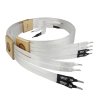
Perhaps you're thinking of Polk Cobra or Goertz cable which have wonderfully low values of L at the expense of high values of C. They have caused some amplifiers to oscillate without the use of a Zoebel network as discussed in Nelson Pass' cable test from forty years ago.

There are other flat cable designs, most notably from Nordost which have a balanced recipe of L and C for a very low EDC. Harry Pearson used both Valhalla and Odin in his phenomenally transparent systems for years. They are one of few companies who provide complete metrics. Carl Marchisotto of Nola swears by them.

Lg-Odin-speaker cable-banana_550-lightbox.jpg
 
Last edited:
I would like to see a company like Nordost take their complete metrics and show what they do compared to the same metrics for other types of cabling. I want to see measurements that show me their cable is “transparent” and not just a tuned filter affecting the overall tone.
 
I would like to see a company like Nordost take their complete metrics and show what they do compared to the same metrics for other types of cabling. I want to see measurements that show me their cable is “transparent” and not just a tuned filter affecting the overall tone.
I would also argue that transparency is inherently measurable- using a many tone input and assessing the SINAD of the system.
If the lack of transparency is due to transmission line effects then the SINAD and spur forest at the output of the amp should be measurably degraded due to the reflections. If the lack of transparency is due to the interconnect cable then the measured SINAD and spur forest should show a significant difference either/or at the output of the amp or at the input of the speaker.
The presence of speakers/cables can in fact cause this very effect. However, few manufacturers (any?) measure it and some amps (the AHB2 for example) seem to be entirely immune as far as I can measure. Even preamps can demonstrate this degradation, and surprisingly they can be affected by cable/load characteristics if they are poorly designed, or in some cases designed to be, well, euphonic.
Clarity, as you rightly point out, can also be effected by relatively small changes in broad frequency response (c. 0.25dB in the c. 2kHz range), but once again that should be exposed by analyzing the amp-cable-speaker interface.
 
Last edited:
Back
Top Bottom
