• The move to the new server is done. There are some software and database maintenance updates in process. This has us passing the hat around to help out. We appreciate any donations. Seriously, even a dollar helps. The payment page may be found here - https://www.audiokarma.org/support.html

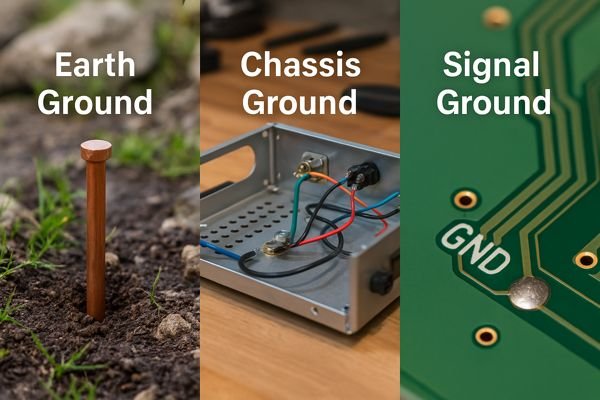
Chassis Ground / Signal Ground / Ground Loops

some tube radios tied one side of the power line right to the chassis. Depending which way the cord was plugged in you could have hot to chassis or neutral. Sounds like you got unlucky and shorted hot right to ground through the ductwork.

I don't like stuff with no power transformer for exactly that reason. Even the transformerless stuff with "isolated chassis" just had a capacitor separating the chassis from the power line, and those old caps went bad pretty often. Transformers can go bad, and given how old some of the stuff we fool with is, the chances of one failing is probably getting higher all the time but its still a lot less of a problem than 1950s capacitors.
 
I found a fuseholder that was broken, shorting the AC line to chassis - found it with an Ohmmeter before plugging it in. I usually use my Sprague cap tester on anything unknown - can find leakage in the transformer, line caps (checking power cord) and shorted diodes, electrolytics, etc. (checking power supply).
 
Hmm that gives me another idea: what about inadvertent contact between the live AC wiring on the primary side and signal ground on the secondary side? Obviously it's far less likely that a loose wire on the primary is going to happen to touch secondary ground than touch chassis earth, but still possible.
 
So when I was young I had one of the old cordless phones, one with metal antenna. Through an oddity of being about 9, i was plugging in something else, and brilliant me had the metal antenna of the base station somehow between the two spades of the plug, and when I plugged the other thing in the antenna was trapped. The top of the antenna was touching my cheek, and I got shocked. Mild buzzing.

So putting 120vac on the antenna didn't blow any fuses or damage the phone.
 
Grounding problems have gotten much worse because of the increased complexity of audio systems.

ANY piece of gear can create leakage current that causes ground loop hum.

You can feel the leakage current with the back of your hand!

If lightly rubbing the back of your hand against an appliance and you Feel a buzzing, That is leakage current.

Star Grounding

PS: You will never know real hum problems until you build phono preamplifiers!
 
@TriodeLuvr What about what @gadget73 said in post #27? I could be wrong, but what if the power transformer primary winding shorted to the part of the secondary such that the secondary/signal circuit ground was floating on top of some portion of the mains voltage. That would be a potential shock hazard at the RCA shell?
In more than 50 years of doing this, I have never even heard of that happening. The primary/secondary insulation in a power transformer is very robust, not like an audio output transformer. Every short I've ever encountered in a power transformer was confined to turns in either the primary or the secondary, a condition that doesn't present a shock hazard (and which usually blows the fuse). And just to be clear on this point, many modern pieces on the market such as CD players, tuners, preamps, etc. continue to be sold with two-wire line cords. They rely on the insulation of the power transformer to prevent a hazardous condition, and the transformers are rated for this service.

OTOH, if we discount all this and we suppose that what @gadget73 suggested is possible, perhaps one unit in a multi-piece system should have its signal ground and 3-wire ground connected together. A loop breaker isn't needed in that situation though, just a direct connection.

Jack
 
I basically agree, but the key for modern two-wire line cord equipment is that:
the transformers are rated for this service
If you're not using an IEC Class II transformer that's engineered for relying on the primary to secondary insulation as a safety critical feature, you're going to be SOL in the off chance someone does get electrocuted due to this failure mode. I suppose it's a question of risk tolerance in the end.
 
Those ratings didn't exist decades ago when most of this old crap was made. Then again grounding didn't exist either so....
 
In more than 50 years of doing this, I have never even heard of that happening. The primary/secondary insulation in a power transformer is very robust, not like an audio output transformer. Every short I've ever encountered in a power transformer was confined to turns in either the primary or the secondary, a condition that doesn't present a shock hazard (and which usually blows the fuse).

Jack
Every PT short that I've seen has been due to people replacing the OEM fuse with a 10- or 20-amp one they got at the auto parts store.

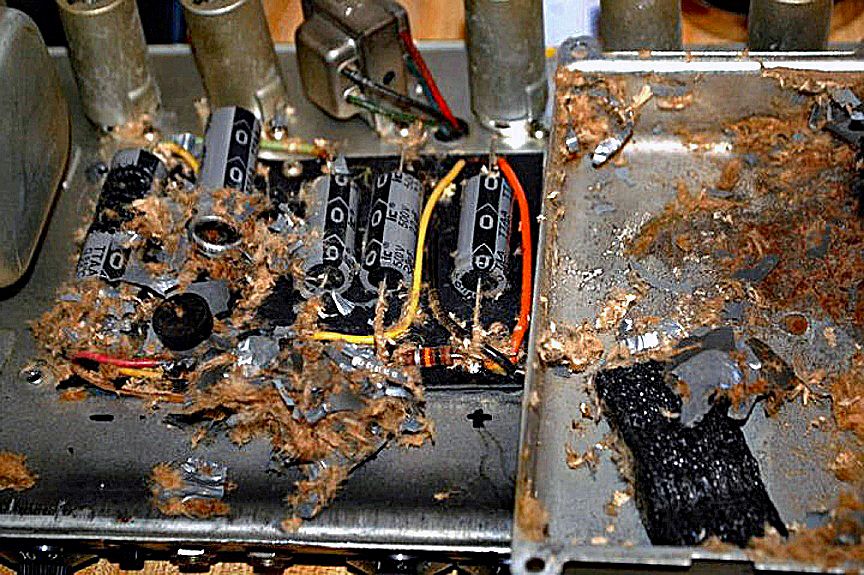
Even in amps that had miswired main power supply caps and blew up, the PT was okay. Schumacher and Triad did make hearty irons.

ae785994-6f1e-433e-ad85-e37d2d83dc92.jpg

The PT was okay, believe it or not.
 
I'm posting this to avoid derailing another recent discussion where the topic of grounding came up as a side issue. In that thread, I mentioned that all my recent projects - amps, line stages, phonoe preamps - isolate signal ground from the chassis. The chassis is only connected to the third wire earth ground. This eliminates hum from ground loops. Member @SS904 then noted he had done the same in an amplifier, but he added a 10 Ohm resistor and .1uF Y2 cap from the cap bank ground plane to chassis. When I asked about the purpose of those parts (which to me appear only to reintroduce the possibility of 3-wire ground loops), he said the path through those parts is "enough to break the ground loop and still provide a measure of safety beyond simply floating signal."

So, my question for @SS904 (or anyone else) is this: What potential safety issues might occur when signal ground is completely isolated from the chassis? Why is it important to maintain some type of connection between signal ground and the chassis (third wire ground)? I'm just trying to understand why this approach might be advisable.

Jack
Hope this will help cut confusion out of grounds applied, in audio equipment, homes and chassis grounds
 
Almost the first statement in that article says it’s about controlling current paths. I have mentioned this a number of times in different threads. Even with an isolated signal ground you can still get into noise issues if you don’t watch current paths of different sections. Especially important is where the common connections in the power supply are attached.
 
Every PT short that I've seen has been due to people replacing the OEM fuse with a 10- or 20-amp one they got at the auto parts store.
The only ones I've had were in un-fused things, which is equally as dumb. One from a console stereo that just never included a fuse, the other was an external power supply for a preamp that was such an absurdly low current that I don't think you could fuse the thing and actually protect the transformer. Potted transformer so I couldn't dissect but it was small and if that primary wire was much thicker than hair I'd be amazed.
 
Back
Top Bottom