
• The move to the new server is done. There are some software and database maintenance updates in process. This has us passing the hat around to help out. We appreciate any donations. Seriously, even a dollar helps. The payment page may be found here - https://www.audiokarma.org/support.html

Cheap transformer upgrade replacement?

durk80

Member
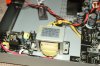
Greetings everyone! I recently bought a Cambridge AXA-25 integrated amp. The stock transformer that came with it reads:
089-00AMS-115
PRI: RED BLACK 115V 60HZ
SEC: YEL-BLK-YEL
23.5V-0-23.5V 1.5A
SW: 5A 130 DEG C

I would like to replace it with a toroidal transformer and something with a higher amperage rating to give the low end some depth. While it's very 'neutral' sounding the bass and treble controls do not seem to help.

I'd love to know:
a. What amperage rating would be preferable?
b. What supplier could I purchase the transformer from?
c. What does SEC and SW stand for?

Thank you for any help!
 

Attachments

  • DSC_0033.JPG
    DSC_0033.JPG
    87.7 KB · Views: 53
Register to hide this ad
You probably won't be able to get any more power out of it without redesigning the entire circuit.

Oh no! The reason why I asked was because when I built a tube amp from a kit, the trans that came with it was quite dinky with little bass at all. I had a better transformer custom made and the dynamics were quite noticeable. Is it different with solid state? 1.8 amps seems quite low if the thermal switch is rated to 5A. Just thinking out loud. What about a 4A transformer made with the same specs?
 
Sec = secondary

The SW is probably a thermal fuse or polyswitch. Rated 5A and 130 degrees Celsius

Cool, thank you! I was thinking that 'SW' meant secondary winding. The 'SEC' on the trans m!eant the same thing. This clears up the confusion! Thank you ;-)
 
A weak transformer (undersized) will drop the voltage whith high current demands, and that could translate to less dynamics (loud strokes amplified a bit less than the rest of the music) A powerful transformer will keep the voltage steady. I think there is room for some improvement if the original transformer is undersized. If the original part has the right size, not too much to be gained.

You have now 47V 1.8A. If size is not an issue you can upsize to 2.5 or 3A. I think 24-0-24V will be easier to find than 23.5-0-23.5V
 
If you're not familiar with them, Antek has very good prices on toroids. Keep in mind, if you up the amperage the transformer is delivering, you're power supply capacitance might not be up to the job of filtering the ripple. So you might need to increase the PS caps. Also, if you're increasing the power delivered to the circuit you're going to increase the power dissipated. Are your heatsinks up to the task?
 
I think the capacitors and heat sinking would be more a matter if you actually make the receiver somehow work harder, not just because the transformer has higher current rating.
 
Only if the transformer is undersized and causing the rail voltage to drop under load. If the transformer isn't too small, a bigger one isn't going to help any

The thing to do here is measure it. Full power output into a dummy load and see what the supply voltage is unloaded vs loaded. its not regulated so it will drop but if the drop isn't excessive there really isn't any need to mess with the transformer.

or just buy a better amplifier. If the supply is too dinky, chances are fair they didn't over-engineer the rest of it either. Beefing up the supply might reveal the next weakest link in an unpleasant way.
 
You have now 47V 1.8A. If size is not an issue you can upsize to 2.5 or 3A. I think 24-0-24V will be easier to find than 23.5-0-23.5V
This was very helpful. Thanks!
I think I found one that might work, if I connect the input in parallel and the output in series. From the looks on the board, there are two yellow wires and one black which must be two positive and a shared ground. I wish I had a schematic for it, but no. It looks like if I jump blue to violet and grey to brown, I can have 115V input. Then for the output, I'd have Black, Yellow and Red to Orange leaving me with three wires. I am unsure of the toroidal transformer schematic on the pdf. How to tell which leads to connect to positive and negative?
https://www.farnell.com/datasheets/2279630.pdf
 
AC voltage doesn't have positive and negative. Black and yellow from the toroidal should go to the AC input on your board, where Yellow wires of the original transformer are now.

Red-orange will be the center tap, same than your actual black wire between the yellow wires.

But, as mentioned, if the original transformer is the right size, a larger transformer won't make a big difference.
 
Is it possible the OP's transformer is rated at 1.8A per rail? This would make the power draw more in line with Cambridge's 180W power consumption spec
 
For Class AB amp various info I see suggests transformer VA should be minimally equal to the amp's output, up to 2x amp's output.

The Cambridge is 50W amp, so the transformer would be minimally 50VA, up to 100VA. But, the existing transformer is ~85VA. Granted, it is an integrated amp so there is a little of the transformer used for other purposes. But, based on "facts of the case" the transformer in the unit isn't by any means undersized. If anything, it's at about the middle ground or a little better.
 
Last edited:
Is it possible the OP's transformer is rated at 1.8A per rail? This would make the power draw more in line with Cambridge's 180W power consumption spec

The 1.8A applies to any part of the winding. You can look at it as 23.5V @ 1.8A times two (47VA × 2 = 85VA) or 47V @ 1.8A (85VA). Either way the transformer rating is 85VA.

A transformer doesn't just stop at the rated current. Rated current is the max continuous rating. It will gladly put out more for short periods of time without any damage at all, although there will be more voltage sag. This is why the thermal fuse is 5A rating. So, if necessary, the transformer can provide more current on demand without nuisance opening, yet, if that happens too often/too long, then the transformer will get warmer and warmer, and if it gets hot enough the thermal part opens.
 
Last edited:
I see you edited your post. 50W amp output from a 50VA transformer? 180W drawn from an 84VA transformer? A 5A fuse for a 1.8A rail? Study? Common sense goes a long way bud
 
Back
Top Bottom