• The move to the new server is done. There are some software and database maintenance updates in process. This has us passing the hat around to help out. We appreciate any donations. Seriously, even a dollar helps. The payment page may be found here - https://www.audiokarma.org/support.html

Could it be caps need replaced?

Dclay1

New Member
Have a Simply 2 integrated amplifier ( 12AU7 preamp tubes, EL34 power tubes). Amp is self biasing. Had been in storage a couple of years. Weak audio from the right channel so I replaced tubes- new issue Tung-Sol EL34s, NOS Tung-Sol black glass 12AU7s. Right audio is still weak (sound stage 3/4 or more toward left speaker) but over about 2 hours, sound stage "centers" its self. Sounds great after about 2 hours. Could I need to replace the capacitors? Unit is about 20 -25 years old.

Link to schematic below (if it helps anyone with much more knowledge than me!)
https://redirect.viglink.com/?forma...udio.com/Circuits/UNISON_Research_Simply2.pdf
 
Register to hide this ad
I think you should measure all resistors. Most could probably be measure in place.
As it seems to be a stereo amp, injecting a sine in both channels and
following the signal, comparing the channels, will pinpoint the missing volume.
Blindly changing components might fix the problem or worsen it, seldom the most economical way.
 
Thanks for the suggestion! The integrated amp has only the input selection knob and a volume control. Have deoxit in small bottle with brush (both red and gold). Used it on all RCA cables, speaker wire connections, and tube pins when I set up system after storage. Not afraid to remove cover (well aware of lethal voltages) just not sure what you think i should deoxit once I am inside! Don't have the skills or equipment to follow peterh suggestions above (but thank you for taking time to respond Peter!). Thanks for the suggestion but could you give me a little more detail? Appreciate any feedback you have...
 
Thanks for the suggestion! The integrated amp has only the input selection knob and a volume control. Have deoxit in small bottle with brush (both red and gold). Used it on all RCA cables, speaker wire connections, and tube pins when I set up system after storage. Not afraid to remove cover (well aware of lethal voltages) just not sure what you think i should deoxit once I am inside! Don't have the skills or equipment to follow peterh suggestions above (but thank you for taking time to respond Peter!). Thanks for the suggestion but could you give me a little more detail? Appreciate any feedback you have...
The first step needs a ohm-meter ( a digital voltmeter will do). Measure each resistor and compare
to the printed-on value, also compare between channels. Any discrepancy is noted and compared
with schematics. No need to remove tubes or unsoldering just make sure that B+ caps has discharged.
The second way needs some instruments, a tonegenerator and an oscilloscope.The idea is to
inject a signal at the input and measure the signal among the amp with power on. As there si two channels
any differences among the channels are interesting.
In both cases i suspect a resistor that has changed value, your job is to find it !
 
Thanks for the suggestion! The integrated amp has only the input selection knob and a volume control. Have deoxit in small bottle with brush (both red and gold).
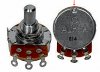
You'll probably need the type that comes in a spray can so you can spray it inside the volume pot and on the contacts of the selector. Direct the spray into the pot where the connectors stick out. There are sometimes also tiny openings in the back cover of a volume pot. The spray versions come with an thin plastic extension which allows you to direct the spray into the opening.
 
PeterH and FlaCharlie - Thanks! Will be implementing your suggestions! Thanks for taking time to respond!!
 
You'll probably need the type that comes in a spray can so you can spray it inside the volume pot and on the contacts of the selector. Direct the spray into the pot where the connectors stick out. There are sometimes also tiny openings in the back cover of a volume pot. The spray versions come with an thin plastic extension which allows you to direct the spray into the opening.

Looks like this. :)

potentiometer slots (alpha).jpg

Or if no indented slots in can, can spray here.

pot-dual ganged slots.jpg
 
Back
Top Bottom