• The move to the new server is done. There are some software and database maintenance updates in process. This has us passing the hat around to help out. We appreciate any donations. Seriously, even a dollar helps. The payment page may be found here - https://www.audiokarma.org/support.html

Crossovers on pcbs.

It seems like assembly and testing would be easier with the crossover mounted on the terminal plate/cup.


The electrolytic caps are about 40mm long x 18 mm dia. The film caps are always larger than similar value electrolytics used in crossovers. The electrolytics are typically 100V rated parts, which keeps their size and cost down, and the PP film caps with the same capacitance are typically 400-600V rated parts which makes them bigger than if they were also 100V parts. I suspect the film caps used in crossovers are rated for high voltages because they are also used as coupling caps in some tube circuits.
Motor run caps can be great for crossovers and filter caps. Even the oil filled type. Those that I found at Partsconnexion were motor run caps as well with great specs. I never get into the weeds looking at film caps. Some of the crazy expensive boutique film caps don't test well at all. Janzen does produce some very nice caps though. So does Mundorf.
I had two and kept one Marantz model 140 power amps and restored them at the same time. The only difference between them when done was the film caps I used on the amp boards. I left the original film caps in one, and used Janzen Superior Z caps in the other. The difference in how the two sounded was very noticable. The amp with the original film caps sounded a bit sterile compared to the amp with the Janzen caps. Thats the only time I ever noticed a real difference in film caps. I build my own tube amps and use a lot of Panisonic ECW polypropylene film caps for bypass and coupling caps. Those and those axial yellow Illinois polypropylene film caps. They sound good and are dirt cheap.
For crossovers I use Audyn, Solen, and Dayton usually.
 
"From a technical perspective it would generally be complete overkill to use expensive high-end capacitors for the low frequency area (bass), as the improvements in performance / sound of higher-grade capacitors, would not be audible at such low frequencies."

Not true. Even different makes of caps in the conjugate position can audibly alter the sound. The question becomes, is the difference audible to you and worth the difference in cost?
 
The question becomes, is the difference audible to you and worth the difference in cost?
There's only one cap to replace in the speaker, and I'm going to use the PP film caps. The price difference between the film cap and the NP electrolytic is about $12-15 each. At that price I'm willing to experiment.
 
Wondering how good or bad pcbs are for crossovers. There's track thickness is it sufficient, are tag boards better, is wood better.

There's microphony, commercial pcbs have all the components glued very firmly to the pcb, but doesn't this just make everything vibrate, for some strange reason I wonder about drilling holes to allow airflow, or pressure wave flow through the board, avoiding tracks obviously. Should crossover pcbs be mounted on springs and dampers or bolted down to the cabinet!

Is the tweeter inductor better off mounted in foam.

Questions questions.
Thank you
Mil-spec type of conformal coatings?

MG Chemicals has a line of conformal coatings. I have never used any of these.
 
Last edited:
Ah thankyou I always wondered what that goo was called, it can be really tough to remove. I don't think I'll be using it either.


Here's quite an interesting and down to earth guide of crossover parts.
 
Last edited:
Motor run caps can be great for crossovers and filter caps. I build my own tube amps and use a lot of Panisonic ECW polypropylene film caps for bypass and coupling caps. Those and those axial yellow Illinois polypropylene film caps. They sound good and are dirt cheap.
For crossovers I use Audyn, Solen, and Dayton usually.
I've found Panasonic ecwf work wonders before and after regulators seems that most hifi components can do with more filmy goodness there.

Also used them on the HF capacitors of a crossover recently, seems ok, I hope Mr humble homemade cap review gets around to rating them sometimes. I'm never sure whether to bypass in speakers, some people like it some don't.
 
I have several of the Audyn Q4s in various values. The cost is reasonable, but I find them to be a bit bright/glarey. They work well in the conjugate position. I teem them up with other makes to mellow their sound, even in the conjugate position.

I really like the Mundorf Evo-oils for the Heils. For tweeters, cap values are typically small so this keeps things affordable even using higher quality components.

You won't find better than Mills resistors.
 
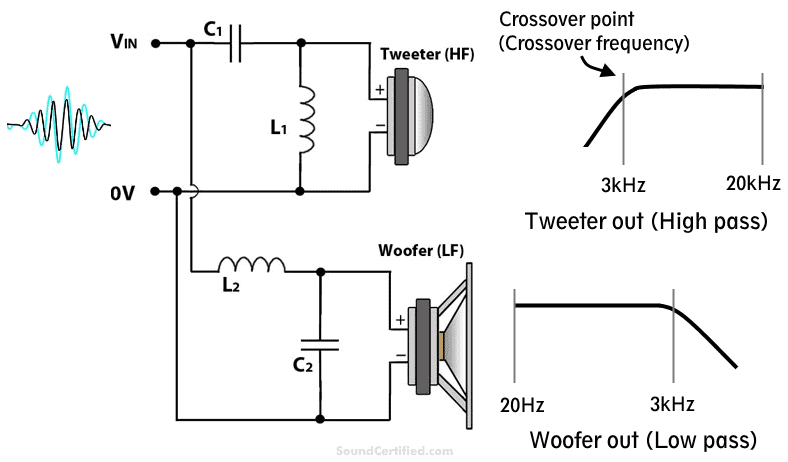
I was using audin q4 but more recently I've found them too bright same as you. Now using Jantzen cross cap. What is the conjugate position, never heard that term before?
 
C2 is in the conjugate position. This is where people/manufactures "cheap out" with the reasoning that the sound that you "hear" does not go though it. But in actual listening, one finds that there are differences, though they may be subtle.

2-way-speaker-crossover-diagram.png
 
Back
Top Bottom