Years ago, Monitor Audio used a big Macrotech amp on a pair of their reference bookshelves. Still a bit brighter than I like, but not offensive (the speakers themselves were a bit bright as well), but the bass, mids, and dynamics were incredible. Effortlessly playing Stevie Ray Vaugn.If not I can go for this one, but I am going to need a bit more power

Crown macro tech 10000 watt amplifier
$3,400.00 Crown macro tech 10000 watt amplifier for sale in Salt Lake City, UT on KSL Classifieds. View a wide selection of Home Audio Other Equipment and other great items on KSL Classifieds.classifieds.ksl.com


You are using an out of date browser. It may not display this or other websites correctly.
You should upgrade or use an alternative browser.
You should upgrade or use an alternative browser.
Crown Amps, the hype is real!
- Thread starter lattiboy
- Start date

whoaru99
Epic Member
If not I can go for this one, but I am going to need a bit more power
Crown macro tech 10000 watt amplifier
$3,400.00 Crown macro tech 10000 watt amplifier for sale in Salt Lake City, UT on KSL Classifieds. View a wide selection of Home Audio Other Equipment and other great items on KSL Classifieds.classifieds.ksl.com
LOL.
I know you're just having some fun but, regardless, that amp would not be a good choice for typical home use. I don't mean simply because of the power, but because the amp is optimized for very low impedance operation.
At more normal/typical impedances there would be better choices for high power, and that don't require 3-phase mains power.


PabloTincho
Super Member
is it possible to change the fan ?

Blue Shadow
Waiting for Vintage Gear from this century
When I was using the PSA-2 not extended headroom, concert touring model, the fan would be at low speed, the music would start and we'd dance or whatever. As soon as the music stopped you would hear the fan drop back down to the low speed. It is supposed to have temp sensors for the fan speed but I think that amp had a microphone listening to decide when to slow the fan down.I can certainly hear the fan in the PSA-2XH in my living room, but not with anything playing.
whoaru99
Epic Member
Depends which amp you're talking about.is it possible to change the fan ?
Many are fairly easy to change, one example is QSC PLX-series amps because they use common 80mm fans.
Some don't have good options for replacement, one example being the big iron Crown Macro Tech / Micro Tech because they use a proprietary fan assembly which also serves as a low voltage transformer. These are sometimes referred to as "fanformers".
Last edited:

It runs at low speed in my system. But I can still hear it if nothing is playing, and I've even cleaned it out in the past. I can also hear the fan in my Yamaha RX-Z9, but it is 22 years old with over 30,000 hours and has never been serviced since the factory fixed an issue under warrantee when new. I do believe that this one has gotten a bit louder over the years.When I was using the PSA-2 not extended headroom, concert touring model, the fan would be at low speed, the music would start and we'd dance or whatever. As soon as the music stopped you would hear the fan drop back down to the low speed. It is supposed to have temp sensors for the fan speed but I think that amp had a microphone listening to decide when to slow the fan down.

Bill Ferris
Lunatic Member
FWIW, All my experiences and use of Crown amplifiers, both in 3 of my home stereos and HT, and in the past (1978-1980) when I was employed for 2 yrs. 6 nights a wk. as a FOH sound engineer for a local popular rock band in South Miami FL. have and were problem/issue free.
And currently, in this room my separates stereo uses a DC-300 Series II, along with the Mc. preamp driving it remain powered up 24/7/365 for yrs. playing my all day WAV. ripped music effortlessly driving a 12" passive internal crossover subwoofer and a pair of Mc. XR-1 book shelf speakers.
Back in the early nineties when I was first creating a high quality stereo in my recently moved into house, I first tried to use one Crown SA-2 for my recently purchased in 1990 Mc. XRT-22 line array speaker system, but promptly realized that one SA-2 was not enough for the low efficiency (87 DB), but excellent sounding Mc. XRT-22 speaker at the desired SPL that I desired in the house`s great room, so I purchased another used SA-2, went through it on my bench to make sure it met all factory specs. before installing in my stereo. Mono configured both, but quickly realized that the living room`s original 15 amp 120 v circuit wasn`t up to the task under elevated SPLs !
So I had a friend help me run a dedicated 10 gage 240 v 30 amp circuit into the area where the SA-2s were mounted in a short height equipment rack.
I then easily rewired the SA-2s for 240v operation, and well the stereo became alive being no longer being starved for input power !
My only complaint about that setup was the SA-2`s fan noise, so I bought a hinged smoked plastic rack cover to try to reduce the amp`s fan noise that wasn`t too bad until the stereo was cranked up playing multiple HQ CDs and the amps ramped up their fan`s speed.
This great sounding stereo got me thinking what could I do to take it to another level, so since over time various repair customers had offered me attractive purchase prices on Crown D-150s, so after checking them out and repairing any issues with them if necessary, I decided to try to bi-amplify the Mc. 22s using a pair of mono configured D-150s, one for each tweeter array.
Well after I got a pair of early nineties era HQ digital time align capable electronic crossover, and got the speaker system`s cabinets time aligned, the system`s performance went up another notch, so now I`m thinking what else can I do to take the system up to another performance level ?
I had also been purchasing used Crown DC-300A/Series II s over the yrs. when offered to me at attractive prices, so when I had enough of the Series IIs, I pulled the D-150s and installed 2 mono configured DC-300 Series II in their place, that raised the speaker system`s dynamic performance when cranked up.
Finally I desired more bass cabinet power than the SA-2s could provide in mono driving 8 ohms (800 watts), so for the first time in my life I special ordered 2 brand new Crown Power Tech IIIs from Musician`s Friend that could be rewired for 240v after obtaining permission from Crown, because those power input configurable amps were only sold for export, but I had been a Crown authorized service station since 1990, so the Crown head service guy had been to my house to check out my house`s workshop and test equipment quality before he authorized me, and saw my (2) SA-2 powered stereo, and knew that I was going to only purchase the 2 PT IIIs for my use and not intend to sell the overseas.
The only change after the installation of the PT-IIIs was to install them in a rack in my living room`s adjacent closed up capable sunroom to isolate their fan noise from the living room`s listening area.
That living room`s excellent sounding totally Crown powered stereo remained in use until 2006 when I decided to try to change over to totally Mc. SS mono block amplification, after replacing the XRT-22 to the Mc. XRT-30 tri-amplifiable line array speaker system purchased new in late 2003.
All the Crown amps were still performing flawlessly (I did have to replace the bedroom system`s 2 mono configured 1970s era DC-300As failing main filter caps in 2004) when removed for the Mc. amps exchange, I just wanted a totally Mc. speaker & amplifier stereo setup for the first time in my life.
And currently, in this room my separates stereo uses a DC-300 Series II, along with the Mc. preamp driving it remain powered up 24/7/365 for yrs. playing my all day WAV. ripped music effortlessly driving a 12" passive internal crossover subwoofer and a pair of Mc. XR-1 book shelf speakers.
Back in the early nineties when I was first creating a high quality stereo in my recently moved into house, I first tried to use one Crown SA-2 for my recently purchased in 1990 Mc. XRT-22 line array speaker system, but promptly realized that one SA-2 was not enough for the low efficiency (87 DB), but excellent sounding Mc. XRT-22 speaker at the desired SPL that I desired in the house`s great room, so I purchased another used SA-2, went through it on my bench to make sure it met all factory specs. before installing in my stereo. Mono configured both, but quickly realized that the living room`s original 15 amp 120 v circuit wasn`t up to the task under elevated SPLs !
So I had a friend help me run a dedicated 10 gage 240 v 30 amp circuit into the area where the SA-2s were mounted in a short height equipment rack.
I then easily rewired the SA-2s for 240v operation, and well the stereo became alive being no longer being starved for input power !
My only complaint about that setup was the SA-2`s fan noise, so I bought a hinged smoked plastic rack cover to try to reduce the amp`s fan noise that wasn`t too bad until the stereo was cranked up playing multiple HQ CDs and the amps ramped up their fan`s speed.
This great sounding stereo got me thinking what could I do to take it to another level, so since over time various repair customers had offered me attractive purchase prices on Crown D-150s, so after checking them out and repairing any issues with them if necessary, I decided to try to bi-amplify the Mc. 22s using a pair of mono configured D-150s, one for each tweeter array.
Well after I got a pair of early nineties era HQ digital time align capable electronic crossover, and got the speaker system`s cabinets time aligned, the system`s performance went up another notch, so now I`m thinking what else can I do to take the system up to another performance level ?
I had also been purchasing used Crown DC-300A/Series II s over the yrs. when offered to me at attractive prices, so when I had enough of the Series IIs, I pulled the D-150s and installed 2 mono configured DC-300 Series II in their place, that raised the speaker system`s dynamic performance when cranked up.
Finally I desired more bass cabinet power than the SA-2s could provide in mono driving 8 ohms (800 watts), so for the first time in my life I special ordered 2 brand new Crown Power Tech IIIs from Musician`s Friend that could be rewired for 240v after obtaining permission from Crown, because those power input configurable amps were only sold for export, but I had been a Crown authorized service station since 1990, so the Crown head service guy had been to my house to check out my house`s workshop and test equipment quality before he authorized me, and saw my (2) SA-2 powered stereo, and knew that I was going to only purchase the 2 PT IIIs for my use and not intend to sell the overseas.
The only change after the installation of the PT-IIIs was to install them in a rack in my living room`s adjacent closed up capable sunroom to isolate their fan noise from the living room`s listening area.
That living room`s excellent sounding totally Crown powered stereo remained in use until 2006 when I decided to try to change over to totally Mc. SS mono block amplification, after replacing the XRT-22 to the Mc. XRT-30 tri-amplifiable line array speaker system purchased new in late 2003.
All the Crown amps were still performing flawlessly (I did have to replace the bedroom system`s 2 mono configured 1970s era DC-300As failing main filter caps in 2004) when removed for the Mc. amps exchange, I just wanted a totally Mc. speaker & amplifier stereo setup for the first time in my life.

Lavane
Lunatic Member
I've been using one of the newer CDi series Crown amps in my garage system. I was given three of them and gave one to my son for his home studio.
I replaced the Phoenix connectors on the back with RCA jacks wired unbalanced with two of them. At first I didn't really care for the sound of these amps. Dry and sterile came to mind for how they sounded when I first used one.
But I've started to warm up to the thing. Its fast, punchy and clean sounding. I tried a tube preamp connected to it recently and it made a huge difference for the better. I think I'll build a unity gain tube buffer to use with it.
The design is interesting. It's different from other Crown amps. It's much lighter than older models since it uses a switchmode power supply and a well filtered Class D type amp driving a fan cooled discrete output stage.
These amps also have built in DSP which I haven't really messed with yet.
Now to find a schematic for a nice tube buffer stage.
I replaced the Phoenix connectors on the back with RCA jacks wired unbalanced with two of them. At first I didn't really care for the sound of these amps. Dry and sterile came to mind for how they sounded when I first used one.
But I've started to warm up to the thing. Its fast, punchy and clean sounding. I tried a tube preamp connected to it recently and it made a huge difference for the better. I think I'll build a unity gain tube buffer to use with it.
The design is interesting. It's different from other Crown amps. It's much lighter than older models since it uses a switchmode power supply and a well filtered Class D type amp driving a fan cooled discrete output stage.
These amps also have built in DSP which I haven't really messed with yet.
Now to find a schematic for a nice tube buffer stage.
I'll take hell of a answer Alex for 10,000Strong statement and one that is possible for those who have evolved past the psycho-acoustics trap. Older Crowns feature boat anchor transformers and banks of metal die T-03 outputs. They are over built, have tons of headroom, and can drive low impedance speakers without breaking a sweat. These are all qualities necessary for the harsh pro environment but they are also qualities that the highest quality home amps possess. I've seen 300 wpc pro amps on the bench performing square wave reproduction test and the traces are near perfect. What all this translates to is superior dynamics, crystal clear peaks, bass that is tight and hard, and quiet spaces that are incredibly dark.

I’ll bet that system sounds fantastic!FWIW, All my experiences and use of Crown amplifiers, both in 3 of my home stereos and HT, and in the past (1978-1980) when I was employed for 2 yrs. 6 nights a wk. as a FOH sound engineer for a local popular rock band in South Miami FL. have and were problem/issue free.
And currently, in this room my separates stereo uses a DC-300 Series II, along with the Mc. preamp driving it remain powered up 24/7/365 for yrs. playing my all day WAV. ripped music effortlessly driving a 12" passive internal crossover subwoofer and a pair of Mc. XR-1 book shelf speakers.
Back in the early nineties when I was first creating a high quality stereo in my recently moved into house, I first tried to use one Crown SA-2 for my recently purchased in 1990 Mc. XRT-22 line array speaker system, but promptly realized that one SA-2 was not enough for the low efficiency (87 DB), but excellent sounding Mc. XRT-22 speaker at the desired SPL that I desired in the house`s great room, so I purchased another used SA-2, went through it on my bench to make sure it met all factory specs. before installing in my stereo. Mono configured both, but quickly realized that the living room`s original 15 amp 120 v circuit wasn`t up to the task under elevated SPLs !
So I had a friend help me run a dedicated 10 gage 240 v 30 amp circuit into the area where the SA-2s were mounted in a short height equipment rack.
I then easily rewired the SA-2s for 240v operation, and well the stereo became alive being no longer being starved for input power !
My only complaint about that setup was the SA-2`s fan noise, so I bought a hinged smoked plastic rack cover to try to reduce the amp`s fan noise that wasn`t too bad until the stereo was cranked up playing multiple HQ CDs and the amps ramped up their fan`s speed.
This great sounding stereo got me thinking what could I do to take it to another level, so since over time various repair customers had offered me attractive purchase prices on Crown D-150s, so after checking them out and repairing any issues with them if necessary, I decided to try to bi-amplify the Mc. 22s using a pair of mono configured D-150s, one for each tweeter array.
Well after I got a pair of early nineties era HQ digital time align capable electronic crossover, and got the speaker system`s cabinets time aligned, the system`s performance went up another notch, so now I`m thinking what else can I do to take the system up to another performance level ?
I had also been purchasing used Crown DC-300A/Series II s over the yrs. when offered to me at attractive prices, so when I had enough of the Series IIs, I pulled the D-150s and installed 2 mono configured DC-300 Series II in their place, that raised the speaker system`s dynamic performance when cranked up.
Finally I desired more bass cabinet power than the SA-2s could provide in mono driving 8 ohms (800 watts), so for the first time in my life I special ordered 2 brand new Crown Power Tech IIIs from Musician`s Friend that could be rewired for 240v after obtaining permission from Crown, because those power input configurable amps were only sold for export, but I had been a Crown authorized service station since 1990, so the Crown head service guy had been to my house to check out my house`s workshop and test equipment quality before he authorized me, and saw my (2) SA-2 powered stereo, and knew that I was going to only purchase the 2 PT IIIs for my use and not intend to sell the overseas.
The only change after the installation of the PT-IIIs was to install them in a rack in my living room`s adjacent closed up capable sunroom to isolate their fan noise from the living room`s listening area.
That living room`s excellent sounding totally Crown powered stereo remained in use until 2006 when I decided to try to change over to totally Mc. SS mono block amplification, after replacing the XRT-22 to the Mc. XRT-30 tri-amplifiable line array speaker system purchased new in late 2003.
All the Crown amps were still performing flawlessly (I did have to replace the bedroom system`s 2 mono configured 1970s era DC-300As failing main filter caps in 2004) when removed for the Mc. amps exchange, I just wanted a totally Mc. speaker & amplifier stereo setup for the first time in my life.
Bill Ferris
Lunatic Member
My long time close friend and fellow audiophool classically trained flute playing Bat Eared B-I-L commented one night while listening to natural non multi track recorded HQ CD by Gerry Mulligan one night, that the sound of that CD which was one of his reference HQ CDs for evaluating his excellent sounding stereos over the yrs.I’ll bet that system sounds fantastic!
I was so pleased when he, unsolicited by me, commented after playing that JM CD that the sound of that CD was the best he ever heard it, as he wasn`t one to mince words and more often than not would not critically comment unless requested, so making his compliment about my previous efforts to achieve the totally Crown powered Mc. XRT-22s that I BI-Amplified, digitally time aligned and carefully 1/3rd octave voiced with my IVEY IE-30A RTA paid off.
I, of course, before he stopped by that night, already thought the setup sounded very accurate to my ears, but I could have easily been biased !
PabloTincho
Super Member
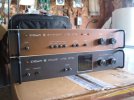
I am able to get a Crown Studio Reference 1, it comes with a weird plug, no problem I found the right adapter, but it got me thinking.
here is the plug
RV 30 Amp To 110V Adapter Plug, 30A Male To 15A Female Camper Power Cord
What are the power requirements for the Reference 1 ?
Is it possible to connected it to a regular outlet or I need a electrician to do some modifications ?
here is the manual
All Studio Reference amplifiers are shipped with an appropriate line cord and plug. The 120 VAC, 60 Hz North American Studio Reference has a special TT30P plug and includes a matching receptacle. Always use an isolated power receptacle whenever possible with adequate voltage and current. Excessive linevoltages 10% or higher above the rated voltage will cause the amplifier to activate its standby mode (seeSection 4.3.2). For example, do not exceed a 132 VACwith models rated for 120 VAC operation.Unless otherwise noted, all specifications in this manual were measured using 120 VAC, 60 Hz power mains with voltage accurate to within 0.5% and THD ofless than 1.0% under all test conditions. Performance variations can occur at other AC mains voltages and line frequencies. Line regulation problems will directly affect the output power available from the amplifier.

 www.crownaudio.com
here is the plug
RV 30 Amp To 110V Adapter Plug, 30A Male To 15A Female Camper Power Cord
What are the power requirements for the Reference 1 ?
Is it possible to connected it to a regular outlet or I need a electrician to do some modifications ?
here is the manual
All Studio Reference amplifiers are shipped with an appropriate line cord and plug. The 120 VAC, 60 Hz North American Studio Reference has a special TT30P plug and includes a matching receptacle. Always use an isolated power receptacle whenever possible with adequate voltage and current. Excessive linevoltages 10% or higher above the rated voltage will cause the amplifier to activate its standby mode (seeSection 4.3.2). For example, do not exceed a 132 VACwith models rated for 120 VAC operation.Unless otherwise noted, all specifications in this manual were measured using 120 VAC, 60 Hz power mains with voltage accurate to within 0.5% and THD ofless than 1.0% under all test conditions. Performance variations can occur at other AC mains voltages and line frequencies. Line regulation problems will directly affect the output power available from the amplifier.
Crown Studio Reference Series
www.crownaudio.com

whoaru99
Epic Member
The amp will be fine on a standard 15A or 20A circuit if you're playing typical music even at quite high levels. These circuits can pass many times their rated current to cover peak demands.
If you're doing something else with the amp, e.g. trying to measure continuous full rated sine wave output or some heavy industrial application that has a high duty cycle, then there is some risk the mains circuit breaker could trip under those conditions. But, no harm comes to the amp, and the type of use that would cause it to happen is not very common for home stereo use.
If you're doing something else with the amp, e.g. trying to measure continuous full rated sine wave output or some heavy industrial application that has a high duty cycle, then there is some risk the mains circuit breaker could trip under those conditions. But, no harm comes to the amp, and the type of use that would cause it to happen is not very common for home stereo use.
PabloTincho
Super Member
Got the amp for $650 shipping include, lets see if the amp survives the shipping