• Please note that Audiokarma will be offline briefly for updates early on Monday morning, September 28th.

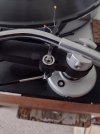
Cue Damping Gone, on Linn Basik LVX tonearm. Repaired successfully!

Hypodermic with 500k cst silicone fluid arrived. Bought on ebay.

Applied through bottom of Cue. Hypodermic steel tip was useful to get fluid beyond lever cam-shaft and near piston.
I couldn't get lever then piston out without damaging. So not ideal access.

Decided not to use a heat gun to warm silicone, to help spread it.

I used a 5/16" diameter hollow punch to cut out a new cover for bottom of Cue. Made from bicycle inner tube. Used silicone sealant sparingly along shallow counterbore, to attach it.
View attachment 2603078

Linn back in operation. Damping looks great. It may slow more with use.
Hope this thread helps next LVX owner with this issue.
View attachment 2603091

Good job, Todd! :thumbsup: Glad it works better now.
 
Bumping this up. I had the same problem with my linn basik lvx arm but was scared to attempt what the OP did. I ordered some 300k silicone oil and using a syringe, just put some on the shaft of the tonearm lift and continuously brought it up and down til the oil worked itself into the barrel. It was a bit messy and not ideal, but got the job done after a few days. I just let the oil creep down slowly from the shaft into the barrel. There was some gunk left by the excess oil that didn’t sink in. I just cleaned it off with some isopropyl alcohol and so far the arm is working nicely. This may be worth a try as another option to fix the linn’s tonearm lifter. Hope this helps.
 
Bumping this up. I had the same problem with my linn basik lvx arm but was scared to attempt what the OP did. I ordered some 300k silicone oil and using a syringe, just put some on the shaft of the tonearm lift and continuously brought it up and down til the oil worked itself into the barrel. It was a bit messy and not ideal, but got the job done after a few days. I just let the oil creep down slowly from the shaft into the barrel. There was some gunk left by the excess oil that didn’t sink in. I just cleaned it off with some isopropyl alcohol and so far the arm is working nicely. This may be worth a try as another option to fix the linn’s tonearm lifter. Hope this helps.
Great you got it fixed, without disassembly.

Took me years, before I got the courage to remove buggered up set screw out, on mine. Was afraid of damaging thread in plastic body. I first tried applying oil to shaft. But i didn't have any luck, slowing drop. Maybe didn't try it long enough, to have effect.
 
Last edited:
Thought I'd resurrect an old thread to share my experience with this repair in case anyone else comes across it via Google like I did.
Done this past weekend on a Basik LVV but it seems to be the same part.

The bottom seal wouldn't budge for me and I didn't want to risk damaging it so I tried going in through the top which is for sure the intended ingress point. The black ring around the lift piston came off very easily and revealed a retaining ring holding down a washer and the lift spring. Remove those and you can pull out the piston entirely.

I completely spaced on getting photos but I'm thinking I'll have to disassemble it again soon because it's a little too stiff now for such a lightweight arm so I'll have to remove some of the oil. I'll update with photos when I get around to doing so.
 
Thought I'd resurrect an old thread to share my experience with this repair in case anyone else comes across it via Google like I did.
Done this past weekend on a Basik LVV but it seems to be the same part.

The bottom seal wouldn't budge for me and I didn't want to risk damaging it so I tried going in through the top which is for sure the intended ingress point. The black ring around the lift piston came off very easily and revealed a retaining ring holding down a washer and the lift spring. Remove those and you can pull out the piston entirely.

I completely spaced on getting photos but I'm thinking I'll have to disassemble it again soon because it's a little too stiff now for such a lightweight arm so I'll have to remove some of the oil. I'll update with photos when I get around to doing so.
If you do disassemble it, photos would be nice!

Maybe use lower viscosity (cSt) silicone oil?
 
used method going in from the top black cover and used some 200k, seems to be working kind of ok but may take apart again as it won't fully go down to the resting position within the mechanism as maybe have to clean the spring and just have it on the actual piston .
 
removed all traces of silicone form everything apart from piston ,now works well but could do with a higher viscocity silicone oil as it could drop a little slower 300k or 500k perhaps .
 
removed all traces of silicone form everything apart from piston ,now works well but could do with a higher viscocity silicone oil as it could drop a little slower 300k or 500k perhaps .
So what arm do you have? My LVX doesn't have a spring that I remember. Maybe a Pic of what your working on.
 
have an LVV, the spring is below the black plastic removable cover washer , circlip, then washer which holds the spring . Image shows the washer removedView attachment 3200649
I got it now.
I think it's a little trial and error, on what viscosity silicone will work best.
500K is maybe a little slow on mine. But, it doesn't stop on way down. So I've left as is.
 
Mine seems to work ok on 200k but ive set it quite high if you have the cueing mech set lower then 300k would work better . Does your arm have the same mech?
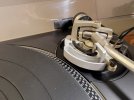
 
Just to clarify I dismantled to add fluid to the reservoir and the piston .Have you dismantled it to add the fluid?
 
Last edited:
I just added some fluid to the internal linkage from the bottom side of que. I didn't try to completely fill it.

I have not removed the top seal as you did.
I don't think the area above that piston is ment to be filled. Now I'm just guessing. I DON'T KNOW what the designer intended.

My opinion is: If that reservoir were filled when arm is down. Raising up the arm would push the oil out the top past the seal. It has to go somewhere. I think the function of the silicon fluid in this que is to increase
friction between contacting surfaces. To slow arm drop. I think it's only necessary to lightly coat surfaces. Now, I've been wrong before.

I have a Technics SL1200 with a fluid damping attachment. It has a silicon fluid filled reservoir. But it's function is to dampen arm vibration while playing records.
The arm has a separate internal linkage for its que. I applied a little fluid to it's linkage surfaces.
20240514_182448.jpg
 
The piston is smaller than the diameter of the reservoir so the fluid can freely move either side , the correct way on mine is to dismantle and fill the reservoir from the top hence the circlip .300/500K is probaby the best viscocity .
 
have an LVV, the spring is below the black plastic removable cover washer , circlip, then washer which holds the spring . Image shows the washer removed
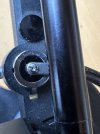
How did you remove the small black washer, I raised the cueing lever to take a closer look, to see if I could fill the reservoir from the top ( I have an LVX arm) , and I will use some 350cst silicon fluid that I have, but the small black washer is not removeable, well unless I cut it and prise it out, which does not look like what you have done, there is a small screw above the washer, did you manage to unscrew it, I tried and stopped, as it would not budge and with a fair amount of force as well :-( IMG_2813.jpg
 
Last edited:
yes remove the screw with the correct size screwdriver and the lever will come off then you can remove the mechanism to dismantle on the bench, you will need the correct size small circlip pliers or improvise to remove as I did with some modelling sprue cutters , once the circlip is removed the washer and spring will come off and then you can access the reservoir and piston to administer the fluid only apply to the piston and reservoir , can be a little messy , but clean can be done with isopryl and a cloth .
 
Back
Top Bottom