• The move to the new server is done. There are some software and database maintenance updates in process. This has us passing the hat around to help out. We appreciate any donations. Seriously, even a dollar helps. The payment page may be found here - https://www.audiokarma.org/support.html

Cutting Boards. Dumping my Bamboo boards.

I notice that the Hinoki boards are not oiled but cleaned with water and a mild soap. If it develops stains you clean those with lemon slices. For the mild soap I am going to use Dr. Bronner's Pure-Castile Liquid Soap. It is a totally natural Castile soap, organic, concentrated and can be used to wash vegetables. I have used it since the 1970's. It comes in an number of different scents, again all natural. I use Lavender, Tea Tree, Rose, and Citrus. For washing this cutting board I will use Citrus. For the Lemon slices I am going to use Millard Citric Acid crystals. This is a totally natural food grade product made from lemons. This is what is used in high end coffee shops to clean their coffee makers. It is much easier to use than lemon slices, and you can put a solution in a spray bottle.


Last edited:
I have several cutting boards. Most are plastic, but I have 3 wooden ones. A mahogany board my daughter got for me in Costa Rica, a very large board that came from Ikea. I use that for brisket or pork butts on one side and bread dough on the other. Then there is the bamboo board. I love that board and will typically grab it for most things. I have never noticed any “damage” or excessive wear to the edge of my knives. I cut vegetables and meats, I don’t chop like Martin Yan on a Ginsu infomercial. Maybe that kind of chopping wears a blade down on bamboo quicker. My bamboo board is not going anywhere.

I understand that many folks love the process of cooking. They get pleasure from using a $300 knife on a $200 cutting board. For me, cooking isn’t a chore, but it isn’t an art form either. I like good tools, but a decent knife and cutting board will suffice for my use.
 
-I got an Acacia wood cutting board from a discount seller (Ross) a few weeks ago. 19-1/2" x 14", 3/4" thick, I forgot the brand. I would have liked to get one thicker but for the price of a good piece of rib-eye I couldn't pass it up. I washed it with mild soap and water after I unwrapped it and the wood grain popped up all over. No worry with a DIY'er with a supply of sand paper. After the sanding I put on four good coats of mineral oil. I've got a smaller bamboo cutting board I use for small cutting tasks.
 
I know it's late to respond to this thread, but here goes.

Plastic cutting boards are the least sanitary of all boards out there. Knife cuts snap shut with bacteria inside that are then released with another cut, but impervious to sanitation between knife cuts. Very difficult to keep sanitized. They also tend to shed bits of plastic, which can be a problem.

Wood, of any kind, turns out the be the "cleanest" in terms of bacteria because the tannins in the wood kill them pretty quickly after washing.

End grain is best for wood boards, bamboo is the worst (very hard fibers). Side grain cut (across the growth rings) is better than flat cut (along the growth rings), but anything wood is better than anything plastic.

Glass cutting boards, which were a thing a few years ago, murder knife edges and I would never use them.

If you want to make a cutting board, use very dry wood (so it won't shrink and crack in use) with fine grain -- maple, poplar, cherry, walnut, etc. Avoid wood with large pores, they trap food particles. When all assembled and flattened, soak in mineral oil until it won't absorb any more. This can be up to a pint for large boards, use a baking sheet with a rim. When it stops absorbing the oil, finish with "board butter" -- beeswax dissovled in mineral oil, maybe 1 part wax to 2 parts oil? Easy for me as I have a dozen bee hives and have nice clean wax everywhere from extracting honey. Rub the board butter in well, won't hurt to heat it in a warm oven (150F or less) for a bit.

This will make the board waterproof for very easy clean-up, just need to refresh the surface once in a while with some board butter.
 
Last edited:
I topcoated mine with Howard hardwax mineral butcher block oil conditioner. It's said to have beeswax and Brazilian carnauba wax in it.

​


Just ordered me a new cutting board. This will be probably my 4th one. I will admit, I'm ruff on them. Between chopping BBQ and removing chicken wing tips, I can do some damage. My cleaver shows no mercy. On sale today. Not much off. Also ordered a 1000 ft roll of foil with it. $20 for the foil.
 
Last edited:
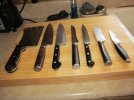
IMG_3958.JPGIMG_3960.JPG

Just got my new cutting board in. Just rubbed it down with 2 coats of mineral oil. I may put a 3rd coat on tomorrow, if I think it needs it.
Laid some of my knives on top just to scare it some. Right now there is not a scratch on it. That will change.

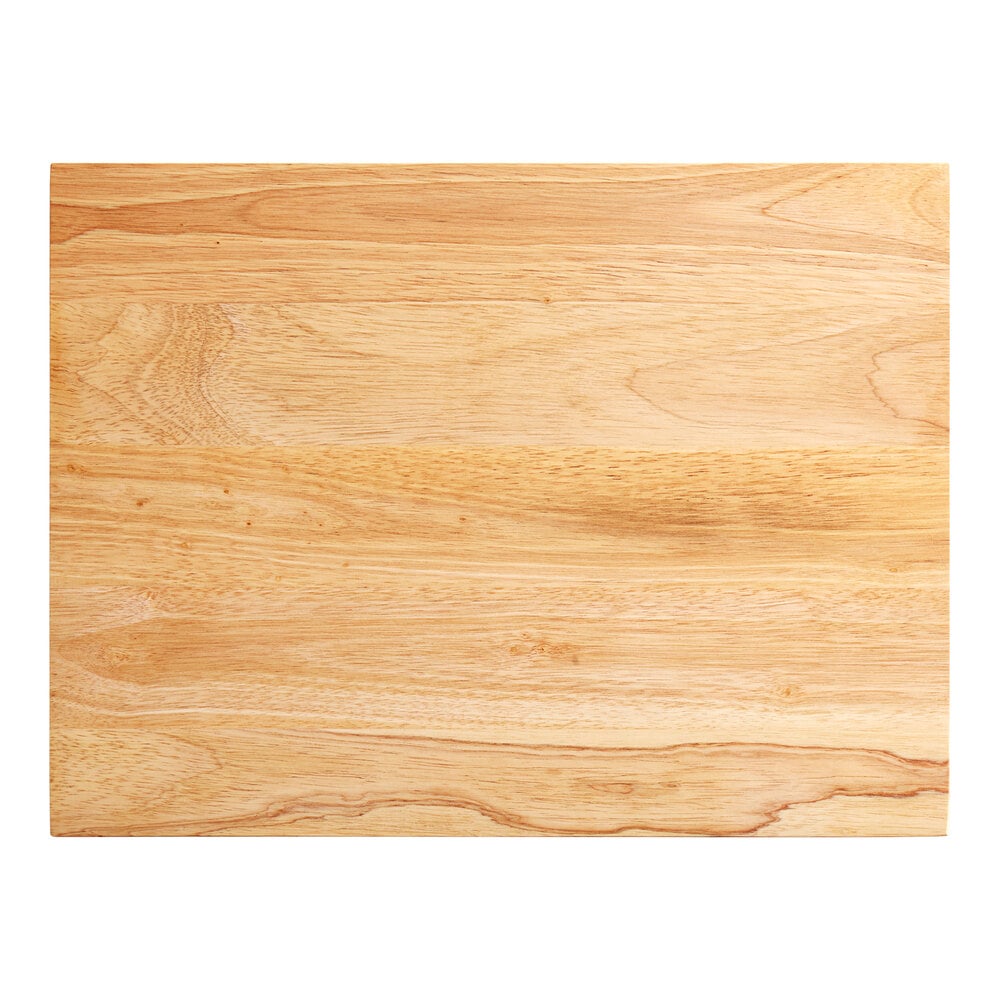
This is a heavy board, made of rubberwood. Got a side shot so you can see the handles.

The board was on sale when I got it for $33. Sale went off that day.
 
Last edited:
My little cutting board needs to be replaced. I dropped it a couple years ago and the glue down the middle split, and when I went to plane the edges square to re-glue it, there was almost 1/8" gap between the halves, I had to put a strip of wood in between to get them square to each other.

I remember my mother getting that board, but not when, so I must have been fairly young. I guess 60 years is a good life for a cutting board, eh?
 
I remember an Alton Brown show where he discussed plastic vs wood cutting boards. His logic was that all of them have the potential to trap bacteria in cut grooves, but the wooden ones will absorb moisture from the bacteria, killing it quicker than the plastic which absorbs no liquid.
I use different boards for different foods anyway. Never cut fresh vegetables on the raw meat board. I’m pretty sure Brown covered the same technique on that show where he used a red board for meats, white for vegetables, and blue for fish.

I scrub the hell out of cutting boards and doubt much is left in the grooves. I have so many that most can dry for days before used again. The main meat board is plastic and gets run through the dishwasher most of the time. Bacteria in the grooves not likely to survive the hot water, soap, and finally heated drying. So far so good at least.
 
Back
Top Bottom