• The move to the new server is done. There are some software and database maintenance updates in process. This has us passing the hat around to help out. We appreciate any donations. Seriously, even a dollar helps. The payment page may be found here - https://www.audiokarma.org/support.html

Deep cleaning vinyl?

Can you describe what the #15 does for you? Also, since you use such a similar method to mine - how do you clean your brushes? And how often?

#15 Solution- From what I read, it's suppose to break loose the tough stuff before you start the 3 step solution process. Now that being said, I really have no way of gauging how much it really helps. I know the 3 step solution works well so I'm trusting the #15 is adding to the process. I usually use it on the second hand stuff that I want really listen too or convert to digital. Since I am spending time cleaning the record, I don't mind the extra step.

After I have the records cleaned and stored, I will use the pure water for a rinse in the future for a light clean up for playing if necessary or before recording to digital.

Brushes - I clean them with distilled water after a cleaning session and let air dry on the kitchen sink dish rack. I usually max out cleaning 10 lps in one sitting, that's about as much the fiancee can handle with the vacuum. With that low number of lps and cleaning the visible stuff off before the 3 or 4 step process, I'm not that worried about cross contamination.

How often do you clean your brushes?
 
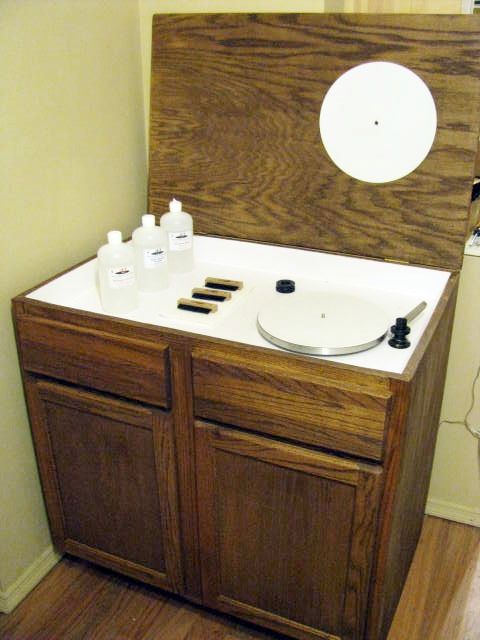
I use the AVIS 3 step solution along with my DIY RCM. Works like a charm!

rcm.jpg
 
Designing my own.

Plan on designing my own combining, 1st pressure wash, rinse, brush scrub, pressure rinse, vacuum. Thinking is to use pvc pipe to build stand with label saver type attachement read in another thread, then a 2 small type pump up sprayers one filled with cleaning fluid( gonna experiment), and the other with distilled water. My thinking is if you presoak,then pressure wash, then pressure rinse, before you do the brush scrub it should remove the harmful loose dirt that could scratch the grooves during the scrub process, then scrubbing, then final rinse and vaccum. What do you guys think?
 
Plan on designing my own combining, 1st pressure wash, rinse, brush scrub, pressure rinse, vacuum. Thinking is to use pvc pipe to build stand with label saver type attachement read in another thread, then a 2 small type pump up sprayers one filled with cleaning fluid( gonna experiment), and the other with distilled water. My thinking is if you presoak,then pressure wash, then pressure rinse, before you do the brush scrub it should remove the harmful loose dirt that could scratch the grooves during the scrub process, then scrubbing, then final rinse and vaccum. What do you guys think?
I think that's the way to go. I do it a little differently at the moment, but what you propose is the gist of it. Every record I wash is rinsed under the tap to remove the loose stuff before the scrubbing starts. Only when it's rinsed clean again afterwards does the vacuuming begin.
 
Here's my method for what it's worth. I've had extremely good results though:

First thing I do comes with purchasing a record. I look at it in good light when possible and determine if it's even worth trying to clean. If it still seems a fairly dark black even under dust or whatever that's a good sign for example. Of course also look for obvious scratches and such.

I use a modified 1 gal shop vac (I modified two crevice tools). I just use a cheap direct drive turntable and a homemade record clamp for turning)

The two most important things in your tool chest are a vacuum and distilled water rinse. Always rinse!

First I try some MoFi Superwash applying it with a velvet brush and leaving it on for a minute or two. Vacuum off. (Vacuuming is critical).
Rinse with distilled water applying with a dedicated brush (I use a paint pad for this). Vacuum off wuth a dedicated wand. (You should use different wands for cleaner and water so you don't cross-contaminate).
If the record still doesn't sound that good i move to stage two:

Stage two is Phoenix Enzyme cleaner appplied with an old D4 brush (Enzyme cleaners will desolve paint pads). I don't leave the enzyme cleaner on though as it gets kind of sticky I think). Vacuum off of course and again use a distilled water rinse and vacuum off.

If that's still not enough I go to the last phase:
I use a home brew cleaner that is basically distilled water. 91% alcohol and a tiny bit of Dawn dish soap.
I apply with yet another paint pad and sometimes use a very soft paint brush with only pressure under it's own weight to get in the grooves and dislodge any stubborn grime. Again I vacuum and then rinse and then vacuum.

If the record still doesn't sound good enough to listen to at least then it wasn't meant to be and goes in the give away pile.
I'm happy to say that my give away pile is very tiny. I have some records that are as silent as CDs. All my records are $1 used ones with the exception of 4 which were $3 to $5 respectively.
 
Last edited:
Clean Records

1st pressure wash, rinse, brush scrub, pressure rinse, vacuum

My cleaning procees takes about 5 mins for 2 records. I first install label protectors made from pvc pipe caps. They are then soaked in plastic ice cube tubs and brushed for 4 mins. The records are rotated 90 degrees for each brushing cycle. They are then pressure blasted (rinsed) with an engine cleaning gun set for about 90 psi. Then dried with a cotton towel. No vacuuming required with this method. This leaves the records so clean it will leave you in awe.:music:
 
I run all my records through a Spin Clean...followed by a treatment of Audio Intelligent No. 6 (1 step) fluid on the VPI 16.5 machine. I had considered the 1-step cleaner just fine as I always use the Spin Clean prior to the records hitting the VPI vacuum machine. However, all this talk about the 3-step cleaning fluids has caused me to wonder what I'm missing. Do you guys think I should switch to the 3-step cleaning fluids despite using the Spin Clean first???
 
My cleaning procees takes about 5 mins for 2 records. I first install label protectors made from pvc pipe caps. They are then soaked in plastic ice cube tubs and brushed for 4 mins. The records are rotated 90 degrees for each brushing cycle. They are then pressure blasted (rinsed) with an engine cleaning gun set for about 90 psi. Then dried with a cotton towel. No vacuuming required with this method. This leaves the records so clean it will leave you in awe.:music:

Sounds like a great system, I like it:thmbsp:

In my mind I think there's to much BS with record cleaning.
 
Nothing beats a good old fashioned wash and vacuum if you really want to pull off all the dirt and grime from the record grooves. I built myself a nice semi-automatic record cleaning machine and I absolutely love it :thmbsp: . It's an essential part of my record maintenance:

DSC06323.jpg


You can see more of the build here: http://www.jdsmarthome.com/index_files/diy.htm

Jimmy
 
Jimmy ^ - wow.... that looks awesome for a record cleaner. With something like that, why wouldn't someone want to clean records.
Very nice!
 
As someone who has read nearly every thread on Gore's Great World Wide Web about record cleaning, and through my own experience, there are a few things I think I'm pretty confident about enough to state:

1. Brushes don't get down in grooves - they may follow a groove in the big picture, but the bristles aren't small enough to get down into where the gunk is. They do serve a purpose in spreading the fluid around, and in agitating it.

2. It's the solution that separates the gunk from the grooves. Finding the right solution for the gunk is the challenge. For 80% of the records I clean, my home made solution of distilled water, 91% IPO, and a drop of Dawn does great. Most of the rest can be cleaned with the Audio Intelligence one step cleaner, and letting it soak in to allow the anti-enzyme agents work. In rare cases I get out the 3 step solution.

3. The final steps are key: Rinse with pure/distilled water spread with a dedicated brush, and VACUUM the solution.

I've done the hand washing with dent pullers and the spin clean and both work to make dirty records cleaner. Spin clean a step above the hand washing, but my VPI 16.5 is 14 steps above either.
 
I think the velvet it's best choise for cleaning deep a record, i use a velvet brush in paralel with dyi solution, than i dry it with a microfibre cloth, i'm really very satisfied with the results. I remember older times when with expensive turntables was delivered with little velvet square brushes:scratch2:, and that convinced me that is the right choise.[ excuse my english].:D
 
I think the velvet it's best choise for cleaning deep a record, i use a velvet brush in paralel with dyi solution, than i dry it with a microfibre cloth, i'm really very satisfied with the results. I remember older times when with expensive turntables was delivered with little velvet square brushes:scratch2:, and that convinced me that is the right choise.[ excuse my english].:D

You are really missing out if you are not using a wet wash followed by a vacuum. One step beyond that is a wood glue peel. If you never try, you will never know. :scratch2:
 
Here's my method. My choice of DIY cleaning fluid could obviously be bettered with something made especially for cleaning records, but the vacuum method is pretty solid.

http://www.youtube.com/watch?v=KTxUju-l5PM

The vacuum in the video is too close to the microphone, so you might want to mute the audio.

Wow, Bob, not only does that look inexpensive, it looks like something I might roust my lazy butt into action just to try.

Thanks.
 
I have tried the wood glue method a few times and found it didn't do anything for me that vacuuming wasn't doing.
 
Here's the thread I started on my DIY RCM.

http://audiokarma.org/forums/showthread.php?t=366285

The most important part is the wand which is modified for record cleaning.

DIY-record-cleaner1.gif


I'm not overly OCD about record cleaning. I believe a high pressure wash would do a great job, but it's messy, and seems like it would take a lot longer than vacuuming. I can clean an album with my RCM in a couple of minutes, max.

I use MoFi fluids, which is a 2-step process. I only use the first fluid if the record is particularly dirty.

In dry weather, static can be an issue. One drawback to RCMs is they create static. I use the MapleShade Ionostat, which is an anti-static gun. Works pretty well.

There were some records that were unlistenable until I made my RCM. I tried sink washing and lots of other methods, but nothing does it like vacuuming IME. Ironically, some of the noisiest records that responded best were brand new audiophile reissues.
 
Back
Top Bottom