• The move to the new server is done. There are some software and database maintenance updates in process. This has us passing the hat around to help out. We appreciate any donations. Seriously, even a dollar helps. The payment page may be found here - https://www.audiokarma.org/support.html

Desoldering Point to Point techniques

That's ^^really^^ expensive.

I use this:-
https://www.mouser.co.uk/ProductDetail/Chemtronics/80-3-5?qs=5UvuuQRM/zfTrSoiAD/HVA==
Cheaper on Ebay?
https://www.ebay.com/itm/143642337343?hash=item2171c0203f:g:eX8AAOSwMQ5e9j5t

I don't do much 'point to point' work, but when I do, I almost always use a solder sucker.

(Be wary of the length of product supplied on a reel when considering which product to buy, obviously this affects product cost).
 
Last edited:
the only thing I don't like about the wick is if the connection is hooked, youre putting a lot of heat on the board and parts unless if I change the part, then I have 1 less to worry.
 
How about that! I was just thinking about making another curmudgeonly post in the (remarkably popular) "Unpopular opinion" thread, something like this:

There is no benefit to point-to-point wiring that comes remotely close to compensating for its poor repairability.

'Druther work on an SMD board with 0201 components. At least there are tools that help with that.

To make an attempt to add value:
  • When removing a lead that is wrapped around the top of a lug, it can be very helpful if you can use some good sharp diagonal cutters to cut the loop, right at the top. The cutter will have no trouble going through the solder, though it might be helpful to such or wick away some of the solder first. If the cut is successful, the rest of the mess will be lots easier to remove, and there will be some "meat" left on the removed wire/component lead for re-soldering if needed.
  • I say there is no shame in using things along the lines of the Sprague "quigs" mentioned above, to essentially make a reinforced butt joint onto the existing wire/lead. Probably the easiest aids to find these days are what are called "eyelets".
Oh, hey - just to add another blasphemy, as long as I'm all worked up: No matter what NEETS or ISO any other formal soldering authority say, I say there is rarely any reason to loop a wire/lead around a lug. I say that just well-flowed solder is a sufficient mechanical bond for the vast majority of purposes. I'll grant exceptions for really hefty components, really long or thick-gauge wires, or (to give NEETS their due respect) if you really, really need the joint to withstand multiple intercontinental journeys in high seas.
 
I don't like to use pigtails if I don't have to, but... in one of the service manuals for some piece of high end test equipment I own, it specifically says (if necessary) to clip component leads right at the component and solder the new part to the pigtails. They actually went out of their way to reinforce that there's nothing wrong with the practice and it can avoid messing up a high-dollar circuit board. I've wanted to copy that section but have never found the particular manual again. I think it was Fluke or maybe HP.
 
: No matter what NEETS or ISO any other formal soldering authority say, I say there is rarely any reason to loop a wire/lead around a lug.


I usually do a U bend on the end of the wire and call it good enough. I don't do the full loop around and back through.
 
Wow-a lot of good suggestions and methods offered-many thanks!

I especially liked the option of possibly just wrapping a new wire over the old and soldering-and call it good. Another was the idea that it was not necessary, often, to actually wrap the wire, but be satisfied with a simple butt connection securely soldered in place.

There are those who likely feel that the above techniques\suggestions are 'sloppy' or 'poor work' or similarly fall short of proper repair. It's a common predisposition with many of us, myself included, to 'do it right, or not do it at all' Some might suggest that proper restoration of gear involves replacing nearly every component (at least caps, small transistors, and diodes). I am still early in my restoration\repair work, so time will tell. At the moment, I am in the 'if it ain't broke, don't fix it' camp, but only time will tell.

One last question that has only been touched on obliquely, is iron wattage. My Hakko is about 30w. I think it would be good to have a higher wattage unit for those situations where heat dissipation is too high. To get melt on a larger lug and wire, the dwell time is too long, and I have lifted pads.

Do folks here keep a higher wattage iron around for these scenarios? Perhaps something like this: https://www.amazon.com/Weller-WE101...t=&hvlocphy=9007836&hvtargid=pla-573154322852

Thanks
 
I've done the double hook and solder thing. I prefer not to, but sometimes there is no other choice, either for lead length reasons, or because whatever the solder point is happens to be so crowded that there isn't any chance of getting the old lead out without causing more damage.

I also tend to be somewhat of a minimalist when I go replacing parts. Stuff that is bad obviously goes, stuff that is known to be failure-prone also goes. Stuff thats working and is generally considered reliable I leave alone.


My Hakko 888 is 65 watts I think. Extremely rare that I need more power than it can deliver. Stuff soldered to the chassis is really the only thing it won't do.
 
Sometimes, trying to desolder and unwrap a point-to-point component causes more damage - a tube socket pin breaking off, solder balls dropping and rolling around causing shorts, overheating other components....
 
Yes, always clean the tip on a damp sponge or similar, then tin it. Otherwise, you don't get good heat transfer. When that happens, people turn up the temperature, which is exactly what you don't want to do. If you have a single knob control that's easy to set, turn it down if you aren't going make a joint for a few minutes.
 
I usually wind up the temperature when dealing with connections to what amount to a massive heat sink. Trying to get connections off a chassis or some other massive hunk of material needs all the help I can give it. On terminal strips and sockets its rarely needed though.
 
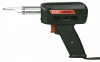
I have done a lot of antique radio restorations in my life time. I find the best way for me to unwind point to point is to use a Weller gun and a decent pair of needle nose pliers to unwrap the wire. I usually don't bother with solder wick.
 
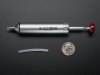
After trying multiple cheap solder suckers, I came across this one. I liked it so much, I bought two in case one broke. (hasn't happened yet in couple of years of use) My Hakko 888 is usually plenty to remove any solder that is not stuck to a chassis, for that, I use an old Weller solder gun. I have had only intermittent luck using solder wick, and that only on printed circuits.

1597-01-3188629340.jpg

Weller.jpg
 
After trying multiple cheap solder suckers, I came across this one.

I'm intrigued, and am going to give one a try. If anyone else is looking for one from a trustworthy supplier, adafruit.com has them.

Loved my old Weller "pistol", too, though not enough to look for another. (Whatever happened to it, I wonder? I'd replaced elements often enough that the fastening nuts were worn, but that wouldn't have made me give up on it. It's probably around here somewhere...)
 
I've had my Weller gun since Christmas 1969. I don't use it much any more. but sometimes you have to get out the big heat on something. I just use the cheapo 30 watters mostly. Every so often I have to file a fresh point on them. But at $4.00, who cares? Whe the tip is worn to a stub I get another one. It's not like you're going to go hunting down a replacement tip on a piece of cheap Chicom crap. Beats spending money on a nice "soldering station" and all that. Just replacement tips alone I can buy 2 or 3 of the crap irons. A hammer is a hammer. Wear it out and get another.
 
A Hakko solder pump is hard to beat, but pricey. Even though I have one, I do at times still need to use wick. I use Hakko or Goot brand wick and Hakko flux. I have a 70W Goot iron with adjustable temp. Choice of tip makes a difference in my experience. I use a 4mm flat tip for as much as I can. A 3mm for most of the rest and a variety of point bits for where they come in handy, including a needlepoint for really small stuff. I find the wide flat tip makes better contact with the wick and transfers heat better.

I should point out that I have 3 different tips for the solder pump, so regardless of device, appropriate tip choice matters.
 
I'm intrigued, and am going to give one a try. If anyone else is looking for one from a trustworthy supplier, adafruit.com has them.

Loved my old Weller "pistol", too, though not enough to look for another. (Whatever happened to it, I wonder? I'd replaced elements often enough that the fastening nuts were worn, but that wouldn't have made me give up on it. It's probably around here somewhere...)
I've used the same sucker for a several years with great success.

Earlier this year, I felt the need for a automatic vacuum pumped station and got one off Amazon. Every time I use it, I get amazed by it.
Regardless of small or big job, there's no point going back to wick or the hand pump.
 
The silver solder used for electronics is only a small percentage and can be dealt with like any other solder. Lead free might have silver and takes a higher temperature. The silver solder I used to solder vacuum plumbing fittings with is a much higher percentage and takes a good torch, preferably with oxygen!

BTW, if you ever need a really strong solder for repairing metalwork (not electronics), this stuff works really well- https://www.harrisproductsgroup.com/en/Products/Alloys/Soldering/Lead-Free-Solders/Bridgit.aspx
 
Back
Top Bottom