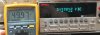
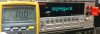
Anyone who's ever seen a pic of my bench knows that I have a lot of test equipment. Most of it is rarely used, but essential when needed. My DMM is by far the most used tool I own, easily used for over 95% or more of troubleshooting. Which is why I spent more on my DMM then I did for my oscilloscope. It's that important. However, for our purposes troubleshooting audio gear calibration isn't necessary.
A DMM is often specified as having 3 1/2, 4 1/2 or even 5 1/2 or more digits. WTF is a 1/2 digit, you say? Good question. The leading (Most Significant Digit AKA MSD) is either a zero or a one. We don't need a really serious meter for audio troubleshooting, but a good quality meter is recommended simply for the trust factor if nothing else.
I'll briefly cover all the functions of a basic DMM. Most are self explanatory.
AC Volts: Good for checking AC into the device under test. Also good for verifying the secondary output on the transformer. And a good test of the DC outputs for ripple; should be in the millivolts if the filters are good.
AC voltage function is also good for measuring the voltage drop across an 8Ω dummy load, with some caveats I'll cover below.
DC Volts: Everything in you audio device runs on DC. So once past the power supply DC is what you're looking for, or possibly finding where you shouldn't. Handy from input to output, and all the other stages as well. Your go to function for troubleshooting a live chassis.
DC Millivolts: This function shines for setting bias and offset, which are both specified in millivolts.
Diode Test: We use the diode function for testing semiconductor junctions in both diodes and transistors. Invaluable for repairing amps.
Continuity: Audible continuity is a not often used but is a lifesaver in certain situations, like the repair I recently did on an NAD:
https://audiokarma.org/forums/index.php?threads/case-history-nad-3400.864486/
Resistance: Verify the resistance of... resistors. If your meter has good resolution you can use the resistance function to help zero in on a shorted component, such as a shorted bypass cap on a power supply rail.
Current: The current function isn't used often. Most of the time we calculate the current by measuring the voltage drop across a known resistance. I have used it to test high voltage capacitors for leakage. Note that you have to put the positive test lead into another jack on the meter. Be sure to move it back before taking any voltage measurements or you'll blow the fuse in the meter, and they're usually something that you won't be able to find locally.
Some meter will have other functions, such as frequency, capacitance or HFE. Personally I prefer my Peak Atlas ESR meter for caps, since it gives me ESR and value in a single test.
It's vital that we not only know our test equipment's attributes but also its limitations. To illustrate that point let's look at 2 multimeters from extreme price points.
First up we have the Harbor Freight 7 function DMM:
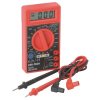
At $5.99, that's less than a dollar a function!
At the other end of the spectrum we have the Keithley 2015THD:
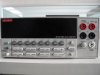
This was a $4,000 meter when new. Fortunately it's of an age where it can be had for around 10% of that. This is a specialized DMM that was made for audio work. Unfortunately its internal sine wave generator isn't of low enough distortion for some of the amps I see. It's perfect for adjusting the distortion in an FM tuner though.
I mentioned above about measuring the voltage drop across an 8Ω dummy load. If you put a 1 KHz signal into an amp and measure its voltage drop across an 8Ω dummy load with both of these meters we'd get 2 completely different readings, with the Keithley being higher than the Harbor Freight model. Why?
This is where you need to know your test equipment's capabilities and limitations. The specs for both meters will tell the tale.
The Harbor Freight specs:

You can see that the Harbor Freight DMM's AC response is only rated to 450 Hz. Its response will fall rapidly after that. Now look at the specs for the Keithley:
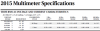
This meter can be trusted to give accurate readings across the 20-20,000 Hz range. Now, could I live with only the Harbor Freight if I had to? As long as I didn't ask it to perform tasks it wasn't designed for, yes. Knowing what your test equipment can and cannot do is crucial to getting good results.
Another gotcha that can trip you up is knowing your DMM's input impedance and when it can be an issue. Most DMM's have an input impedance of 10 megohms. It doesn't usually become an issue in solid state amps, but can in tube amps where resistors in the megohm range are more common. Measuring across a 10 megohm resistor with a meter having an impedance of 10 megohms will give you a grossly erroneous reading.
Most of our voltage measurements are going to be well within the capability of our DMM. But what if you're working on high voltage power supplies, such as you might find in an electrostatic speaker? Your DMM, and even more importantly the probes, are probably rated to 1,000 VDC. So how do you measure something in the kilovolt range? Use a high voltage probe, such as this:

The alligator clip goes to ground, and the dual banana goes into your DMM. It essentially forms a voltage divider with the input impedance of your DMM. I have the probe shown above, left over from my days repairing CRT TV's. This probe is good to 40 kilovolts.
A few other accessories that I find indispensable are the oft mentioned banana to minigrabber clips, shown here:
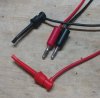
And my favorite for probing into tight places:

These came as a pair, and allows you to get into tight spaces without fear of shorting something else, as only the tip is exposed. While it's usually a non issue, they are rated for 300 VDC, while the probes are good to 1,000 VDC. Be aware of these limitations as they are a safety issue.
As always, if I've forgotten something or made an error please post or contact me directly.
A DMM is often specified as having 3 1/2, 4 1/2 or even 5 1/2 or more digits. WTF is a 1/2 digit, you say? Good question. The leading (Most Significant Digit AKA MSD) is either a zero or a one. We don't need a really serious meter for audio troubleshooting, but a good quality meter is recommended simply for the trust factor if nothing else.
I'll briefly cover all the functions of a basic DMM. Most are self explanatory.
AC Volts: Good for checking AC into the device under test. Also good for verifying the secondary output on the transformer. And a good test of the DC outputs for ripple; should be in the millivolts if the filters are good.
AC voltage function is also good for measuring the voltage drop across an 8Ω dummy load, with some caveats I'll cover below.
DC Volts: Everything in you audio device runs on DC. So once past the power supply DC is what you're looking for, or possibly finding where you shouldn't. Handy from input to output, and all the other stages as well. Your go to function for troubleshooting a live chassis.
DC Millivolts: This function shines for setting bias and offset, which are both specified in millivolts.
Diode Test: We use the diode function for testing semiconductor junctions in both diodes and transistors. Invaluable for repairing amps.
Continuity: Audible continuity is a not often used but is a lifesaver in certain situations, like the repair I recently did on an NAD:
https://audiokarma.org/forums/index.php?threads/case-history-nad-3400.864486/
Resistance: Verify the resistance of... resistors. If your meter has good resolution you can use the resistance function to help zero in on a shorted component, such as a shorted bypass cap on a power supply rail.
Current: The current function isn't used often. Most of the time we calculate the current by measuring the voltage drop across a known resistance. I have used it to test high voltage capacitors for leakage. Note that you have to put the positive test lead into another jack on the meter. Be sure to move it back before taking any voltage measurements or you'll blow the fuse in the meter, and they're usually something that you won't be able to find locally.
Some meter will have other functions, such as frequency, capacitance or HFE. Personally I prefer my Peak Atlas ESR meter for caps, since it gives me ESR and value in a single test.
It's vital that we not only know our test equipment's attributes but also its limitations. To illustrate that point let's look at 2 multimeters from extreme price points.
First up we have the Harbor Freight 7 function DMM:
At $5.99, that's less than a dollar a function!
At the other end of the spectrum we have the Keithley 2015THD:
This was a $4,000 meter when new. Fortunately it's of an age where it can be had for around 10% of that. This is a specialized DMM that was made for audio work. Unfortunately its internal sine wave generator isn't of low enough distortion for some of the amps I see. It's perfect for adjusting the distortion in an FM tuner though.
I mentioned above about measuring the voltage drop across an 8Ω dummy load. If you put a 1 KHz signal into an amp and measure its voltage drop across an 8Ω dummy load with both of these meters we'd get 2 completely different readings, with the Keithley being higher than the Harbor Freight model. Why?
This is where you need to know your test equipment's capabilities and limitations. The specs for both meters will tell the tale.
The Harbor Freight specs:
You can see that the Harbor Freight DMM's AC response is only rated to 450 Hz. Its response will fall rapidly after that. Now look at the specs for the Keithley:
This meter can be trusted to give accurate readings across the 20-20,000 Hz range. Now, could I live with only the Harbor Freight if I had to? As long as I didn't ask it to perform tasks it wasn't designed for, yes. Knowing what your test equipment can and cannot do is crucial to getting good results.
Another gotcha that can trip you up is knowing your DMM's input impedance and when it can be an issue. Most DMM's have an input impedance of 10 megohms. It doesn't usually become an issue in solid state amps, but can in tube amps where resistors in the megohm range are more common. Measuring across a 10 megohm resistor with a meter having an impedance of 10 megohms will give you a grossly erroneous reading.
Most of our voltage measurements are going to be well within the capability of our DMM. But what if you're working on high voltage power supplies, such as you might find in an electrostatic speaker? Your DMM, and even more importantly the probes, are probably rated to 1,000 VDC. So how do you measure something in the kilovolt range? Use a high voltage probe, such as this:
The alligator clip goes to ground, and the dual banana goes into your DMM. It essentially forms a voltage divider with the input impedance of your DMM. I have the probe shown above, left over from my days repairing CRT TV's. This probe is good to 40 kilovolts.
A few other accessories that I find indispensable are the oft mentioned banana to minigrabber clips, shown here:
And my favorite for probing into tight places:
These came as a pair, and allows you to get into tight spaces without fear of shorting something else, as only the tip is exposed. While it's usually a non issue, they are rated for 300 VDC, while the probes are good to 1,000 VDC. Be aware of these limitations as they are a safety issue.
As always, if I've forgotten something or made an error please post or contact me directly.