• The move to the new server is done. There are some software and database maintenance updates in process. This has us passing the hat around to help out. We appreciate any donations. Seriously, even a dollar helps. The payment page may be found here - https://www.audiokarma.org/support.html

DIY Isolation Platform help request

OmegaHyperio

Active Member
I have a bit of a curve ball for you guys,

I am in need of creating a custom isolation platform for the pumps and compressor of an electron microscope. (told you it was a curve ball)

Since the requirements for the microscope are quite high (its on a very good suspension system that will make that of a turntable blush in envy) But i want to make damn sure that the motors in those things don't interfere with the microscope.

So, since its basically doing the opposite of a turntable isolation platform, i thought id ask you guys for help.

Though, the knowledge gained here will be used to create a turntable isolation platform for my turntable. The microscope is just the larger problem that needs solving right now.

Just a heads up, its quite possible id have to split the platform up into 3 platforms, since this platform well very likely need to hold about 120 to 150 Kg of load. (split up into 50 + 50 + 20 Kg)

My thoughts so far where to use a thick MDF plate on rubber speaker isolation stands. I have done a quick google search, and found the idea of adding sand to the platform interesting.

Input from you guys would be appreciated. (also, yes im aware this is an audio forum, not an electron microscopy forum, but if anyone knows how to make a isolation platform, then its the turntable guys. At least in my opinion)
 
Register to hide this ad
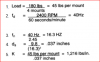
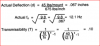
Mechanical energy isolation is a well know field. On a professional level it takes into account the frequency of the energy and its amplitude among other things.

Below are some basic examples.

upload_2017-7-7_20-40-9.png

upload_2017-7-7_20-42-25.png

There is a wealth of information on the net that may help one get closer to their goal than just random experiments.
 
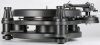
I would look at one of the best turntable isolation around

SOTA

so_eng_02_sm.jpg
so_eng_03_sm.jpg


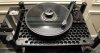
The lofty goal of Environmental Isolation resulted in the development of SOTA’s unique sub-chassis system, the Seismic Platform. Environmental Isolation means isolating the moving platter from all the physical and mechanical threats (footfalls, room resonance, air-borne waves, etc.) that will ultimately disrupt the retrieval of the information contained in the record grooves.

Key to the SOTA floating seismic platform is the theory of basic mechanics that tells us that the motion of a moving mass will be most constant when supported by the inertia of a greater mass. In the SOTA turntables, the 12 pound platter is successfully isolated from the environment because of the enormous mass of the 22-pound sub-assembly. To further enhance isolation, the sub-chassis is constructed of self-damping materials (again, constrained-mode construction techniques), with lead providing mass and energy sinking. Each sub-chassis is individually balanced at the factory, complete with its matching platter attached.

The unique SOTA turntable sub-chassis is then hung from a four-point spring suspension (spring utilized on the Sapphire, Star, Nova and Cosmos), giving it all the stability of four pendulums at rest. The four springs are damped to absorb high frequencies and decoupled from the sub-chassis to minimize energy transfer, fixing the suspension frequency at 2.5 Hz. By "hanging" the sub-chassis on springs, gravity stabilizes all external energies due to the centering tendency of the pendulum motion, rather than pulling the mass off center as is the case in the typical "compressed" spring suspension. With a four point suspension (made of four springs placed equi-distant from the center of gravity) and four equal masses (one of which is the adjusted mass* of the tonearm), the SOTA turntables offer a level of stability that can only be achieved with a constantly-balanced- mass system. No matter the tonearm, mass is constant, motion is predictable, and the end result is once again a system that achieves our goal of Dynamic Stability.

* Mass of tonearm plus added lead shot

And if you look at their TOTL
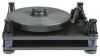
Like the critically acclaimed SOTA COSMOS, the MILLENNIA utilizes an ultra-rigid, unified sub-assembly utilizing a critically damped one piece sub-chassis, milled from a one inch thick solid aluminum plate. Unlike the COSMOS and previous SOTA top-of-the-line turntable models however, the MILLENNIA incorporates a spring-less, hanging four-point balanced-mass visco-elastic suspension system. The multi-layer suspension utilizes a variety of materials including Axidynea®, a unique energy absorbing visco-elastic polymer, to provide excellent outside energy rejection at critical midrange frequencies.

images.jpg

And SEM tables are kind of the same with the platform hanging from pillars.

imgres.jpg images-1.jpg images.jpg
 
I am in need of creating a custom isolation platform for the pumps and compressor of an electron microscope. (told you it was a curve ball)

Since the requirements for the microscope are quite high (its on a very good suspension system that will make that of a turntable blush in envy) But i want to make damn sure that the motors in those things don't interfere with the microscope.

Just a heads up, its quite possible id have to split the platform up into 3 platforms, since this platform well very likely need to hold about 120 to 150 Kg of load. (split up into 50 + 50 + 20 Kg)

It appears that he needs something other than isolation for his turntable.
 
The advantage of an air bladder is that the air pressure and 'spring rate' can be adjusted to suit whatever load is put upon it. Tweak for least vibration transmission by adjusting the air pressure in the bladder. You'd have to do it before each session.... don't know if that's an issue....
 
Why reinvent the wheel? There are plenty of scientific isolation platforms for test equipment.

But they are large, heavy, and expensive. Things like pumps and compressors, if they are of any size often have to be anchored in concrete or at least solid steel footings. At least in an industrial setting. Any electron scope is going to have instructions and specifications from the manufacturer on how to install their product. Work from that. Certainly you would want input from engineers and scientists, not a bunch of audio hobbyist yahoos who putz around with turntables.

I imagine you are looking for things like this.

$_57.JPG

$_57.JPG

$_57.JPG


I doubt MDF with speaker isolation pods are stiff and inert enough to get the job done.

Regards
Mister Pig
 
Last edited:
I think that I have found a suitable thread to post this instead of starting a new one.

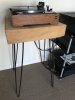
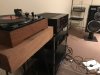
I have finally made my isolation table.
I tried different materials and with vibration testing it seems like the 40 lb hunk of mahogany is the best so far.

It’s not the prettiest but will work on that later.

So far, I have only mounted heavy steel pinlegs onto the wood without any additional isolation or absorbtion material to the legs or TT.

4D4B381F-4C5B-40DA-8FDD-FE8506F113EF.jpeg

7BE63EAE-A855-4F7E-A395-4CC2F8AAD3EA.jpeg

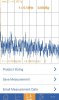
This has made a great improvement and I can’t feel any vibration at all but still measuring some at
90db listening.

91B7F653-D2CE-47BC-88E7-52FC50DBCE6F.jpeg

I’m very happy with how the TT is sounding now balance of channels, imaging, quietness but may still try to improve a bit more so any input is
appreciated.

Thanks,

S
 
Last edited:
A useful factoid is that when you hang something from a spring (like a bungee cord), the resonant frequency is dependent only on the deflection. Bungee cord suspension can isolate some types of things really well. If you put the following into Excel, G5 is the input (deflection) in inches and the formula cell with give you the resonance in Hz. Find the lowest frequency you're trying to isolate, usually a shaft RPM related thing, and go maybe 10 to 50 X lower for the suspension.

=(1/(2*PI()))*SQRT(9.81/(G5*0.0254))
 
A real cheap experiment: a heavy patio block/stone (maybe 2 or 3) sitting on 2 tenis balls cut in half (4 feet). Less money yet: cut down a cardboard box and fill with sand.

Not final solutions but may guide you toward one.
 
Last edited:
On further thought, place pumps on a shelf seperate of the microscope's tabe top. Vibrtions of the pump will be transfered to the wall.

Easy peasy
 
Back
Top Bottom