• The move to the new server is done. There are some software and database maintenance updates in process. This has us passing the hat around to help out. We appreciate any donations. Seriously, even a dollar helps. The payment page may be found here - https://www.audiokarma.org/support.html

DIY "Pro-Audio" Interconnects

I sometimes make cable with Canare L-4CFB (also available from http://www.markertek.com), its an RG59 type coaxial cable, tinned copper braid shield plus a foil sub-shield, PTFE insulation, and a solid center conductor. It has lower capacitance, and is a little cheaper than starquad (only $0.23 per foot), but has a harder time rejecting noise, and doesn't feel as nice in the hand, or lay as well along the floor, so I don't use it much for regular interconnects. It is, however, a great choice for lower noise environs, and it has a nice solid OFC center conductor. I DO use it to make coaxial digital cables because the lower capacitance is more important for a digital signal (made one last night).

So, a coaxial type cable (single solid conductor) is good for some things while the Canare or other multi conductor (2 or 4 stranded conductors) are good for others?

I have a Canare StarQuad cable made by a member here, and I am making another one from a 2-conductor Audio Technica mic cable. I emailed BJC about the difference and they whole heartedly recommended coax because it has very low capacitance (of course, this is what they sell, but I think if they believed in mic cable interconnects they'd sell that too).

Any thoughts on this?

Also, for clarification... coaxial cables need the shield connected at both ends, but for mic cables, it's best to connect only one end, correct?
 
I use very find silver, where it is braided,, same size for the + pin and the - pin then a copper ground. This is for XLR only as the cost of silver is so high and the silver is mostly used in jewelry. I used to sel, them but now I make just a few a year, as i really cannot see the wire and have to do it by touch and memory.

I use an MIT to my bass electronic crossover and modulator and the same out to the bass amp. I have one of my fist out from my DAC 3, to LS5, and one to my mid-high F tube amp.
 
So, a coaxial type cable (single solid conductor) is good for some things while the Canare or other multi conductor (2 or 4 stranded conductors) are good for others?

I have a Canare StarQuad cable made by a member here, and I am making another one from a 2-conductor Audio Technica mic cable. I emailed BJC about the difference and they whole heartedly recommended coax because it has very low capacitance (of course, this is what they sell, but I think if they believed in mic cable interconnects they'd sell that too).

Any thoughts on this?

Also, for clarification... coaxial cables need the shield connected at both ends, but for mic cables, it's best to connect only one end, correct?
Yeh, the digital and video you best with a typical coax. Here is insulation is paramount, except if you use fur digital and use pure, not plated silver, same with return, but sheave can be copper. If you need several the component is this type, you get three.

For audio analogue, you want more to traditional, yet this is where it gets complex, skin effects, different diameter wires, different theory and some so well thought out, it comes down to a matter of subjective preference.

Silver plaiting, some believe, works with analogue, but with the coax, your best bet is a good annulled copper with a thicker than average coax line/
 
:thmbsp:Nice thread and very informative has got me looking for parts to make a pair my self
 
What about a stereo pair in one star quad?

If this has been mentioned earlier, I missed it.

I was looking at a 3.5mm stereo mini plug to dual RCA cable and wondered what about making a similar cable with dual RCAs on each end?

I'm thinking about short distance interconnect, probably all less than 3 feet.

Would there be too much capacitance between channels?

An alternative could be two twisted pair cables sheathed in one heat shrink and braid.

The ~conventional approach would be two separate star quad cables but that seems bulkier than it needs to be to just make a u-turn from my DAC to my amplifier.

So if any of those approaches have a drawback, what is it?

Thanks.
 
What about a stereo pair in one star quad?

If this has been mentioned earlier, I missed it.

I was looking at a 3.5mm stereo mini plug to dual RCA cable and wondered what about making a similar cable with dual RCAs on each end?

I'm thinking about short distance interconnect, probably all less than 3 feet.

Would there be too much capacitance between channels?

An alternative could be two twisted pair cables sheathed in one heat shrink and braid.

The ~conventional approach would be two separate star quad cables but that seems bulkier than it needs to be to just make a u-turn from my DAC to my amplifier.

So if any of those approaches have a drawback, what is it?

Thanks.
Do not do this. Are you trying to save $10-15 on interconnects sacrificing sound quality? It is not worth it.
 
I'm not worried about saving $2.00

I just think a stereo pair in one piece is a lot more convenient than mono everywhere.

Since the topic is a DIY pro audio interconnect, how do those snake cables work? They are long to get from the stage to the sound booth, 100' is probably average but they get many channels to live in one cable. They are balanced connections but if I'm only going 3' unbalanced from a DAC to an amplifier, how bad could it be?

If anyone has done this and tested it (by measurement or by ear), let me know.
 
Now for the really important question: How does one pronounce "Canare"? Like the bird?
 
Just to bump this thread, I picked up a few Canare F-09s and a few F-10s, just to compare. The F-10s are indeed a lot bigger. Longer as well as fatter. Those who said they can be a problem in close quarters are right.

Both are solid and easy to solder, but the only advantage to the F-10s I can see is the teflon insulator. Unless you really stink at soldering and can't get on and off fast, this shouldn't be a big deal.

Both are real nice RCA plugs for the price, but I think I'll stick with the F-09s.
 
Last edited:
I'm not worried about saving $2.00

I just think a stereo pair in one piece is a lot more convenient than mono everywhere.

Since the topic is a DIY pro audio interconnect, how do those snake cables work? They are long to get from the stage to the sound booth, 100' is probably average but they get many channels to live in one cable. They are balanced connections but if I'm only going 3' unbalanced from a DAC to an amplifier, how bad could it be?

If anyone has done this and tested it (by measurement or by ear), let me know.

This is a style I've been making for my 8002 B&O tables. The two channels are each in a twisted pair; the shielding grounds at the DIN connector and is tagged to a banana plug at the preamp end.
There are a stationary pair of banana jacks mounted to the grounding lug on the (C2-x) preamp. (I also do this with the external ground wire on non-DIN socketed tables) This makes changing turntables very easy as well as checking hum levels with and without chassis grounding)
This cable is 26" long and 70pF.
It has enviable hum level and sounds wonderful, if a cable can be responsible for such things!
 

Attachments

  • IMG_0704.jpg
    IMG_0704.jpg
    101.7 KB · Views: 105
  • IMG_0705.jpg
    IMG_0705.jpg
    67.7 KB · Views: 85
Arcom speaker cable - very well working - low budget

Good Morning,

img7.gif


img15.jpg


img16.gif


In Dutch:

Making an Aircom speaker cable.

Best regards Fred
 
OK,.... Its my turn.

I run a small high-fidelity portable recording rig. To support it, and to adapt to ever changing needs, I build a lot of one-off cables.
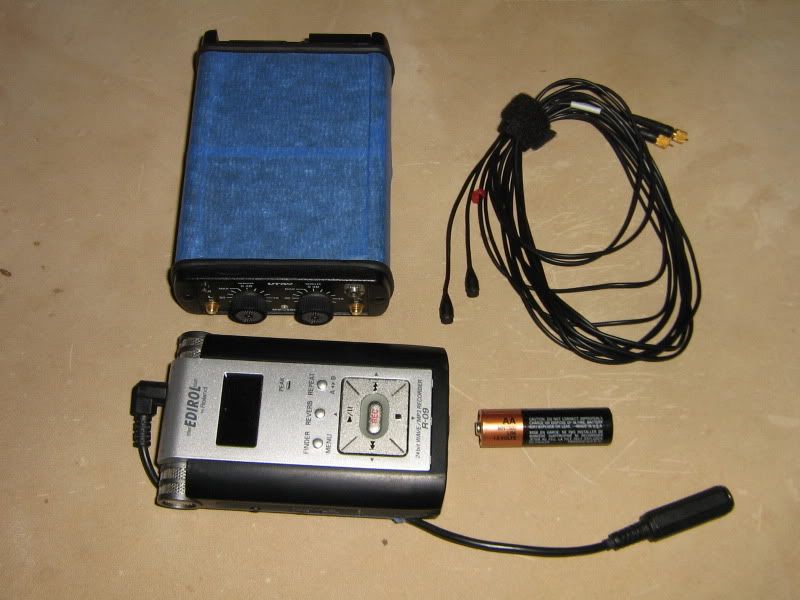
One of the rigs that I run is a Danish Professional Audio (DPA) 4060 miniature omnidirectional pair, and its preamps, in the form of a DPA MMA6000 two channel, 1/8' TRS stereo output. It is an unbalanced rig.
This is that rig:
IMG_5270JPG.jpg

The DPA MMA6000 preamp is wrapped in blue masking tape, because I have some velcro strips adhered to one side of it to hold the output cable securely.
The mics connect to the preamp via what are called microdot connectors. The output from the preamp is 1/8" TRS stereo.

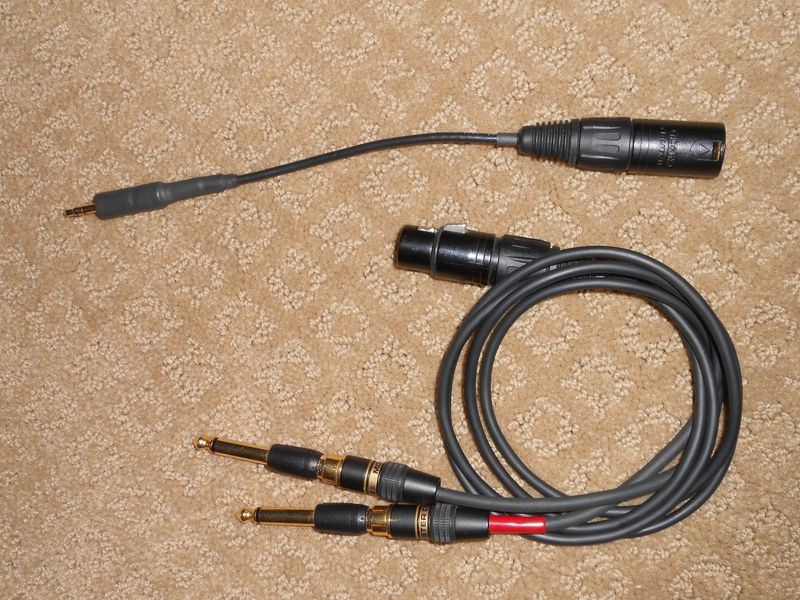
I'll quite often set this rig up remote from my recording location, and require a cabling run to get back to the recorder. Because it not balanced, I keep the mic to preamp cabling short, and run a longer line-level output. I do so via a custom cable rig that consists of a 1/8"/3.5mm TRS stereo connector > XLR (3-pin) I connect that adaptor to a standard XLR cable (Canare L4E6S), and utilize it as a stereo cable. At the terminal end, I have another XLR connector that leads to two cables that are terminated via RCA connectors. I can adapt from those as necessary. I often use a 1/4" TS connector, as they can go into the XLR/TRS inputs of my recorder, a Tascam DR70D four channel hi-rez portable recorder.

These are the adaptors for the MMA6000 preamp, to make a single XLR cable into a stereo cable.
Stereo XLR adaptors:
DSCN2556_zpsoynvwlhg.jpg


Adapters in use.
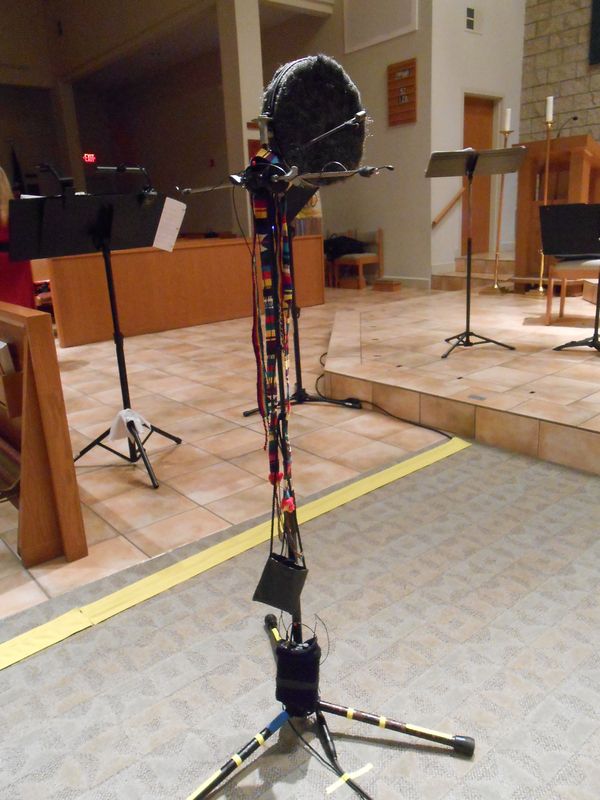
The MMA6000 preamp is velcroed to the bottom of the mic stand, and you can see a single XLR output cable on the floor:
DSCN2721_zpsvqxrcivw.jpg


And into the recorder; one cable into either side of the recorder (ch. 3 & 4):
DSCN2719_zpsxyogly2w.jpg
 
Last edited:
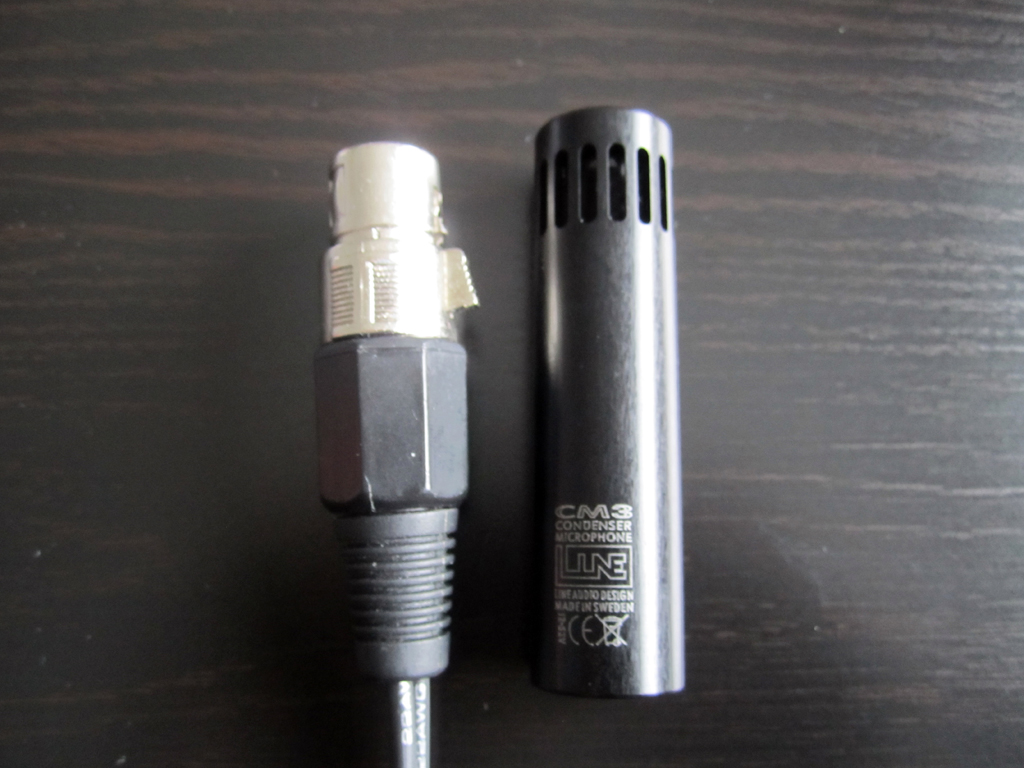
I bought a new pair mics this past week. They are small mics that can be easily overwhelmed with standard XLR cable and connectors. They have stander XLR connectors at their rear. They are literally the same size as a pair of XLR connectors. Line Audio CM3 sub-cardioid small diaphragm condensers.
To make mounting them more easy, and to take the load off the mics, which keeps them in a proper attitude within their mounts, I built a pair of what I call Right Angle Stubby XLR Whips. The right angle cable gets the cable heading in the right direction, and the stubby design reduces their weight, and keeps them more low profile.
cm3_size_02_small.jpg


Stubby Right Angle XLR Whips (female) Built yesterday:
DSCN2898_zpsitntbeqt.jpg

DSCN2899_zpsnz8fyeja.jpg


Stubby R.A. Males:
IMG_0664JPG.jpg


The cable stock for the Stubbys is Belden 1804a silver plated copper StarQuad design (same design as the Canare L4E6S), with a heavy braided shielding.

The males are break out cables that I used with my larger portable preamp, a Grace Lunatec V3. The output connectors were on the rear, bottom of the unit; so a breakout cable kept me from having to remove the preamp from my recording bag every time.
 
This is the DPA MMA6000 mic preamp, output side (bottom) that I mentioned earlier.
The right side of the bottom is the output side. The left side is the battery box (single 9v dry cell), concealed by a sliding door.
The unit outputs via a 3.5mm/1/8” TRS stereo jack. The jack in inset into the unit, and makes using a right angle cable difficult. SO, I built a custom output connector with a poured in place epoxy connector.

The output side (bottom):
DSCN2558_zpsiecn6dwp.jpg


The epoxy potted connector:
DSCN2559_zpsckj4b0dk.jpg


In place, nice and snug:
DSCN2560_zpsjedhyu4o.jpg

DSCN2561_zpsypodjfjp.jpg


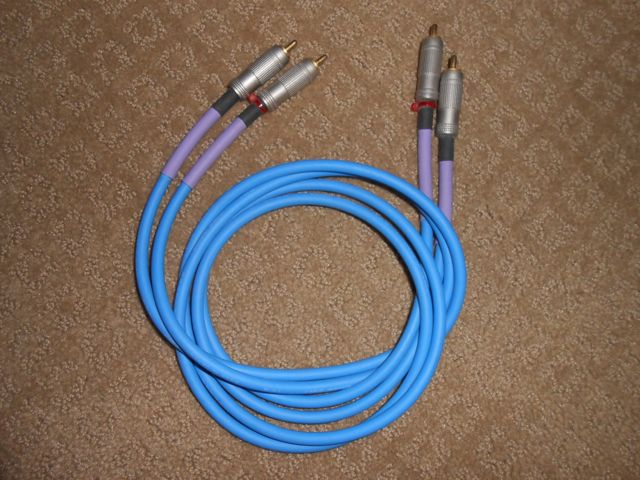
And, finally, a normal RCA cable pair, made from Canare L4E6S cable, and Canare F09 ends.
canare_rca_zps57d405b7.jpg
 
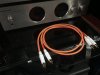
Just want to say thanks to the OP. About a year ago I saw this thread. I was tired of buying these nice looking but expensive interconnects. So I went out and bought all the recommended stuff, including soldering Iron and everything else I needed. I have never soldered before so I was a bit nervous about doing it. It took me a year to finally break out all the stuff I bought and sit down and make my first set of interconnects. This was much easier than I expected. This thread specifically is what I used to figure it all out. I've been running Analysis Plus Oval One throughout my system, but I picked up a new amp this past weekend and realized I needed another set of interconnects. Was going to buy another set of the oval ones but the price tag was killing me. Then I sat here and thought, "Why did I buy all that crap if I was never going to make any myself?" So I said to hell with it and sat down tonight and made my first set. What can I say? They are awesome and A/Bing these with my Ovals....I cannot hear a difference. No noise just like the ovals.

For the record I am not a believer in interconnects adding to the music...I have always believed a good cable will not add anything at all and that is what I got with these...for a fraction of the cost and a little time. I'm going to make a few more sets (because I like matching cables). So big thank you. I'm stoked!

Used Canare L4E6S and Amphenol plugs.


IMG_0400.JPG

IMG_0402.JPG
 
Last edited:
Sam, nice write up. Did the same with the star quad. I have long runs between preamp and amp, and the star quad works very well.
 
Back
Top Bottom