

You are using an out of date browser. It may not display this or other websites correctly.
You should upgrade or use an alternative browser.
You should upgrade or use an alternative browser.
Do I need a Quad Receiver for this Cocktail Bar?
- Thread starter Stierwalt
- Start date


Coolhandjjl
Embiggened Pompatus
Home gear in a public space is asking for issues, many already mentioned.
A solid state receiver with no speakers connected (yes, it’s safe), and either a preamp-out or tape-out to drive any number of pro grade power amps is the way to go. You can pick up used Crest CA power amps, the old led sleds, pretty cheap as pro sound support has gone class D. Or buy new Crown class D power amps.
If you go the tape-out route, the power amps have gain controls, but you will loose tone shaping. You can then insert in-line an old Yamaha dual channel 31 band EQ, or an old Ashly dual channel parametric EQ depending on your tastes and ability level. EQ’s usually have master gain controls as well.
For vintage speakers, I wouldn’t use anything less than 4 Cerwin Vega D9 speakers. It’s pretty easy to fry tweeters in home speakers if you get some static, drop a needle, or other mishap in a loud venue. Or look for some used all-in-one club speakers. Music stores or Guitar Center is a place to look.
So you will get the cool factor of having the vintage receiver present running everything, without the limitations and risks of using home gear.
I’d also check with your insurance company. They may have a say in using vintage home gear in a commercial setting, or maybe not.
I hope you will be purchasing an ASCAP/BMI license as well.
Last edited:

Last edited:

Dr. Ears
Super Member
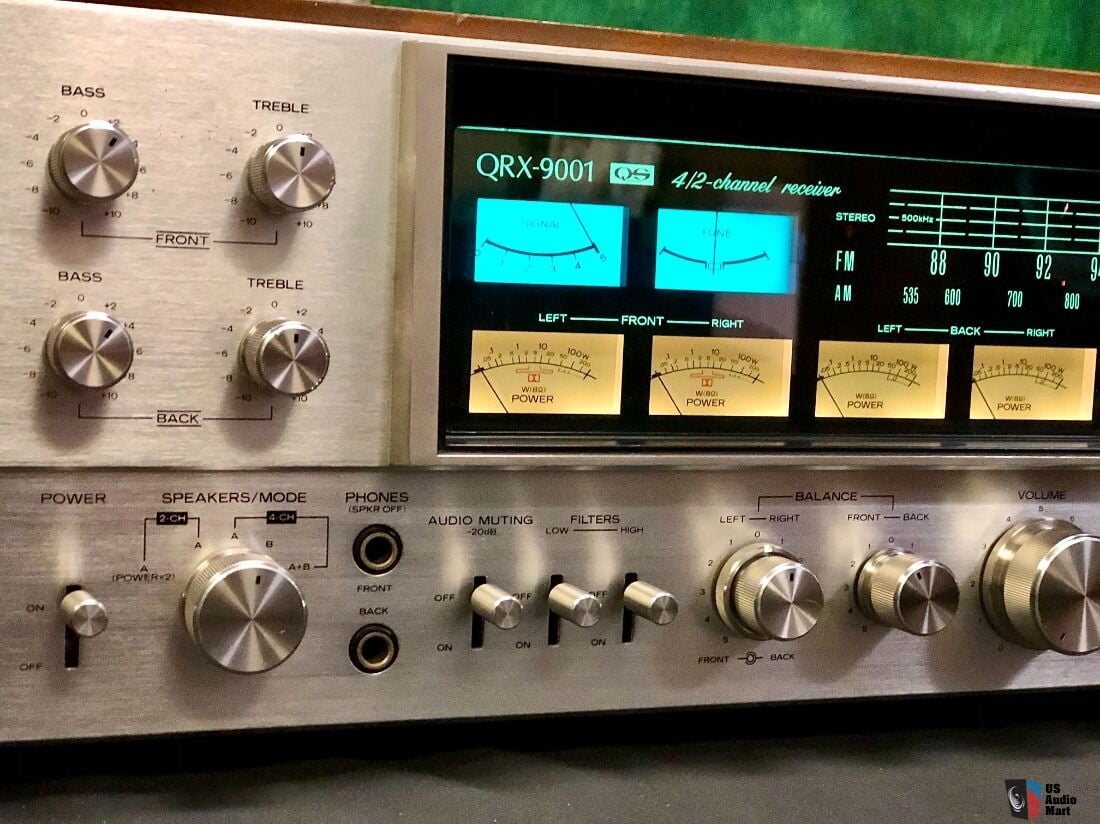
I would look at a vintage Sansui quad receiver. They will do everything you want and are easy to service . The QRX series are very cool looking and very reliable. They will make a Statement.
I have a QRX-6500 =, but I don't know how to hook it up to get 4 mono channels out of it.
It's so cool looking I would just leave it on not hooked up.

toodletunes
Well-Known Member
I hope you will be purchasing an ASCAP/BMI license as well.
Right, because if you don't, they will 'suggest' you do. And blowing off their 'suggestions' has never fared well. As in, never.

RunOutGroove
Addicted Member
That thing always seemed like a bit of a racket to me... I don't envy business that have to deal with that.Right, because if you don't, they will 'suggest' you do. And blowing off their 'suggestions' has never fared well. As in, never.
Coolhandjjl
Embiggened Pompatus
Why is it a racket?That thing always seemed like a bit of a racket to me... I don't envy business that have to deal with that.

Dr. Ears
Super Member
The only way a quad receiver or amplifier can have four totally independent outputs is if it has the option for four independent inputs,I.E. discretinputs.
Doug
The QRX-6500 can take a 4 channel tape player and play in descrete mode, but don’t know if it can play 4 mono channels .



Doug G.
Lunatic Member
The QRX-6500 can take a 4 channel tape player and play in descrete mode, but don’t know if it can play 4 mono channels .
If it has four independent inputs in discrete mode, it can play four independent channels of mono material. The four channels are completely separate from one another.
Doug
Dr. Ears
Super Member
Thanks!If it has four independent inputs in discrete mode, it can play four independent channels of mono material. The four channels are completely separate from one another.
Doug
These Japanese listening bars are exactly what I am pulling inspiration from! Thanks for the tipI highly recommend heading over to Tokyo and checking out their bar scene. Cool vintage stereos and turntables are in just about every place but a ton of them have Mac's and huge vintage JBL's, most places are similar in size to what your looking at but it doesn't stop them from buying the big stuff. This place was neat, you can see the two Macs, I think the TT's were 1200's but I can't remember. What you can't see is a cubby with a stack of more Mac's, the DJ said he liked to rotate the different amps depending on his mood. Most bars are like this with concrete walls but with some tonic, the music sounds great.
Records are a givin, they are a great conversation piece, most places have a few dozen like this, some places even put them out on the floor for the customers to look through, some bars even have agreements with local used record stores to stock (and sell) used records that they can also play.
View attachment 2622014
This seems to be the most common suggestion here.He said he wants a vintage receiver.
He could use the receiver as a preamp, driving pro power amps (which could be hidden away); one amp for the speakers in the front zone and one amp for the speakers in the back zone.
This way he gets the looks of the vintage unit and the power, reliability and impedance handling of the pro amps.
And if he gets power amps with gain controls, he would have the ability to control volume independently in each zone.
OP, this would require a receiver with preamp-out connections. Pretty common.
You could even have its power supply and preamp sections restored, for reliability.
Another hybrid option....
Use the receiver as the power and volume control for the bar area speakers, where the receiver would be visible and perhaps a topic of conversation for patrons and bartender(s). Use the receiver's tape out jacks as a feed for another amp with built in volume control, integrated amp, or even a second vintage receiver to power the back room speakers.
I actually like this. The quiet areas will be pretty standard volume, not needing to be changed often. The front bar area will need more micromanagement to match the standing room.
See below for our loose room layout (before the city and contractor chop it up and change everything). Ceilings are about 12ft tall. Room is about 16 x 75.
Attachments

Yeah, absolutely. I have an old Marantz receiver that was made in the 70s and other than having a few caps and lights (LED ones that will never wear out) replaced, it hasn't needed much and hasn't cost me a lot to maintain. There's also the fact that you can repair the thing much more easily if there is a problem, than with cheaper modern stuff. More expensive modern gear is more easily repairable, but stuff on that level costs a lot and may be missing some features that the old stuff had. A receiver too isn't a bad option if one ever wants to tune into the radio and honestly, the look of vintage gear might be an enhancement to the aesthetics of a place...
Incidentally, I think that the type and placement of the speakers is going to be the really important part. Ultimately it seems that you'd want to have it all done up in a way where the music can be heard clearly throughout the place, but not at the expense of having it really loud in any one particular spot. I'd probably go with more smaller speakers, rather than fewer larger ones and done properly you can probably have stereo pairs. With that kind of setup though, you might need a more powerful amp and one that in particular is able to drive a very low impedance load. The switching part shouldn't be a problem because speaker switcher/slitter things are available that work with a number of different speaker pairs...
See above - just posted our loose room layout.
Seems like we've lost the OP. I'd still like to know if the room dimensions would allow it to be stereo -- seems like you'd lose a lot with mono, but obviously that might be required depending on the rooms.
I went to a local upscale bar and was very pleasantly surprised to see Bose 901's hanging from the ceiling for the sound system. I'm not a 901 fan because I have never heard them properly set up -- but I thought surely they had done some setup on this system. Unfortunately, they didn't. When the live band ended and they turned on the bar music, it was easily the worst sounding audio I've hear in any bar/restaurant. I don't even think they had the 901 EQ included (presumption based upon sound).
If you're gonna have the "vintage look", you've got to also have great sound or it is all for naught (better off having a modern system that sounds good). I'm confident that vintage equipment can easily be used to sound good, just need to be careful about selections and setup.
See above - just posted our loose room layout. I'd love to keep stereo in the space, but I have guests from wall to wall. Open to ideas and thoughts from ppl more knowledgable than me though!
I know and like this bar! They had a HUGE budget.
I've ran cocktail bars in Nola and NYC for the past decade, but this is a little project in my hometown in North Alabama. Passion project kind of deal.@Stierwalt
Where is this bar, some might want to stop in.
This is great advice, thanks!Home gear in a public space is asking for issues, many already mentioned.
A solid state receiver with no speakers connected (yes, it’s safe), and either a preamp-out or tape-out to drive any number of pro grade power amps is the way to go. You can pick up used Crest CA power amps, the old led sleds, pretty cheap as pro sound support has gone class D. Or buy new Crown class D power amps.
If you go the tape-out route, the power amps have gain controls, but you will loose tone shaping. You can then insert in-line an old Yamaha dual channel 31 band EQ, or an old Ashly dual channel parametric EQ depending on your tastes and ability level. EQ’s usually have master gain controls as well.
For vintage speakers, I wouldn’t use anything less than 4 Cerwin Vega D9 speakers. It’s pretty easy to fry tweeters in home speakers if you get some static, drop a needle, or other mishap in a loud venue. Or look for some used all-in-one club speakers. Music stores or Guitar Center is a place to look.
So you will get the cool factor of having the vintage receiver present running everything, without the limitations and risks of using home gear.
I’d also check with your insurance company. They may have a say in using vintage home gear in a commercial setting, or maybe not.
I hope you will be purchasing an ASCAP/BMI license as well.