
• The move to the new server is done. There are some software and database maintenance updates in process. This has us passing the hat around to help out. We appreciate any donations. Seriously, even a dollar helps. The payment page may be found here - https://www.audiokarma.org/support.html

Does this make sense?

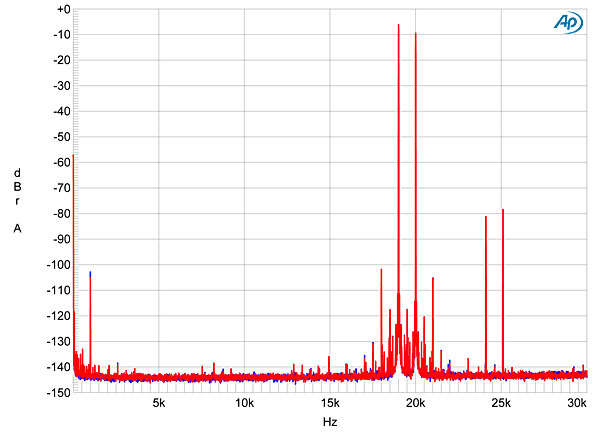
Ever seen this plot??? Of course you have. It demonstrate that when two "nearby" frequencies are produced simultaneously, you also produce the sum and the difference, though to a much lessor extent. Here they plot 19 and 20kHz simultaneously, and while neither is audible by itself, the 1kHz difference certainly would be if loud enough.

So if we extend the response up into the ultrasonics, who knows what "differences" may be produced and at what levels? So maybe in some cases there could be a downside to this extension of response.
1011iDafig11.jpg
 
Its probably a mix of truth and some marketing BS mixed in. Getting frequencies off a CD at 20K is mediocre at best. Even if you can do it, you are getting two samples to represent the sine wave. Not too good.
Not how it works. Provided you have a band-limited signal the waveform will be reproduced exactly up to half the sampling rate. There's no issue with 20KHz from a CD.
If you look at many high end pieces they try to achieve a bandwidth of 10hz to 100k or more.
Amplifiers, so they're stable. Not necessary at all for digital replay, pointless in fact. You just heat up the tweeters reproducing ultrasonic noise along with the music.
 
Not how it works. Provided you have a band-limited signal the waveform will be reproduced exactly up to half the sampling rate. There's no issue with 20KHz from a CD.

Amplifiers, so they're stable. Not necessary at all for digital replay, pointless in fact. You just heat up the tweeters reproducing ultrasonic noise along with the music.
if you are fine with 20K being represented by two samples, sure its great.
 
Ever seen this plot??? Of course you have. It demonstrate that when two "nearby" frequencies are produced simultaneously, you also produce the sum and the difference, though to a much lessor extent. Here they plot 19 and 20kHz simultaneously, and while neither is audible by itself, the 1kHz difference certainly would be if loud enough.

So if we extend the response up into the ultrasonics, who knows what "differences" may be produced and at what levels? So maybe in some cases there could be a downside to this extension of response.

1011iDafig11.jpg

Ok i know I read an article about this years ago, late 80s maybe? The idea was that 2 high frequency sources would cancel out to result in audible sound.

Was it just conjecture? Has anyone done this?
 
I have heard that adding some white noise at higher frequencies can add ‘air’ to the presentation, but doing so at anything above 20k ( and probably much lower) would be pointless, unless you are a bat or a wax moth.
 
Last edited:
Ok i know I read an article about this years ago, late 80s maybe? The idea was that 2 high frequency sources would cancel out to result in audible sound.

Was it just conjecture? Has anyone done this?


mixing 2 high frequencies to produce sum and difference is how radio has worked for a century. Thats a superheterodyne. Much higher frequencies but the principal is the same. Radio station comes in at say 93.3, the oscillator runs at 104 mhz, those two come together in the mixer and the output can be filtered out to the 10.7 mhz difference. Thats the IF strip.

I can tell you it exists at audible frequencies too, and the initial frequencies don't matter. I used to calibrate a frequency counter I own by zero-beating it to a 10mhz WWV signal. The crystal inside was 10mhz and the oscillator leaked enough that it would radiate out to a nearby shortwave receiver. If WWV and the crystal were not the same frequency, you'd get a tone that would measure the difference between the two. As it got closer the tone would drop in frequency into the subsonic range, but it would still be audible as a "flutter" sort of sound, then down to a slow "throb" sort of noise. Once it matched that sound would go away completely.
 
if you are fine with 20K being represented by two samples, sure its great.
You might want to refresh yourself on how sampling works. Or just read my post again.

Not that I (or almost any other adult in the world) can hear out to 20KHz. But nevertheless, providing the sampling frequency is 40KHz or higher, it's reproduced perfectly in any case.
 
Those two samples describe the signal perfectly, because there is exactly one and only one possible matching waveform (provided the signal is bandwidth-limited, which in this case it is).
 
You might want to refresh yourself on how sampling works. Or just read my post again.

Not that I (or almost any other adult in the world) can hear out to 20KHz. But nevertheless, providing the sampling frequency is 40KHz or higher, it's reproduced perfectly in any case.

there is a reason why the commercial record companies ditched 16/44.1 as fast as they could.
 
there is a reason why the commercial record companies ditched 16/44.1 as fast as they could.
Recording is entirely different. Noise will build up as you bounce tracks around and do post production, so the higher sampling rate and bit depth give you more leeway in that regard, but even recording at 16/44.1 or 16/48 is way better than the best analogue tape in that regard.


For playback it's not needed; although you can make the argument that if they recorded in 24/96 you might as well have playback at the same.

I used to record professionally. That statement is not even worth replying to.
 
I used to record professionally. That statement is not even worth replying to.
I've also worked in the industry and met many recording engineers. Most know how to work the equipment but have no knowledge or interest in how the equipment works. Consequently there's almost as much nonsense talked in the pro world as there is in domestic hi-fi.

Look at the frequency response of the still very popular vintage mics and their modern copies, they don't even pick up as high as 20KHz. That's before we start listing all the great sounding recordings made on 16/48 equipment.

20k is unnecessary on any vocal mic. As is 10k. Virtually zero sounds over 7k from any voice.
 
Hi guys,

What do you think of this excerpt from the booklet of an SACD bundle? Particularly the framed section.
It looks like a boatload of bullshit to me. What do they mean, "typically"? They're always cut off, no exception. And what good is it to bring them back (actually not just bring them back, but make them up completely) if they aren't audible anyway? "Restore the original smoothness and reverberation in the hall" by fabricating some non-audible frequencies? Huh?!? o_O
The rest of the blurb also sounds dubious to me, though I'm not educated enough in matters of mastering techniques and processes to be really sure.

Am I right that this is nothing but horseshit? Or am I missing something and it does actually make (some) sense?

Thank you.

View attachment 3842137
Well is "typically" in this case means: COMPLETELY at every instance. :eek:
 
Back
Top Bottom