• The move to the new server is done. There are some software and database maintenance updates in process. This has us passing the hat around to help out. We appreciate any donations. Seriously, even a dollar helps. The payment page may be found here - https://www.audiokarma.org/support.html

Drivers for 811b's ?

Hi, Jack!

I've just updated post #53 to include the results with Model 19 crossover, plus the impedance curve. Perhaps you can tell us more what the impedance peaks mean? :dunno:

We're testing a reconfigured version of that crossover in a project over on LHF. I'll mod one of these M19 crossovers to try that, as well.

806As are down 20 dB at 20 kHz as opposed to D210Ti down just half that. The Selenium is therefore more amenable to compensation. Best I can reasonably make 806As extend is 14 kHz; that's with CX3400 stock CD boost, which I've just shown is more than is required to get the D210Ti playing flat to 20 kHz.

I have two more options to try with these: A simple R||C, and JBL 3120A CD compensation.

HL14-25 is a narrow beamwidth exponential horn. They use that as "Standard" to show the drivers in a favorable light, as the horn itself does some compensation acoustically. I'm obviously getting better results doing it electrically on 811B.

If I had to rank diaphragm materials generically for sonic smoothness, it'd be Mylar, then aluminum, then titanium. Titanium has primary application in sound reinforcement, where it's ruggedness is essential. My best-sounding drivers here are titanium, but it is damped, as I showed in another thread. The diaphragms for D210Ti are cheap, so I may order a few and try some of that sort of tweak. They're not sounding bad without it, tho.

Running active at 1.2 kHz, it's 24 dB/octave L/R. Looking at the M19 measurements, the filter seems to be rolling it down 3 dB at ~1.5 kHz. It's 3rd-order, 18 dB/octave, so that may be getting close to compliance with the factory recommendation. The curve shows it's getting yanked down pretty steeply at highpass.... :yes:
 
I received a pair of threaded versions today from PE in case I want to swap out the JBL drivers on the theatre's JRX-125's, the blogs on PE suggest that as an upgrade. :yes:
That's the $10 PT waveguide Jack is referring to.

I'll be testing the D210Ti with those, next.... :thmbsp:
 
That's the $10 PT waveguide Jack is referring to.

I'll be testing the D210Ti those, next.... :thmbsp:

Blog

Here's the blog from PE, no spell check?;
Awsome upgrade for stock horns
Tuesday, June 19, 2007
LongTheTiger from Chicago
I upgraded the drivers in my jbl jrx125's with these and WOW the diffrence is amazing they are crystal clear and very smooth for a budget driver. i highly reccamend anyone with jrx's to get these!
 
We don't need no stinking impedance peaks!

Hi, Jack!

I've just updated post #53 to include the results with Model 19 crossover, plus the impedance curve. Perhaps you can tell us more what the impedance peaks mean? :dunno:

I am not the guy to explain the impedance peaks, but after looking at the manufacturers charts versus yours, the impedance changes depending upon the horn the device is mounted on. Seems like it has to be a loading effect. The impedance peak is at 2 KHz with a minor peak at around 700-800 Hz when mounted on a plane-wave tube, but the HL14-25 horn adds significant peaks at 450 Hz, 750 Hz, and 1100 Hz. Then your impedance curves on the 811B are totally different.

I am going to be very curious about what it looks like on the JBL waveguide. And very curious about how you plan to doctor the diaphragms. Would doctoring the diaphragms alter the loading, perhaps? HHMMmm. This could become a real project here, couldn't it? I may need to tweak my crossover values, since I just calculated them at 8 ohms.

And you and dgwojo are really night owls. You must have been up all night measuring and thinking. I was fast asleep. :boring::boring:
 
Please advise as to when this order is to be placed. I have an email to Assistance Audio to find out if the BMS 4552ND can be crossed over at 600 Hz in a home environment. If the answer is yes, I may be interested in 3 of the BMS 4552ND drivers.

Thanks, Larry
 
Please advise as to when this order is to be placed. I have an email to Assistance Audio to find out if the BMS 4552ND can be crossed over at 600 Hz in a home environment. If the answer is yes, I may be interested in 3 of the BMS 4552ND drivers.

Thanks, Larry
Hi Larry,
I'm dealing with Jack at Assistance, they're out of 8 ohm 4552 and 4540 drivers right now, he said they expect more next week, Dave. :yes:
 
Good work from Zilch, again, on posting his results. Unfortunately, now I'm more confused than ever. The Selenium shows some good promise and the price is very nice. I've also been offered a pair of 802-8g's but entry price is of course, much higher. The 802-8g's are a bit below the price of a set of GPA 902's. The BMS, as Zilch and others have shown, does extend the high end out significantly. What to do? :scratch2: :scratch2:
 
902s also have extended VHF, at least they're showing that on RTA in the 9844 thread over on LHF.

They are showing the same roller-coaster response curve as the Selenium, however.

I'll stick BMS on there again and see if it's my present measurement setup doing that here. 802s did somewhat the same thing.

Are new 902s twice the price of BMS?

More?
 
Good work from Zilch, again, on posting his results. Unfortunately, now I'm more confused than ever. The Selenium shows some good promise and the price is very nice. I've also been offered a pair of 802-8g's but entry price is of course, much higher. The 802-8g's are a bit below the price of a set of GPA 902's. The BMS, as Zilch and others have shown, does extend the high end out significantly. What to do? :scratch2: :scratch2:
If the 802-8G's are original with the 23744 phragms then they might be worth buying vs the new GPA 902's as the 802's can be flipped for big money on that auction site, on the other hand, they're 30 years old and could need a magnet recharge where the 902's are new and never need recharging. Obviously the solution is to buy them all and see what floats your boat!! I'm still getting a pair of BMS as I don't own any and have not heard any so I'm excited to try something new. The Seleniums are a no brainer to me as they're so cheap right now, say $36 with S&H from PE, I'm sure those can be flipped for at least that much if you decide to replace them, good luck, Dave. :thmbsp:
 
The current lineup:

Drivers for 811B horns, per pair, plus shipping:

1) Selenium D210Ti - $50 - $62
2) Eminence PSD2002 - $114
3) BMS 4552nd - $317
4) Vintage Altec 802-8G - $350
5) GPA 902-8A - $400

Corrections?
 
More Data:

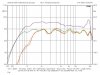
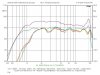
Unit-to-unit uniformity is good, Red and Orange, both on Model 19 crossover.

Testing to see if a simple R||C filter would work for compensation, 8 Ohms in parallel with 6 uF, the pair in series with the driver, Green. Answer: yes, at least when actively crossed. Listened quite a bit, sounds O.K.

Substitute BMS 4550 driver, same simple filter. Gain increased 3 dB to raise the curve for better comparative visibility, Violet. It ain't the setup, room or the horn making the response undulations, folks.

We may not be looking at the best choice cheap Selenium, either; this one's but $11 more at PE, and was recommended by one who knows, instead:

http://www.seleniumloudspeakers.com/site2004/catalogo/pdf/D220Ti.pdf

http://www.partsexpress.com/pe/showdetl.cfm?&Partnumber=264-271

Also available thread-on:

http://www.partsexpress.com/pe/showdetl.cfm?&Partnumber=264-270

Edit: Finally, back on the M19 filter, can I dial BMS flatter? Yup, bottom, Cyan, with a series notch on the 18.5 kHz spike: 0.47uF, 0.08mH, 4 Ohms.

attachment.php


attachment.php
 

Attachments

  • #1, #2, and BMS 4550 64.jpg
    #1, #2, and BMS 4550 64.jpg
    46.6 KB · Views: 356
  • #1, #2, and BMS 4550 M19 64.jpg
    #1, #2, and BMS 4550 M19 64.jpg
    48.5 KB · Views: 353
Zilch, does that 18.5k spike correction matter much since we can't hear frequencies that high anyway?? :scratch2:

On the D220Ti from PE, I'll have to order a set on my next order, they sound interesting, maybe they're clearing out the D210's in preparation of the the D220 as a replacement?? :scratch2:

Nice curves, thanks for posting them, Dave. :music:
 
Zilch, does that 18.5k spike correction matter much since we can't hear frequencies that high anyway?? :scratch2:

On the D220Ti from PE, I'll have to order a set on my next order, they sound interesting, maybe they're clearing out the D210's in preparation of the the D220 as a replacement?? :scratch2:

Nice curves, thanks for posting them, Dave. :music:

In my work with the 4550 and 4552, I can hear no difference with or without the 19KHz notch filter on either music or pink noise. My philosophy on this is to keep xover complexity to the minimum nec to achieve the desired result. Since I can't hear the "spike" and the xover is already fairly complex with the passive compensation and impedance correction, I decided to ignore it and leave the notch filter out. I recall Zilch commenting similar awhile back but he decided to leave it in. Be interesting to hear his take on why that is the route he chose.
 
Zilch, does that 18.5k spike correction matter much since we can't hear frequencies that high anyway?? :scratch2:

In my work with the 4550 and 4552, I can hear no difference with or without the 19KHz notch filter on either music or pink noise. I recall Zilch commenting similar awhile back but he decided to leave it in. Be interesting to hear his take on why that is the route he chose.
I can't hear anything up there either, but there are those who can, particularly those of the fair sex, who DO matter in the final analysis. ;)

It's quite disconcerting to be able to dial VHF response around, watch it happening on the display, and not be able to hear any difference. There are credible arguments that we "hear" UHF via other means, and that is part of our overall perception of the sound. Whatever. The standard is 20 kHz, and I'm working it. Just when I get there, they move it to 30 kHz, then, most recently, 50 kHz. :p:

If you look at the factory distortion curves, it seems that spike is in part, at least, a spurious resonance of some sort, as Tom suggests. Some TAD curves have it, as well, so BMS is in good company in this regard. It's more prominent on some horns and waveguides than others; more evidence.

I conclude it's worth mitigating for ~$10 in additional parts, and it's a filter design challenge that's fun to pursue.

I had a friend in college who always had a train timetable with him, and a sharp pencil. Almost compulsively, he would reroute the trains to optimize departures and arrivals.... :thmbsp:
 
Back
Top Bottom