• The move to the new server is done. There are some software and database maintenance updates in process. This has us passing the hat around to help out. We appreciate any donations. Seriously, even a dollar helps. The payment page may be found here - https://www.audiokarma.org/support.html

dumb question about phono input

John Parkey

Member
Holiday greetings everyone. I have several integrated amps from the late 70's and would like to hook up a CD player, a Tuner, and an external DAC for streaming. All of my integrated amps have AUX, Tuner, and Phono as inputs. Would it be harmful to the integrated amp to hook up the CD or DAC to the phono input?
I have always wondered about this.

However, I realize I can also hook something up to the Tape Input and thus avoid using the phono input, but I still would like to know.

Thank you.

John
 
Register to hide this ad
You don't want to use a phono input for anything but a phono cartidge,

Reason 1 - Additional gain to compensate for the extremely low output of a magnetic cartridge.

Reason 2 - It applies an equizalation (RIAA) curve needed to get the proper performance from said magnetic cartridges.

Reason 3 - It may not damage your receiver but I'll sound like a$$.
 
Last edited:
What he said. not a dumb question if you don't know the answer, but the answer is that phono is different from all other inputs and you shouldn't use it for anything but a phono cart.
 
I had a similar problem, too many devices to plug in and too few inputs. I found a simple solution is adding a switch box with four inputs and one output. Such a switch box can be purchased for less than $10.
 
I had a similar problem, too many devices to plug in and too few inputs. I found a simple solution is adding a switch box with four inputs and one output. Such a switch box can be purchased for less than $10.

Just as a heads up I have done the same, I got an "Ocean Matrix" A/V switch box and just used the stereo audio portion of it... it appears that all the shells of the RCAs are commoned up. It's not a problem in my application, and I don't think it would be a problem in many (and I can't actually think of one where it would be) but it's worth being aware of.
 
Just as a heads up I have done the same, I got an "Ocean Matrix" A/V switch box and just used the stereo audio portion of it... it appears that all the shells of the RCAs are commoned up. It's not a problem in my application, and I don't think it would be a problem in many (and I can't actually think of one where it would be) but it's worth being aware of.
That is a good point.
 
Just as a heads up I have done the same, I got an "Ocean Matrix" A/V switch box and just used the stereo audio portion of it... it appears that all the shells of the RCAs are commoned up. It's not a problem in my application, and I don't think it would be a problem in many (and I can't actually think of one where it would be) but it's worth being aware of.

Far as I know, RCA shell being common is pretty much common/standard practice.

I can check my Zektor HDS 4.1 switch too, but if I were a betting man I'd bet they're all common on that too.
 
John: Using the tape input and/or a switch box (depending on how many extra line-inputs you'd need), would definitely make more sense in your case, but just for completeness sake, an existing MM phono input could always be used as a line-input, if one hooks a so-called "reverse RIAA" circuitry in between, which brings down the level and applies RIAA (pre-)equalisation. However, that will of course have a bit of an impact on signal quality (*). So in practice one rather wouldn't use such a reverse RIAA circuitry as part of a regular hifi setup, but might nevertheless want to have one at hand as signal adaptor for testing phono stages, e.g. so one can feed the phono input for example with software-generated test tones from the line-out of a computer soundcard or external sound-interface.

Greetings from Munich!

Manfred / lini

*) and of course one could theoretically also think of such a circuitry for MC inputs, but that would be more problematic, 'cause the MC input would require an even lower signal level and often pose the additional problem of being lower impedance than the output of the source...
 
Do all phone inputs on integrated amps have amplification and equalization? Aren't there several different equalization standards? We use a Vad Lyd preamp for our digitization studios and it comes with 4 curves for 33/45 and six for 78 and one FLAT. We digitize all speeds and all dates which makes this a necessity for us. We have many 78rpm recordings recorded prior to RIAA standards, when each manufacturer had their own curves. How is this handled by one phono input on an integrated amp or receiver? I know there has to be record enthusiasts out there who would also listen to vintage records. I suppose you can buy a preamp and use a line level input? Are all phono sections strictly RIAA?
 
'cept the ones after the late 90's that expect 'phono it' to be 150mv and pre-eq'd via the new sexy turntable: pre-amping IN the unit...
 
Do all phone inputs on integrated amps have amplification and equalization?
Yes. but it wasn't always this way. Just from the 50's on when 33 1/3 records became the industry standard.

Priior to that, the 78 market was the wild west. Different manufacturers used different equalization. As such, collecting 78s can be problomatic.

I had a Marantz 7C which allowed the user to select, at the turn of a knob, any of several different eq curves but, keep in mind that that unit came about early in the life of "modern" recordings and many old farts still had their 78s

I don't think anything but RIAA has been used on 33 1/3 records. As for the remaining 78 afficianidos, I don't know what they use. If you can find anyone that collects them, perhaps they could shed some light on this..

So, yes. You can safely say that all phono inputs on modern equipment adheres to he RIAA standard. Since every record made in the last 60 years, it's a pretty safe bet that it will be the most common one. Now, I'm sure there is a specialty market out there that deals specifically with 78s and all their various promogulations but that's so far off the beaten path that not too many are familiar with it. I know I'm not.
 
For more completeness on this thread, Phono is different

Tape, Aux, CD, Tuner and almost all other dual RCA jack inputs are so close in spec that anything other than phono can plug in, in general.
One looks a many receivers and sees only an Aux and a Phono input and wonder but there are usually 1 or more tape monitor loops that can be used as inputs for high level sources like all those mentioned except phono (but a phono preamp would be appropriate).
 
The LP (Long Play) record was introduced by Columbia in 1948 and it used the Columbia equalization curve. When other record companies starting releasing their LP records they used any one of a number of equalization curves. Amplifiers and preamplifiers of the 50's would often have setting for the more popular equalization curves. The RIAA equalization curve became the standard in 1954 and by the time stereo records were introduced in late 1957, most of the consumer electronics with a phono section, provided for the RIAA curve only. However; there were some that included multiple equalization curves.

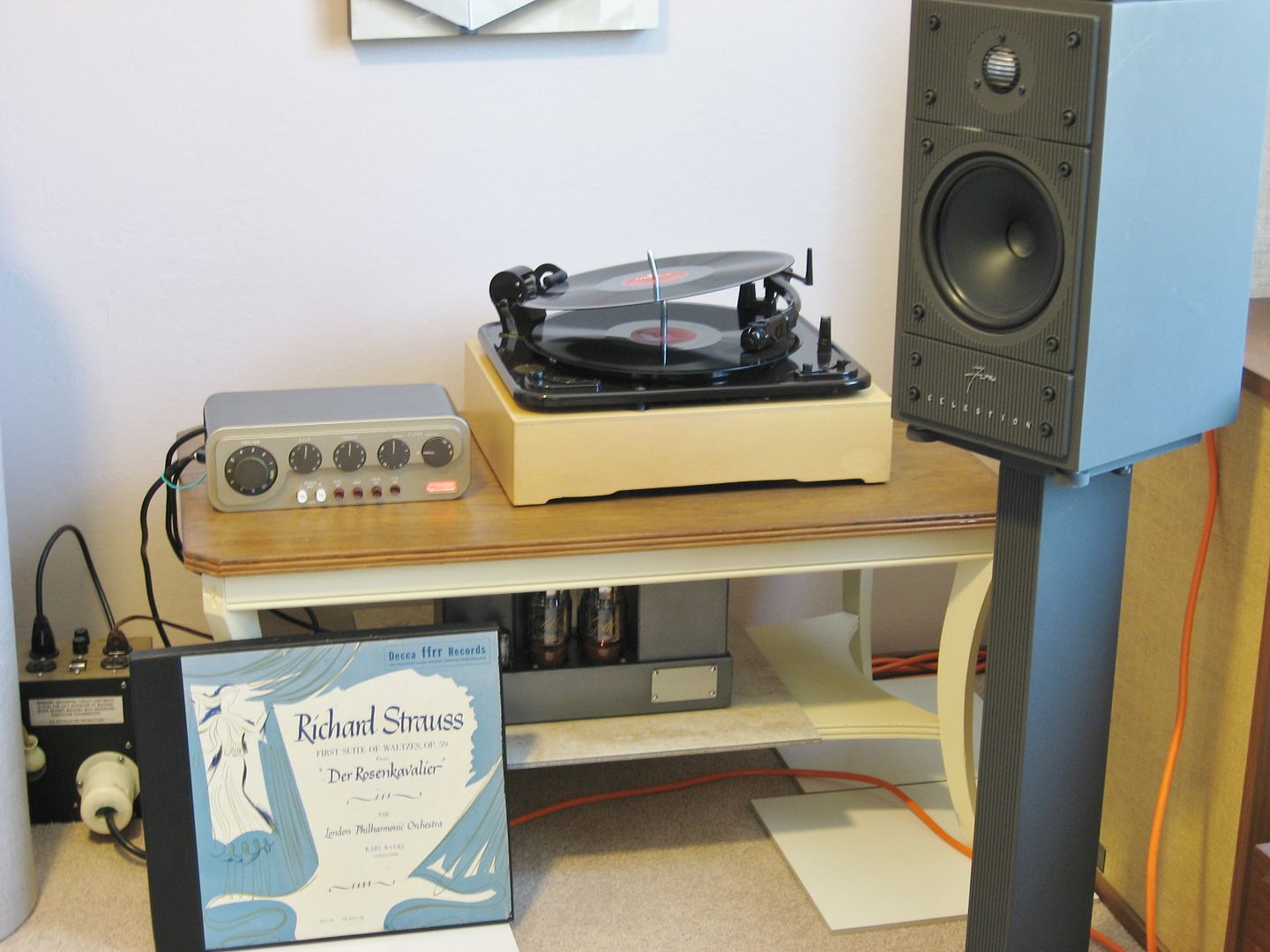
Today, if an amplifier or preamplifier has a phono input, it follows the RIAA curve. There are some stand alone specialty preamplifiers that are designed with controls to play back the historical curves. Another option, for one wishing to play back the pre-RIAA records, is to use vintage electronics. Some popular examples of vintage equipment, with multiple equalization curve capability, would include: H H Scott 121, McIntosh C-8, QUAD QC II, Heathkit WA-P2.

Music system using the QUAD QC II to play a SP record using the FFRR curve:
SP%202_zpsygqe3qfh.jpg


Heathkit WA-P2 with turnover and rolloff equalization switches:
WA-P2 Sys2.JPG
 
Last edited:
Back
Top Bottom