• The move to the new server is done. There are some software and database maintenance updates in process. This has us passing the hat around to help out. We appreciate any donations. Seriously, even a dollar helps. The payment page may be found here - https://www.audiokarma.org/support.html

Dynaco PAS3 noise

Walter R

Active Member
I recently acquired a Dynaco PAS3 preamp. It has a new pc board replacing the selenium rectifier and associated filter capacitors. There is a slight hiss or hum at low volume. It doesn’t sound like power supply hum. It doesn’t increase when I turn up the volume. In fact, with no input signal the noise goes away with the volume turned up beyond a certain level. Any clues on the possible cause would be appreciated. Could it be a noisy 12AX7 on the PC-5 board? They’re all new JJ 12AX7s. Also the power source has a bucking transformer to lower the mains voltage about 7 volts, a vestige of when I was running Eico 20 amps. Could this be causing the problem? I’m using it with a Dynaco ST-70 which appears to be free of noise with no input from the PAS3.
 
Register to hide this ad
Is it a "hiss" or is it "hum" ?
What input is selected, and is the input open or grounded ?
 
I’d say it’s a hum, not a hiss. I’m using the ‘spare’ input on the PAS3 and can switch input signals with an external box. The noise is there regardless of which input signal is selected externally, including no signal. If the noise was in the input signal, I’d expect the noise to get louder when I turn up the volume on the PAS3. It doesn’t, just the signal gets louder. Also the PAS3 doesn’t have a grounded power cord, so I guess there’s a floating ground.
 
Here's something I wrote about the PAS-3x a while back that may or may not be what you're hearing:

There is a trace of hum present due to ground loops in Dynaco's somewhat poorly thought out ground scheme. This can be remedied with a bit of rewiring, but the right channel will usually have some excess hum when compared to the left. This appears to be due to proximity to the transformer and AC line wiring, though there may be yet more grounding issues involved. When examined with a spectrum analyzer, both channels have the same level of 120 Hz contamination and harmonics, but the right channel also has a 60 Hz component not seen on the left, thus my belief that's it's related to the AC mains and transformer.

When the 60 Hz line is rectified it becomes 120 Hz, thus 120 Hz is power supply related and 60 Hz is line related.
 
Problems with kit built Dynaco PAS, etc. are not due to the design, problems are mainly due to poor assembly and age.

The best way to deal with them is to strip them down to the chassis and rebuild per the original Dynakit instruction manual using new capacitors.

Once the unit is stripped down, it is much easier to address the decades of carbon build-up on the contacts. Spraying with Deoxit is only a superficial and temporary fix.
 
I’d say it’s a hum, not a hiss. I’m using the ‘spare’ input on the PAS3 and can switch input signals with an external box. The noise is there regardless of which input signal is selected externally, including no signal. If the noise was in the input signal, I’d expect the noise to get louder when I turn up the volume on the PAS3. It doesn’t, just the signal gets louder. Also the PAS3 doesn’t have a grounded power cord, so I guess there’s a floating ground.
Wiring is important. When using a dedicated power board i find it best to route all B+ and grounds on top
of the chassies. Be careful to route them close to the chassies and away from tha board as much as possible.
Also i find it beneficial to connect a wire between eyelet 1 and 8 on the line board.
The cas must be closed to keep a PAS humfree
 
Try connecting a wire to the mains safety ground and the chassis. I had one that I quieted down with a 3 wire safety cord.
 
It’s well worth doing a deep dive into a PAS 3. Aside from the usual caps and resistors, deep clean, remove old solder, resolder, new RCAs, replacing the cumbersome selector switch (moving RIAA caps to the board and removal of the loudness switch. These all made a huge difference in my PAS which sounds great and is super quite. Finally, wire positions are important in most all amps, - clean, shorter wires that are close to chassis.
 
I’ll start by replacing the capacitors on PB-5 and checking the values of the resistors on it. I won’t use the phono input so I’m not too concerned about PB-6. The eBay seller said it was serviced but I guess that doesn’t mean hum free. Two of the PB-5 capacitors were already replaced. It’s a shame because the ST-70 I bought is working beautifully.
 
It would help to know what you’er hearing, without actual test equipment there’s phone & table apps that will help distinguish the noise, download something like the Decibel X app

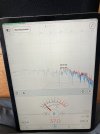
Turn the system on with nothing but the noise coming out of the speakers and hold the phone with the app running up to the speaker and note the frequency….

Andy

edit—you can adjust volume and al note any changes

loudness or filter turned on, any changes by doing so? or does it change by turning the tone controls?
 
Last edited:
I ran Decibel X on my iPad and photographed it with my iPhone. Attached is the picture. It doesn’t seem to be 60 or 120Hz.

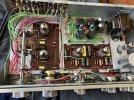
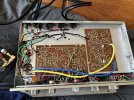
I photographed the insides, both top and bottom, also attached.

The noise is there at minimum volume. It disappears with the volume control at the 2 o’clock position, then increases again at full volume. This is with no input connected.
 

Attachments

  • IMG_0313.jpeg
    IMG_0313.jpeg
    89.8 KB · Views: 41
  • IMG_0315.jpeg
    IMG_0315.jpeg
    186.6 KB · Views: 41
  • IMG_0320.jpeg
    IMG_0320.jpeg
    174.7 KB · Views: 44
Last edited:
The loudness on-off doesn’t make a difference. The noise is minimized with both bass and treble at minimum.
 
It would help to know what you’er hearing, without actual test equipment there’s phone & table apps that will help distinguish the noise, download something like the Decibel X app

Turn the system on with nothing but the noise coming out of the speakers and hold the phone with the app running up to the speaker and note the frequency….

Andy

edit—you can adjust volume and al note any changes

loudness or filter turned on, any changes by doing so? or does it change by turning the tone controls?
See my new post
 
I started checking the voltages at the PC-5 12AX7 tubes. The plate voltage on pin 1 of both tubes is low, ~133vdc compared to 175vdc in the manual. The plate voltage on the other section of both 12AX7s, pin 6, is 185vdc on one tube and 193vdc on the other. The manual says 200vdc.
 
Back
Top Bottom