• The move to the new server is done. There are some software and database maintenance updates in process. This has us passing the hat around to help out. We appreciate any donations. Seriously, even a dollar helps. The payment page may be found here - https://www.audiokarma.org/support.html

Dynakit Stereo 70 - My Introduction to Tubes

David_NC

Super Member
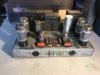
I was at the local Goodwill today - the one with a separate electronics room - and found this amp. I kept checking it out and walked away from it a couple times. An older gentleman started talking to me about it. Evidently, he has the same model and really likes it. At any rate, $249 is way over my Goodwill store price, but this seemed worth it. The manager hooked it up for me, and it produced sound. I felt better about it already.
I paid for it, got it home, and hooked it up. Even with the super cheap single-driver RCA surround speakers I bought for testing, it sounds really nice. About every 10 minutes or so, I get static and a fairly soft rhythmic popping in the right channel. It lasts maybe 10 seconds and then goes away. I have no clue as to how old this unit is, but I'm sure it needs caps replaced, at a minimum. Even with that, I'm quite impressed with how good this amp sounds! I have an old Sony 2000 preamp and a couple Marantz 1060's which I can also use as a preamp. It'll be a while for either of those, however, as they are both in NC, and I really don't have anybody there to pack them properly for cross-country shipping. I guess I'll use the preamp outs on my Luxman R-115 to start.
I'd appreciate any help on eliminating this noice issue and also where to start on refurbing it in general so I can put it to regular use.
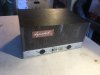
Cover.jpeg Bare.jpeg Glow.jpeg
 
Register to hide this ad
Nice score! ST 70s are great amps.

Try swapping the tubes from channel to channel to see 8f the noise follows, if 8t do3s, you’ve got a flaky tube.

If you’re going to keep it, yes, recap the entire amp. Use good quality caps throughout. While you’re at it swap out all the resistors as well. Keep all the same values, just use good quality components.

You should also replace the selenium rectifier (google it) with diodes as it is a piece that often fails.

If you can post a pic with the bottom cover removed! Let’s see what it looks.ike under the hood.
 
Nice find! Looks like two of the capacitors on the driver board (and the filter capacitor can) may be original, and I don't know if the bias supply has been redone, but it looks like you did quite well! I suggest reading the ST-70 Restoration Article I wrote awhile back for some pointers. As far as the noise issue goes, I would probably start by swapping the 7199 driver tubes around, and see if the problem switches to the other channel. At the same time, I would clean the contacts of both of the driver tube sockets using DeOxit. Good luck, and happy listening! :)
-Adam
 
You MUST replace the can-cap! And do it NOW if you want to use it. A few months ago I used an ST70 (I have two). I brought it up slowly on a Variac: did it right. It played gorgeous music — for 15 minutes.

The can-cap EXPLODED! I mean Flash-Bang-Smoke and dark slime spewing everywhere. Horrible. I haven't gone near it since, I have to get over the shock. I want to know if it caused more damage, and if I can fix.

Don't let this happen.

To add to the chorus, Nice Score! Don't jeopardize it.
 
You've got a great opportunity here and at a rather terrific price. My suggestion would be to take your time learning about it before making any circuit changes. Actually, circuit changes really aren't necessary, anyway. I do recommend going through the whole amp and making sure it is in its original configuration, which might entail undoing some homegrown changes that took place over the years.

There's no substitute for studying the original Dynaco manual and becoming familiar with the amp. The original Dynaco manual does not require a lot of technical knowledge to understand and will serve you well: https://dynakitparts.com/wp-content/uploads/Dyna-ST70.pdf

For further reading, here's a watershed study of the original stereo 70 - it's kind of technical but nevertheless promulgates a sensible philosophy: http://www.audioregenesis.com/documents/ST-70 Base Line Testing.pdf

PS - another suggestion, right off the bat... if the four power tubes are what I think they are, I'd replace them with another set of tubes to use as workhorses while you get the amp running properly. The four in there now may be rare, original 6CA7 and you wouldn't want to take a chance of damaging them if the amp isn't working quite right.


PPS - There's a date stamp on the left side of the face of the power transformer (the middle of the three transformers). If it is still legible, it will give you a pretty good idea for how old it is.

Reason for edit: Clarification.
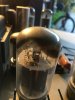
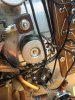
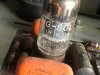
I can't find a date on the transformer, but I read that often the date is also on the bias pots. If that's true, this is a 1964 unit... just a couple years older than me! Maybe these pics show enough of the tubes. These do appear to be 6CA7's. What would you recommend using in their place while it's on the bench? I wonder if I should do the same with the 7199's, as adapters and modern equivalents would be relatively cheap, compared to replacing one of the originals. This unit has a newish grounded power cord, but for whatever reason, the ground wire isn't connected to the chassis. That's one thing I'll remedy soon, too. I've read to replace the can-cap as well, and I'll try to source one of those as well. In the meantime, I guess it's research time!
EL34.jpeg Under.jpeg 7199-1.jpeg
 
Amp looks to have been partially re-capped given the orange drops on top and the new RCA sockects are dead giveaways. Replace the can cap, bias resistors and diode out the selenium rectifier are must-do's, IMHO.

After that I'd start checking voltages, keep her close to stock as much as possible. Again, a very nice find for that price and one musical amp.

Wow! Top deck only looks dusty to me and not at all pitted either. :thumbsup:
 
That is the most extreme description I have ever read of the quad can failing. Some electrolyte leaking and a hum developing are the usual descriptions. I wonder if in your case something else was afoot..?

Naah, just a bad filter cap going to Valhalla.

Ohmic heating from leakage current either electrolyzes the electrolyte, creating H2 and O2, or boils it, causing the sealed case to rupture. This is why a plug exists. Sometimes the plug can't blow out in time and the casing instead explodes.

Remember, the dielectric layer (insulator) is basically anodized aluminum built up during the formation process. In regular use the dielectric is continually reformed, which is why the voltage rating over time drops to the typical applied voltage. With disuse the anodizing dissolves into the electrolyte dramatically reducing the insulation's effectiveness because it is not being reformed. At some point the voltage arcs through the weakened dielectric, a loud "BANG!" occurs, and the field test of the robustness of one's sphincters occurs.

Some excellent guides to restuffing cans exist on AK.
 
I wonder if I should do the same with the 7199's, as adapters and modern equivalents would be relatively cheap, compared to replacing one of the originals.

What kills the 7199 is breakdown of the heater-to-cathode insulation which results in leakage and hum.

Elevated heater voltage is the solution.
 
PS - another suggestion, right off the bat... if the four power tubes are what I think they are, I'd replace them with another set of tubes to use as workhorses while you get the amp running properly. The four in there now may be rare, original 6CA7 and you wouldn't want to take a chance of damaging them if the amp isn't working quite right.

Excellent advice.

The reason is that the ST-70 kit used Mullard tubes re-branded with the Dynaco logo. So replacements of that level of quality will be very, very expensive.
 
The ST-70 kit used Mullard tubes re-branded with the Dynaco logo. So replacements of that level of quality will be very, very expensive.
When I got mine, one of the four Mullards was smashed. I replaced all with EH. Obviously I saved the three Mullards. I don't recall if it said 'Mullard' on the tubes, but 'Made in UK' gave me a big hint — just as 'Made in W Germany' told me they're Telefunkens.

I now have many Telefunkens cannibalized from Dyna and Fisher NG units. I use four in a Luxman all-tube preamp — despite their age and who knows how much use, they're sensational, and dead-quiet.
 
About every 10 minutes or so, I get static and a fairly soft rhythmic popping in the right channel. It lasts maybe 10 seconds and then goes away. I have no clue as to how old this unit is, but I'm sure it needs caps replaced, at a minimum.
Nice find! It is an assembled KIT as all dynaKITs are. I've found a few solder joint problems and loose pin sockets with these as they were assembled in garages and basements. Some people didn't have good tools or skills to do the job and some did.
 
I can't find a date on the transformer, but I read that often the date is also on the bias pots. If that's true, this is a 1964 unit... just a couple years older than me! Maybe these pics show enough of the tubes. These do appear to be 6CA7's. What would you recommend using in their place while it's on the bench? I wonder if I should do the same with the 7199's, as adapters and modern equivalents would be relatively cheap, compared to replacing one of the originals. This unit has a newish grounded power cord, but for whatever reason, the ground wire isn't connected to the chassis. That's one thing I'll remedy soon, too. I've read to replace the can-cap as well, and I'll try to source one of those as well. In the meantime, I guess it's research time!
View attachment 1400620 View attachment 1400621 View attachment 1400622

I can read the EIA code on the bias pot in the second photo. 1376444 = CTS manufacture, made in the 44th week of 1964. Likely a fairly early example, for the most part, as also evidenced by the cloth transformer wire visible. Very nice find! :)

Looks like the selenium rectifier for the bias supply is still wired in place; it should be replaced with a silicon diode (1N4004 or better) with the striped wire from the transformer connected to the striped end of the diode, and the black wire leading to the filter capacitors to the non-striped end. You can use one (but not both!) of the terminals of the old selenium rectifier as a tie point for one end of the diode. I'm not sure if the two electrolytic capacitors under the chassis have been replaced, but if they look old, replace both of them with 47µF@160V or better capacitors. Again, good luck!
-Adam
 
Looks like the selenium rectifier for the bias supply is still wired in place; it should be replaced with a silicon diode (1N4004 or better)...

A low-noise diode (low Qrr) would be better than the 1N series. Plus a dropping resistor to approximate the internal resistance of the selenium rectifier.
 
I tend to leave selenium stuff alone in low current applications like this since they rarely fail provided the filter caps aren't shorted. I'd be far more worried about the can cap and the other bias caps than the rectifier. No, its not as reliable as a modern diode but its less likely to cause you trouble than a 50 year old electrolytic cap.
 
Nice score! ST 70s are great amps.
Try swapping the tubes from channel to channel to see 8f the noise follows, if 8t do3s, you’ve got a flaky tube.

If you’re going to keep it, yes, recap the entire amp. Use good quality caps throughout. While you’re at it swap out all the resistors as well. Keep all the same values, just use good quality components.

You should also replace the selenium rectifier (google it) with diodes as it is a piece that often fails.

If you can post a pic with the bottom cover removed! Let’s see what it looks.ike under the hood.

Nice find! Looks like two of the capacitors on the driver board (and the filter capacitor can) may be original, and I don't know if the bias supply has been redone, but it looks like you did quite well! I suggest reading the ST-70 Restoration Article I wrote awhile back for some pointers. As far as the noise issue goes, I would probably start by swapping the 7199 driver tubes around, and see if the problem switches to the other channel. At the same time, I would clean the contacts of both of the driver tube sockets using DeOxit. Good luck, and happy listening! :)
-Adam

To keep things simple and not introduce multiple variables, I thought I'd try removing the tubes and reinserting, in case a bad / intermittent connection was causing the noise. I realize I need to actually clean the tube contacts, and I have Deoxit and brushes on the way. The tubes were really tight! I'm not sure of the recommended method for removing tubes, but inserting a 3/16" flat screwdriver between the tube base and socket and using it as a lever to gently move the tubes worked. I did this at about 6-7 places around the tube, and actually went around twice. I only pried enough to see the tube base move from the socket the slightest bit. At any rate, the tubes were then removable. I reinserted them in the same locations and gave it another listen. I'm happy to report that after about 45 minutes of listening, the static and rhythmic thumping / popping was gone. I put an ear to each speaker with nothing playing and heard only the very slightest hiss. It was certainly less than I've heard on most amplifiers. I noted no hum, either, which tells me that this is def. a quiet amplifier. The only noise I could detect at all was a very slight hum from the power transformer. I'm not sure if I could hear it as much as feel it. The amp is sitting on a plastic folding table at the moment, and I know that amplifies any sort of vibration.

What's the best cleaner for the nickel base? So far, I've just used a damp rag to remove the dirt. There's very little pitting, and I'd like to polish it up some. As for parts needing replacement, I'm getting an order together. I've downloaded manuals and will go over them. I'm sure I'll have many questions along the way regarding component replacement!
 
Back
Top Bottom