• The move to the new server is done. There are some software and database maintenance updates in process. This has us passing the hat around to help out. We appreciate any donations. Seriously, even a dollar helps. The payment page may be found here - https://www.audiokarma.org/support.html

Eico 2536 Receiver - How to Bias

mcaddie7

Active Member
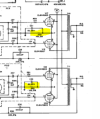
Hi all! received an Eico Tube receiver that looked pretty cool for cheap. I checked all of the tubes (same replaced in 69) and they all pass, albeit the 4 matching pairs highlighted in red appear to have more of an “open” according to my tube tester.

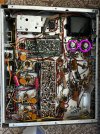
Anywho, replaced all electrolytic caps and now I’m wondering if there is general advice or biasing? I see two pots on the underside that could be turned, also highlighted, but other than that don’t have much experience with this model.

IMG_2725.jpegIMG_2724.jpegIMG_2764.pngIMG_2763.png
 
Register to hide this ad
Looks like cathode bias. Nothing to adjust. The two pots are the hum balance pots, basically adjust for minimum hum in each channel.
 
Thank you for your answer! Still learning about tubes vs transistors. Mind explaining like I'm 5 if you have the time why this is cathode bias, and what that means in terms of not needing to adjust / bias anything. Thanks!
 
Cathode bias develops from current flow across a resistor. These two on this amp

1731531049213.png

The more current that flows, the more voltage develops. The more voltage that develops, the less current will flow, so it self-regulates to a degree. Tubes control current by having the grid negative relative to cathode. The cathode can be grounded at 0v and a dozen or so volts negative supplied to the grid, or the grid can be tied to ground through a resistor so it sits at 0v, and the cathode above ground by 12v. Same difference so far as current flow is concerned.

there are some limits to cathode bias, the big one is that it can only compensate to a point. If the coupling caps are leaky or if a tube is really bad or severely mismatched it can't do anything about that.


there are some designs with adjustable cathode bias. Fixed bias, counter-intuitively, is more likely to be adjustable, but some amps have non-adjustable fixed bias. Fixed bias is when the grid is supplied with negative voltage, "fixing" it to some voltage relative to cathode rather than relying on current flow to develop the voltage.
 
Back
Top Bottom