
• The move to the new server is done. There are some software and database maintenance updates in process. This has us passing the hat around to help out. We appreciate any donations. Seriously, even a dollar helps. The payment page may be found here - https://www.audiokarma.org/support.html

EL86 / C6W5 tube question

Curtwheeler

AK Subscriber
Subscriber
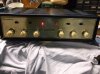
Hi. I've been working on my Dewald model N 2200 amp I've done a complete recap to original values and the amp looks like it hasn't been altered from stock. The amp calls for EL86 tubes but came with 6BQ5 tubes and actually sounds pretty good. My question is, I'd like to try some original tubes and was wondering if anyone has tried the Russian 6P43P-E tube for a replacement for a EL86 / C6W5 tube. Thanks in advance for your help. Curt
 

Attachments

  • image.jpg
    image.jpg
    77.9 KB · Views: 56
Register to hide this ad
Have lots of 6CW5s and nothing that uses them at the moment...

The 6BQ5 likes a load impedance of 8-10K, the 6CW5 more like 3K, so this won't be ideal for 6BQ5s. The bias will be near cutoff for 6BQ5 at -17V, though perhaps that's been tweaked. If you need it, I have a scan of the Sams folder - tbavis(at)rochester(dot)rr(dot)com
 
The only thing I've seen an EL86 used for was a Norelco/Phillips output transformerless "Bi-Ampli" design. The EL84 drove into the EL86, with output from the cathode of the EL86 into an 800 ohm speaker.

but yes, they are rather different tubes, though they do share the same pinout. Can't help but suspect it would behave better with the correct tubes, assuming someone has not modified the unit so that the correct tubes are now a 6BQ5.
 
Hi. As you recall my DeWald N 2200, came with 6BQ5 tubes when I got it, but calls for EL86. Today I took a really good look at the photofact sheet and compared it to my amp and everything looks the same. No signs of alterations.. I measured the voltage of the 6BQ5 tubes with a line voltage of 117 volts. I got 221 volts at the sceen pin 9 the schismatic shows 190 volts and I get a plate voltage of 263 volts pin 7 schismatic shows 235 I'm just wondering if a EL86 would work. The amp really sounds great with the 6BQ5,s I gave it another listen today. But Couldn't stop wondering what the EL86 tubes would sound like so I ordered a quad today I'll let you know what happens. Also I'm thinking of installing a thermister as my line voltage is 119 volts. If you guys have anything to say I'd appreciate it as I am trying to learn Thanks. Curt
 
Hewlett Packard used these tubes in one of their audio signal generators. Apparently the tubes offer very low distortion.
 
Check the bias voltage before installing 6CW5s - grids should be about -17V. With 6BQ5s, it's probably best to connect an 8 Ohm speaker to the 4 Ohm terminals, is that will present a better match to the tubes. I think voltages are high because 6BQ5s will draw very little current at -17V bias.
 
Tubes for DeWald

Thanks. Tom. But the 4 ohm speaker connection isn't a option the DeWald only has 8 and 16 ohm speaker taps. I know this is a newbie question but what is the correct way to check the grid voltage when I install the correct EL86 tubes.
 
Pin 1 or 2 on each output tube should measure around -17VDC to ground - around -10V would be optimum for 6BQ5s (though the transformer isn't...)
 
EL86 tubes

Ok. The grids with 6BQ5 tubes are -8.1 volts. That probably explains why the power transformer runs so cool. I guess I should have ask how is the correct way to match the EL86 tubes when I get them. Thanks again. Curt
 
Last edited:
EL86 tubes

Ok. The grids with 6BQ5 tubes are -8.1 volts. I guess I should have ask how is the correct way to match the EL86 tubes when I get them. Thanks again. Curt
 
There should be -26V at the junction of the bias rectifier and first cap. Then there's a resistor divider that sets grid bias. Either a resistor has been changed or the value has drifted considerably - like doubled... Original values should give -17V.

Oh, and I should mention that a $5 Harbor Fright meter will read low at the grid since it's only 1 meg input. The 270K grid resistors will drop a portion of the voltage, much less so with a 10 meg meter.
 
Last edited:
Would the grid voltage be low becouse of the 6BQ5 tubes. And ,How did you know I was using a Harbar freight meter, only mine was free. Guess you get what you pay for. Time to look for a upgrade any suggestions?
 
The 6bq5 tubes won't cause the grid voltage to be any different. There is no appreciable current draw there. A leaky coupling cap could do it, but if all tubes read the same, thats not likely.
 
All voltages the same and all new coupling caps. Also checked most of the resistors against the photofact but with my harbor freight meter. I will be getting a better multimeter soon. And recheck voltages.
 
DeWald N2200

Well. I got a better multimeter and some Amperex 6CW5 / EL86 tubes. I still had -8 volts at the grid. So I got out the schematic and noticed that the C6 electrolitic capasitor 50 uf 25 volt was wired negative to ground. I had replaced it the way it was with a 50uf 50 volt. It should be positive to ground. The C5 capasitor was correct positive to ground same values. Now I have -17 volts at the grid and 230 volt at the plate or pin 7 of the 6CW5. Apparently a previous owner did this to run 6BQ5 tubes. It did play and sound very good, but I don't know how long that cap would have lasted. I wonder how common this was. Also I put in two CL-80 thermistors on both legs of the power line. The voltage dropped from 120v to 112v and I get a slower worm up. I really haven't had a chance to listen to it much with the 6CW5 tubes as it's getting late. But I think it sounds pretty good. I'll report back later. Heres the part of the schematic I'm dealing with.
 

Attachments

  • image.jpg
    image.jpg
    75.4 KB · Views: 56
Hi I just wanted to add that I have the complete phtofact folder for the DeWald N2200' in my album in my Public profile. Thanks
 
Backwards bias filter cap is really common. I know I've done it more than once. Too easy to get into the habit of tying negative to chassis. They do not last long. One I did got hot within minutes. It didn't go bang, but I threw it out. I figure any time a cap has been run long enough to get hot, it had to have been damaged. For the $2 a replacement costs, its not worth baking my output tubes if the bias supply goes TU.
 
Backwards bias filter cap is really common. I know I've done it more than once. Too easy to get into the habit of tying negative to chassis. They do not last long. One I did got hot within minutes. It didn't go bang, but I threw it out. I figure any time a cap has been run long enough to get hot, it had to have been damaged. For the $2 a replacement costs, its not worth baking my output tubes if the bias supply goes TU.
. This is very strange,and I don't mean your comment. Because it had 6BQ5 tubes in it when I got it and it sounded good after recap. But I new it had the wrong tubes. Then I started checking voltages and discovered the reverse cap. Just out of curiosity I tried the 6BQ5 tubes after I switched out the cap and it barely played So it seems it was done intentionally to use 6BQ5 tubes. Also the cap in question looked like the original. Anyway it works. :banana:
I got this amp for a inexpensive learning project and it proved to be one. Later today I'll get a chance to listen to it. thanks for your comments. Curt

</div>
</body>
</html>
 
FWIW, I really like the 6CW5, especially when paired with Lafayette iron. Kinda like the 6AQ5, it's sounds a lot bigger than it is. IMHO the 6CW5 makes great, tight, bass.
 
Possible it was purposely reversed to drop the voltage, but thats a fairly bad way to go about it. The better way is to use a dropping resistor rather than to purposely install a cap in such a way that its bound to have a considerably reduced lifespan.
 
Back
Top Bottom