• The move to the new server is done. There are some software and database maintenance updates in process. This has us passing the hat around to help out. We appreciate any donations. Seriously, even a dollar helps. The payment page may be found here - https://www.audiokarma.org/support.html

Elekit TU-8900 kit 300b/2a3 SET amp - mods

bhairavi

AK Subscriber
Subscriber
I have an Elekit TU-8900 that sounds fantastic. I want to do a couple of mods and have technical Qs.

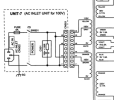
Here are the schematics:


1. It's the Japanese version, so 100V. Since this amp uses less than 100 watts, I plan to install a small Nissyo TP-811 stepdown transformer inside the chassis, and reroute the wiring. Is there anything 'wrong' with this, from a safety standpoint, as long as everything is insulated? There's plenty of space inside the chassis away from the tubes.

This is the model of stepdown: https://nicologyjp.com/products/nis...mer-from-ac110-130v-to-ac100v-up-to-110-watts

I have already opened it up to take a look - just a big toroid in a plastic case.


2. I'm making a new hardwood faceplate, and I wish to add a 12v 70 mA incandescent bulb to the front. Can anyone identify a good place for me to take off power for the bulb? It's incandescent so flexible with the voltage.
 
Register to hide this ad
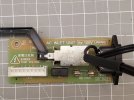
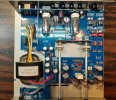
Well no one said anything, here goes- inverted the outlet and basically stuck the Nissyo in the middle. Kept the ground though unused on the cable. I'll tidy it up once I'm done with the other mods.


Anyone have recommendations for places on the circuit where I could add the bulb?
 
Last edited:
Can the Nissyo handle the current? It looks like the power transformer has 115v primaries as well.

1762824608314.png
 
Spec for max power is 95W. 110VA should be fine, no?

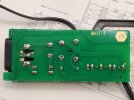
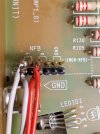
But interesting what you said about primaries. Is there some way to tap it? Here's what the circuit board looks like for that 9 pin connector, with pin#9 being at extreme left:


20251110_175338.jpg

It looks like #4 orange and #9 yellow are unused (but the respective wires are coming from the transformer). Could I just disconnect the 100V wires and jumper pins 8-9 and 3-4??


(Update for posterity for anyone reading: yes, this is all that is needed to make the amp work on N American mains voltage)
 
Last edited:
Man this is 'big if true'! And it seems like it is... I'm going to jumper the connections on the PCB. I took out the 100v taps from the molex connector.

Do you guys think the fuse needs to be changed? 4A/125V


17628283460145290343945324198597.jpg
 
Last edited:
I would have thought - being an ELEKIT "kit" sold internationally - the amp would be able to be easily wired for either 100V, 110V, 230V or 240V somehow.

Of course, I am sure you will likely have exhausted this line of thought, but it surprises me if you cannot make the conversion more simply than installing a step-down transformer... o_O
 
Last edited:
So there's some drama regarding the N American importer/dealer for Elekit doing a lot of the work translating their documents and then later on they turned around and made a deal with someone else to import. I don't know much else about it, but the guy who did the translation and is still the importer for the Canadian market specifically says he does not support the Japanese origin - the main thread about this amp in the diyaudio forum is his. I suspect that he did not know, or is keeping under wraps, the fact that the even the kits that are bought from Japan (as mine is) have transformers that will work on US mains voltage. He would not give me English language documents for the kit for the same reason. Very well, I still bought direct from Japan because it ended up being much cheaper - all told about $700 cheaper. Which was more than enough to get a couple RCA 2a3s and Sylvania 12bh7s.
 
Last edited:
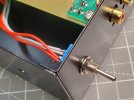
This amp has an option to turn negative feedback on or off. It's a jumper adjustment, but it requires you to take out the tubes and unscrew one of the plates. Following some other folks, I threw a DPST switch in, and routed it to the rear of the unit.

20251110_200310.jpg20251110_200335.jpg
 
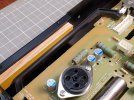
One thing that bugged me about this amp is that the power button felt very clunky --literally. It kinda thunks and makes a hollow sound, and there was a lot of give in it before it actuated. So I double taped in a strip of wood, which makes this long plastic arm snug against it, resulting in zero flex and a much more solid feel.


20251110_201320.jpg


I'll be turning a wood power button once I figure out how thick the hardwood face is going to be. The face itself is actually quite good. A solid chunk of aluminum, but I want a different look.
 
Last edited:
Spec for max power is 95W. 110VA should be fine, no?

But interesting what you said about primaries. Is there some way to tap it? Here's what the circuit board looks like for that 9 pin connector, with pin#9 being at extreme left:


View attachment 3631674

It looks like #4 orange and #9 yellow are unused (but the respective wires are coming from the transformer). Could I just disconnect the 100V wires and jumper pins 8-9 and 3-4??
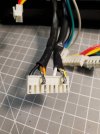
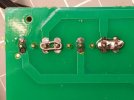
Went ahead and jumpered:

20251110_184918.jpg
 
Well crap, I guess I don't understand how transformers work, or something's up.

Hooked up just the transformer to mains after modifying the pcb, and the voltages on the secondaries are all high - 248 instead of 220, 100 instead of 90, etc. Basically the multiplier between 100v and 120v...

(Update for posterity, this is just what happens when secondaries are unloaded)
 
Last edited:
Although it's a completely different animal, I upgraded a TU-8500 a bit but haven't laid hands on an 8900. Fwiw, some things I did were upgrade the IEC inlet to a gold-plated copper one, installed an Aucharm silver fuse and cut all the connectors off the wires and shortened/ soldered them directly to the board. I also installed Mill-Max gold plated opamp sockets and swapped the phono opamps around a few times and upgraded all film caps to polypropylene and added some polystyrene. Upgraded tube sockets to heavier-duty gold plated types. Vintage CONN organ tubes sounded the best of all the ones I auditioned. I bet that 300B sounds very, very nice. Good luck with it.

20240125_092035~2 (2).jpg
 
Last edited:
I UN-modified the amp and using 100V, re-checked voltages on secondaries without load, and they are similarly high, though the multiplier is different. Then I checked the load-voltages, and they are very close to spec.

So now I am going to go ahead and RE-modify the pcb, disconnect the 100V primaries, reconnect to mains voltage and power up, and check voltages under load.

Wish me luck.


@onanysunday handsome amp!
 
Well.. not sure what's up.

After disconnecting the 100v primaries and connecting the 115v primaries, I tried bringing it up on DBT with no luck. DBT would cycle bright. Clearly amp was not happy. Not sure what's up, but it may have something to do with the designation of the transformer. I've noticed my transformer's designation is A4J2P where what people internationally get is some variant of Axx3P. Suspect there might be winding differences, I don't know.

I found pictures of the 115V inlet and it is functionally exactly the same as my modification to the 100V unit. Also when connected to 100V, each primary shows the correct voltage (100V primaries are 100V, 115V primaries show 115V).
 
Last edited:
Alright it looks like something happened to the 2a3s. Sad day. Not sure if they saw too much voltage or what, but judging from the DBT, it seems like they are shorted. There was no arcing but there was a hum/metal sound whenever I would turn on the amp with the 2a3s in, and the DBT would brighten/dim cyclically. The resistance across pins 1-4 is 0.4 ohms.

When I took them out, everything returned to normal.
 
Last edited:
Back
Top Bottom