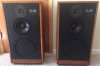
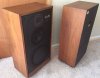
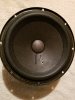
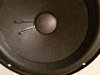
That was a really nice write-up of a restoration project, and the quality of the work is superb. The decision to stay with original cap value is a good choice, and the correct foams and new posts are well executed. My only question, and possible disagreement, is that if you have basically bought into the notion of the original design, why would you feel a desire to abandon the switch circuit which was originally included for a specific purpose? And no close-up pics, front or back, to show type and operation of switch? I see people doing this all the time with EPI's, and I know Huw recommends this, but I just don't get it. My early EPI-100's have the original rotary control, and I think it is great to have this feature in order to adjust for varying interior environments.
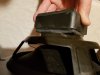
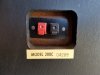
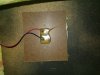
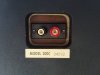
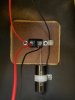
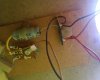
Thanks for the compliments on my workmanship and strategy! As you requested, I'm posting a picture of the tweeter switch, both front and back. Your question about the tweeter adjustment switch is a very good one, and I'd be happy to explain my thought process. The decision to bypass this feature was not taken lightly, as I am very persnickety about keeping things "stock".
Pragmatic reason: I have heard anecdotal stories claiming that of many of the speakers in this era added a tweeter switch simply as a marketing ploy, for showroom appeal--Not that it didn't do anything, but just that it wasn't really needed. Presumably the "neutral/flat" position represents the intended design position for the tweeter. The switch offers only attenuation of the tweeter (-3db, -6db). Since I have nothing special or unusual with my listening room (living room), I didn't expect to need special attenuation of the tweeter.
More on this point: I am running these things with a variety of mid-to-upper level vintage receivers, all of which have multiple settings on the tone controls (ranging from high boost/cut, to selectable frequency band, to full-blown equalizer). In nearly all cases, I find myself listening to most music in the "neutral/flat" position. So, I really didn't expect to need tweeter attenuation unless they turned out to be unusually "hot".
Lastly, there is the allegation that the switches are troublesome, and offer additional places for signal loss and/or bad connections.
Practical reason: The tweeter switch (and original crossover cap) are on the BACK of the speaker baffle, and up high. You need to stand on your head, and use mirrors to see it, let alone work on it. I had a hell of a time, just getting a photo. Not sure I could have done a nice neat job of installing and soldering the components.
So, that was my strategy. By the way, when I "removed" the switch from the circuit, I did not cut or remove ANYTHING from the switch circuit, including the original 16uF capacitor. In fact, I never even removed the original (thin) wiring. I just clipped it at the binding post, rolled the wire up, and chicken-banded it to the tweeter switch board. So, if someone was so inclined, they could easily reconnect the entire original circuit (or connect the new wiring to the tweeter switch). Thus, if I find the finished product to be in need of a selectable tweeter switch, I do have the option to go back inside and "refurb" the switch circuitry.
By the way, I'm at a loss as to how to fix my pictures so that they do NOT show up upside down or sideways. Argh!