

You are using an out of date browser. It may not display this or other websites correctly.
You should upgrade or use an alternative browser.
You should upgrade or use an alternative browser.

markshan
Sir Thrift a Lot
The non-matching dustcaps would screw with my OCD.Those woofers are original. They've been re-foamed and a slightly bigger dust cap has been installed.

RTally
Speaker addict
I appreciate all of your comments I am all ears in this subject.
I assume that I will have to replace the caps due to age, am I correct?
Since the seller says the original caps are still is there, the caps should be replaced. Each speaker will have a 10 uF electrolytic cap that can be replaced with a metallized film cap like the 10 uF Audyn Q4 from Parts Express.
RTally
Speaker addict
He states he only painted the surrounding part of the tweeter.
That does not tell me anything. If he painted the surround, he ruined the tweeters.
Around the concave part of the tweeter there is a small inward roll before it flattens out onto the frame. Considering my experience with this tweeter I think the roll is effectively a surround. It can move. If this inward roll is painted it might affect the tweeter's response. And I'm still not too sure about those woofers.
The OP picture is fuzzy, but it looks like he painted the diaphram flange and the surround up to the concave diaphragm (inverted dome). If he did, then those tweeters are compromised. I would replace the tweeters if that were the case and the purchase price would have to be adjusted to account for the damaged tweeters.
If he only painted the flat part and left the concave surround and concave diaphragm original, then the tweeters are only cosmetically compromised.
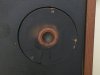
Here is a pic of my original, untouched masonite tweeter on my EPO 100. Notice the ring around the concave diaphrame (inverted dome). That concave ring is the surround and must not be painted.

1Toolfan
Active Member
Is t
Is thus a fairly easy procedure?
Since the seller says the original caps are still is there, the caps should be replaced. Each speaker will have a 10 uF electrolytic cap that can be replaced with a metallized film cap like the 10 uF Audyn Q4 from Parts Express.
Is thus a fairly easy procedure?
1Toolfan
Active Member
If i
If I move on these I will replace them, or can I remove the paint without damaging the integrity of the tweets, or is it a done deal, just replace them?
That does not tell me anything. If he painted the surround, he ruined the tweeters.
The OP picture is fuzzy, but it looks like he painted the diaphram flange and the surround up to the concave diaphragm (inverted dome). If he did, then those tweeters are compromised. I would replace the tweeters if that were the case and the purchase price would have to be adjusted to account for the damaged tweeters.
If he only painted the flat part and left the concave surround and concave diaphragm original, then the tweeters are only cosmetically compromised.
Here is a pic of my original, untouched masonite tweeter on my EPO 100. Notice the ring around the concave diaphrame (inverted dome). That concave ring is the surround and must not be painted.
View attachment 2705352
If I move on these I will replace them, or can I remove the paint without damaging the integrity of the tweets, or is it a done deal, just replace them?
Last edited:
RTally
Speaker addict
Is thIs thus a fairly easy procedure?
If you can handle a soldering iron, easy peasy. If not, this is a good time to learn. If you do not want to learn to solder, you can cut the old caps out, leaving as much of the capacitor leads as possible. You can then use wire nuts to connect the new caps to the original leads that were left in place.
To recap, you need to remove the woofer, pull out the fiberglass insulation (wear long sleeve shirt and nytril or rubber gloves), store the fiberglass fill in a clean garbage bag. The capacitor is at the back panel near the speaker terminals. I also replace the original spring clip speaker terminals with 5-way binding posts.
RTally
Speaker addict
If I move on these I will replace them, or can I remove the paint without damaging the integrity of the tweets, or is it a done deal, just template them?
Hard to say without personally inspecting them. Depends on the paint used and how thickly it was applied. If you are lucky, the paint may not have adhered well to the surround if it was painted.
Generally, the best way to remove paint is with a solvent. But the tweeters are put together with glue, so any solvent strong enough to remove the paint will likely soften the glue holding the tweeter parts together.
Mechanically removing the paint, such as by scrapping, will be difficult if not impossible. The tweeter diaphragm and surround are delicate and small.
I don't understand what you mean by "just template them."

So since you're close, first check the tweeters for the above suggestions - if there's paint on the corrugated part they probably won't perform the same as the original. Also ask the seller to pull the woofers. Look for a 4" or so square magnet with a production date sticker (should be somewhere in the mid-70s).
Dayton 10 uF caps are about $3 on PE. They work great. You can soften the glue gently or, as I did, muscle the old ones out with a screwdriver.
I still think you should get a more unmolested pair of these fantastic speakers though. eBay has tons of them right now some looking very original.
Dayton 10 uF caps are about $3 on PE. They work great. You can soften the glue gently or, as I did, muscle the old ones out with a screwdriver.
I still think you should get a more unmolested pair of these fantastic speakers though. eBay has tons of them right now some looking very original.

Since the seller says the original caps are still is there, the caps should be replaced. Each speaker will have a 10 uF electrolytic cap that can be replaced with a metallized film cap like the 10 uF Audyn Q4 from Parts Express.
In general I prefer the Audyn Q4 to the Dayton for a few bucks more. YMMVDayton 10 uF caps are about $3 on PE. They work great. You can soften the glue gently or, as I did, muscle the old ones out with a screwdriver.
Considering the long production life these speakers enjoyed it is probable the amount of hot glue holding the caps varied over time. On mine the extent of the glue prohibited the pure muscle approach, others maybe not so much. In addition to the cap the base of the binding clips was also deeply buried.