• The move to the new server is done. There are some software and database maintenance updates in process. This has us passing the hat around to help out. We appreciate any donations. Seriously, even a dollar helps. The payment page may be found here - https://www.audiokarma.org/support.html

EQ and DSP added to rated Frequency Response

22frank

Active Member
Bose 901 EQ.jpg

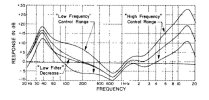
This is an example of the Bose 901 "equalizer" that the 901 came with to sound passable. Is this what the new "Klipsch" dsp box does to the Klipsch Jubilee, Klipschorn & LaScala loudspeakers to make them sound passable?

When a Company or individual DIYer states Frequency Response how can EQ or DSP be added to the results? It would seem that any old conglomeration of components could be made to look wonderful as far as stated frequency response.
 
Register to hide this ad
Yes it is easy to add tone controls, EQ, loudness contour & DSP to a system, but should these be part of the stated response?
 
Iirc, Klipsch adds a lot of gain to the low end, particularly on the Jubilee and AK series; they’re somewhat limited with the AL-6

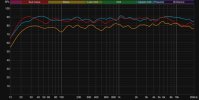
Heees how my 3-way horns read:
SPLlrl+r.jpeg
I used to be a smiley face eq kid, but this sounds just right to me.
 
Thanks for posting your response graphs as above, but my question is - what would it be without the DSP?

Looking back in the "past" the Klipschorn and LaScala used a single inductor to bring down the rising response of the
woofer. The Klipschorn folded path did a better job than the LaScala on it's own. (extra folds)

Klipschorn.png


If you remove the 2.5mH coil the bass unit still sounded OK .

Then came the experiment to make a "better" bass unit, eventually named 1st gen Jubilee. The passive needed so many parts
I couldn't describe what was being done to the natural response of the two woofers used.


1st Gen Jubilee.png


You have, from what I can see, used the back movement of the woofer to drive a passive radiator not a port. How did it measure without the DSP?

Late to edit in but you would need a lot more sub bass level to be able to perceive it in to relation to the mid range?
 
Last edited:
Yes it is easy to add tone controls, EQ, loudness contour & DSP to a system, but should these be part of the stated response?
I don’t know, probably just a matter of opinion. I try to avoid the use of DSP if possible. But have a few sets of speakers that require it to sound good. For example, a set of Lii Song Silver 8s in Caintuck baffles. They were designed to go in a box, but sound spectacular when DSPed to tame the highs and blend with a couple of open baffle subs.
 
sound spectacular when DSPed to tame the highs and blend with a couple of open baffle subs.
Yes it may sound better, but should the DSP result be part of the stated frequency response, and you needed "subs",
because your mains lacked enough bass.
 
Yes it may sound better, but should the DSP result be part of the stated frequency response, and you needed "subs",
because your mains lacked enough bass.
Well this was a DIY project and I’m not selling anything, but get your point on commercially sold speakers.
 
And sorry, I didn’t notice this is in the Klipsch forum before responding.
 
"About 1/2 of what you read on the internet is true......problem is knowing which 1/2!!"

No worries it is all made up LOL
 
The only excuse for passive crossovers is their low cost. Their behavior changes with the signal-level-dependent dynamics of the drivers. They block the power amplifier from taking maximum control over the voice coil motion. They are a waste of time, if accuracy of reproduction is the goal.

Siegfried Linkwitz

Chris
 
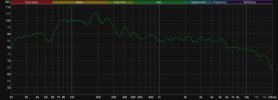
This is what it looks like without DSP.
spl.jpg

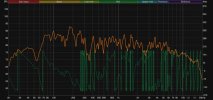
more importantly, here's the phase alignment:
SPL Phase passive.jpg

I don't have a time or group delay measurement with passives, but in general here's what you'll get: the sound is ok, and if you'd not heard a pair of horns that are time and phase aligned, you might think it sounded pretty good. However soundstage and imaging are almost non-existent. Music comes from the right speaker and the left, there's no illusion of sound emanating between, beyond, fore and aft of the speakers, it just comes from the speakers and it;s a little honky and resonant. If you have passive LS or KH, you're familiar with this; you may even think you like it. It doesn't sound great.

Using DSP, you can not only flatten the response and ameliorate resonances, but you can time and phase align your speakers. When this happens, it becomes magical. In my room, the speakers begin to disappear; when I close my eyes, I hear sound from the right and left, as well as the center, with instruments and voices seemingly appearing in a soundstage in and beyond the bounds of my living room. I had some buddies over to spin vinyls one night when my partner was out with the the gals; one of them described my setup as "full-body headphones." you simply cannot get that experience with a passive crossover.
 
This is what it looks like without DSP.
View attachment 3530029

more importantly, here's the phase alignment:
View attachment 3530030

I don't have a time or group delay measurement with passives, but in general here's what you'll get: the sound is ok, and if you'd not heard a pair of horns that are time and phase aligned, you might think it sounded pretty good. However soundstage and imaging are almost non-existent. Music comes from the right speaker and the left, there's no illusion of sound emanating between, beyond, fore and aft of the speakers, it just comes from the speakers and it;s a little honky and resonant. If you have passive LS or KH, you're familiar with this; you may even think you like it. It doesn't sound great.

Using DSP, you can not only flatten the response and ameliorate resonances, but you can time and phase align your speakers. When this happens, it becomes magical. In my room, the speakers begin to disappear; when I close my eyes, I hear sound from the right and left, as well as the center, with instruments and voices seemingly appearing in a soundstage in and beyond the bounds of my living room. I had some buddies over to spin vinyls one night when my partner was out with the the gals; one of them described my setup as "full-body headphones." you simply cannot get that experience with a passive crossover.
In addition with dsp from what I understand is you get more dynamics, more efficiency, and you can mix amplifiers for a different taste in sound. You can also size your amplifier per driver , so you can have a 200w to the bass and only a 50w to the treble if you want. The only downside to me is that now you have more amps, which means it costs more, and takes up more space...unless you go to plate amps.
 
In addition with dsp from what I understand is you get more dynamics, more efficiency, and you can mix amplifiers for a different taste in sound. You can also size your amplifier per driver , so you can have a 200w to the bass and only a 50w to the treble if you want. The only downside to me is that now you have more amps, which means it costs more, and takes up more space...unless you go to plate amps.
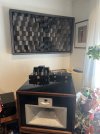
My amps:
IMG_9564.jpeg
They fit neatly on each speaker. All things considered, I don’t have too much in them. $300 each for the class d amps after rolling the op amps; I’ve a bit more in the tube amps after rolling the tubes replacing the capacitors with better grade and converting them to mono. The class D amps are stupid good for the money and oven better with the right op amps. While I have more in it than the average vintage receiver, I’ve spent remarkably little for the sound it delivers.
 
This is what it looks like without DSP.

Thanks for your posting the curves, also for being so enthusiastic about your system..
The most interesting reading was the part about the sound stage opening up.

The first Klipsch speaker I got was the LS-BR LaScala. Purchased new in 1975 specifically for use as a center
channel. Recently I downsized my system, and like yourself built a better loudspeaker for my still center channel.

I use an older Bob Carver preamp/tuner to drive QSC smps. The Carver has the Sonic Holography feature.
That does sort of work with some programing if you are seated in the correct spot. Nothing like your alignments!

My avatar is a 2 way horn using an Altec 811 and a 4 ft high fiberglass horn with a 15inch driver. Drivers are physically
time aligned, straight on only - side to side it is terrible.
 
Last edited:
My amps:
View attachment 3530730
They fit neatly on each speaker. All things considered, I don’t have too much in them. $300 each for the class d amps after rolling the op amps; I’ve a bit more in the tube amps after rolling the tubes replacing the capacitors with better grade and converting them to mono. The class D amps are stupid good for the money and oven better with the right op amps. While I have more in it than the average vintage receiver, I’ve spent remarkably little for the sound it delivers.
I switched from Icepower 50asx, and 125asx amps to 3 Fosi v3 monoblock amps (3) per channel and I was shocked how much better the newer fosi amps were. Best sound I have had for such a small inexpensive amp!
Did you try the Fosi non tube amp on the horn too, or just the Fosi tube amp? If you did, can you tell me how it changed the horn sound...just curious as I have never run tube amps on my setup.
 
I switched from Icepower 50asx, and 125asx amps to 3 Fosi v3 monoblock amps (3) per channel and I was shocked how much better the newer fosi amps were. Best sound I have had for such a small inexpensive amp!
Did you try the Fosi non tube amp on the horn too, or just the Fosi tube amp? If you did, can you tell me how it changed the horn sound...just curious as I have never run tube amps on my setup.
I’ve just used them on the bass and treble horns, but i suspect I’d have no problem with them in the mids. I do like the tubes on the mids, it’s warm and detailed, with excellent imaging. I’d run one amp in stereo and decided I liked it enough to get a second and upgraded it to match.
 
Last edited:
...Is this what the new "Klipsch" dsp box does to the Klipsch Jubilee, Klipschorn & LaScala loudspeakers to make them sound passable?
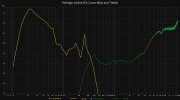
The Heritage Jubilee (with internal bass ports) has a similar sort of "smiley" EQ. Here is a plot of the output voltage of the Klipsch-provided DSP box (without external API adjustment that's available to the owners). Note that the bass bin is actually EQed so that it has flat response while being positioned in-room away from the room's walls (at least 3-4 feet). If the bass bin is closer than this, the bass EQ below ~60 Hz must be changed to significantly reduce that big bass boost, otherwise the bass response in the deep bass region below 40-50 Hz will be unbalanced (too much):
Heritage Jubilee EQ Curves (Bass and Treble).jpg

The La Scala AL6 with tri-amped DSP option and Klipschorn AK7 with tri-amped DSP option both use a new controlled directivity midrange horn and (I believe) a new tweeter. They both come with passive crossovers, and have the option of being upgraded via the DSP kit that Klipsch sells (for a price). It has been noted that the DSP tri-amp option blows away the passive crossover version in listening trials. Since I wasn't there, I can't personally attest to the magnitude of the difference, but I can say that my efforts tri-amping a Belle center loudspeaker between two TAD-4002/first gen Jubilees was like the difference between the living and the dead. When I first got the Belle pair, after listening to one of them using only passive crossover between the Jubilees in my listening room, I was ready to sell them. Only after I tri-amped and EQed/time aligned them did the Belle start to become useful in the setup.

The Heritage Jubilee bass bin is "cheating" in that it is losing sensitivity below 70 Hz (as can be seen in the EQ plot above). The Celestion Axi2050 on a K-402 also loses sensitivity as the frequency increases above ~2.5 kHz. These are not new revelations.


When a Company or individual DIYer states Frequency Response how can EQ or DSP be added to the results?

All controlled directivity horns (i.e., midrange and tweeter) require EQ. That's just physics.

But the question you really should be asking is: how much sensitivity loss in the driver is acceptable across its operating band, and does this limit the output of the entire loudspeaker. In the case of the Heritage Jubilee, that big EQ boost is a bit too much (IMO). The solution is to place the loudspeakers much closer to the corners of a room (or at least place them with their backs touching the wall)--then re-EQ the loudspeakers individually.

Otherwise, the listening performance of these EQed-flat loudspeakers (and time aligned--unlike any of the other Klipsch Heritage loudspeakers) far exceeds in terms of sound quality their predecessors.

Things change over 59 years, and one of the biggest changes that has significantly increased the sound quality of loudspeakers is in the area of in-room EQ and time alignment of drivers/horns to each other.

It would seem that any old conglomeration of components could be made to look wonderful as far as stated frequency response.
You say this as if it is a disadvantage. It's not. It's a big advantage over loudspeakers designed using only passive crossovers without DSP amplitude response EQ or time alignment/flattened phase response. The old passive crossover loudspeakers really can't be easily upgraded or even refreshed (if old drivers develop issues over time), because the passive crossovers were custom designed for those particular drivers when new. If anything changes, you've just compromised the "frequency response" (a.k.a., transfer function) of the loudspeaker.

Nowadays, you don't even need a loudspeaker company like Klipsch if you've got access to competitively priced drivers and horns that you can integrate together yourself using a DSP crossover. Suddenly, the goal of the "tinkerer" hi-fi guys is a reality: they can now switch out drivers and even horns in their loudspeakers, then measure/redial-in their transfer functions (amplitude and phase) using a high quality DSP crossover.

Things just got better...a lot better. But first, you need to learn how to do in-room acoustic measurements and how to dial-in a DSP crossover to flatten response. It's a much more straightforward process that takes mere minutes instead of days/weeks/months to modify passive crossovers, I've found.

Chris

 
Last edited:
All controlled directivity horns (i.e., midrange and tweeter) require EQ. That's just physics.

But the question you really should be asking is: how much sensitivity loss in the driver is acceptable across its operating band, and does this limit the output of the entire loudspeaker.
Thanks for your very informative posts. I do use Electro Voice Constant-Directivity mid range horns and tweeters.

In both of my rigs the midrange drivers roll off above 3000 Hz. One could cut the low mid range or boost the top
end of the midrange driver. Or simpler I added a tweeter. The top of the midrange driver I just let it roll off on it's
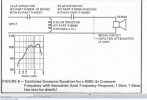
own. For the tweeter ( EV ST350B) I use the passive recommended by Electro Voice.

EV ST350B.PNG


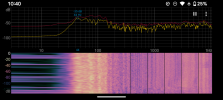
This is a phone app, so the little cell phone mike does not pick up bass frequecies well. White noise from my listening area.
I am using a Carver CT-17 Pre/Tuner will tone controls set flat.

Whie Noise.png


As far as loss of sensitivity, The system in the plot is about 110 dB/ watt, the Tweeters (3 used) are the limit of total output
SPL possible (they are really a glorified T-35 with a CD lense). One watt into the system puts very little into the tweeter.
 
Last edited:
Back
Top Bottom