• The move to the new server is done. There are some software and database maintenance updates in process. This has us passing the hat around to help out. We appreciate any donations. Seriously, even a dollar helps. The payment page may be found here - https://www.audiokarma.org/support.html

EQ and DSP added to rated Frequency Response

This thread treats DSP, EQ and Tri-amping as the same. I can honestly say I've got 90% of the performance of the tri-amped AL6 and miles above the passive AK7 with my passively crossed LaScalas and DSP with manual EQ. If nothing else, the LS needs a huge cut at ~150 Hz. I heard the same bump with the AK7, but I don't know if it was the speaker or the room. I'm using Dirac and on its own, it ruined the sound. However, using REW and making a lot of little adjustments, I got a sound that is balanced, dynamic and images well. The speakers dissapear and most people think the center channel is playing until they walk over and hear that it’s not with their own ears. My one caveat to this is that I can hear something slightly off in the upper midrange that I suspect is the overlap of the squawker and tweeter.
Eventually I'll get a MiniDSP with Dirac and use it to run subs and mains as a single channel each. If that's successful, I may try tri-amping. My point is that the new horns and ported bass bins made modest improvement compared to the EQ/time alignment. However, they had an additional $17k worth of amps and crossover to do it.
 
In my first post above I posted a graph of what the Bose EQ box might do for the 901 speaker.

In all fairness, the other day I helped a friend connect a yard sale pair of Bose 901 series 6 to his
Sony AV-720 140 watt AV Receiver.

The EQ box supplied needed a proper tape monitor loop, connected to the receivers tape loop 2 it did not work.
The other connection would need a separate amplifier, not available. (box could be DOA)

However with just the bass control set to max on the receiver the Bose 901 really filled the room with sound.
As one review states "The 901's are passable tonally if you are not in the room with them"
I don't think any time alignment is possible, perhaps how close they are to the room walls?
 
Last edited:
The speakers disappear and most people think the center channel is playing until they walk over and hear that it’s not with their own ears.

Thanks for posting about your experiences. Do you have a center channel speaker and not use it all the time?

In my system I always have the center speaker running, You don't hear it per se, It does however add to the wall
of sound.
 
This thread treats DSP, EQ and Tri-amping as the same. I can honestly say I've got 90% of the performance of the tri-amped AL6 and miles above the passive AK7 with my passively crossed LaScalas and DSP with manual EQ. If nothing else, the LS needs a huge cut at ~150 Hz. I heard the same bump with the AK7, but I don't know if it was the speaker or the room. I'm using Dirac and on its own, it ruined the sound. However, using REW and making a lot of little adjustments, I got a sound that is balanced, dynamic and images well. The speakers dissapear and most people think the center channel is playing until they walk over and hear that it’s not with their own ears. My one caveat to this is that I can hear something slightly off in the upper midrange that I suspect is the overlap of the squawker and tweeter.
Eventually I'll get a MiniDSP with Dirac and use it to run subs and mains as a single channel each. If that's successful, I may try tri-amping. My point is that the new horns and ported bass bins made modest improvement compared to the EQ/time alignment. However, they had an additional $17k worth of amps and crossover to do it.

Unfortunately, you’re not getting the full benefit of DSP if you’re not time aligning your drivers with a multi-amped setup. it makes a night and day difference in soundstage and imaging making the sound seem more like a point source speaker than a three-way with over 3 feet of distance separating the bass and treble drivers.

I have about $3k invested in my amps and crossover, but I probably could have done it for under a grand if I’d tri-amped instead of using 6 mono amps and gone straight class D and not rolled any op amps.

The Bose sound, on the other hand, while not necessarily unpleasant, is basically smearing the sound all over the room. It’s nice for background music at a party, but falls short for critical listening, as the imaging falls apart.
 
Last edited:
you’re not getting the full benefit of DSP if you’re not time aligning your drivers

As far as "time alignment" this would be better elaborated in a thread of it's own.

My interest in posting was about posted frequency response. If the tone controls should be added into the mix.

I do realize that the listening room plays a big part with the perceived sound of a loudspeaker.

For an example: The Bose company did not post frequency response for the 901. (with or without EQ box)
However Klipsch does post a frequency response for the newest Jubilee rendition. (with the EQ box) .

Perhaps my thread should have been "Should EQ and DSP be allowed to be added to the Rated Frequency Response"?
 
As far as "time alignment" this would be better elaborated in a thread of it's own.

My interest in posting was about posted frequency response. If the tone controls should be added into the mix.

I do realize that the listening room plays a big part with the perceived sound of a loudspeaker.

For an example: The Bose company did not post frequency response for the 901. (with or without EQ box)
However Klipsch does post a frequency response for the newest Jubilee rendition. (with the EQ box) .

Perhaps my thread should have been "Should EQ and DSP be allowed to be added to the Rated Frequency Response"?
I think if you just want eq, get a 31 band graphic eq and eschew the DSP. For me and many others, there’s no point to DSP if you’re not time aligning your drivers and using it to its full extent as a crossover.
 
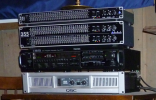
I do have the 31 band EQs in my system. I like the bass end up.

31 Band.png


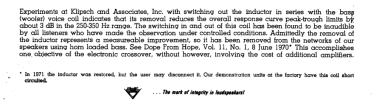
I always hear the amplifier has more control over the woofer with the electronic crossover. I see that PWK also was
aware of this. From Dope from Hope Vol 12, No 2 - Mar 9, 1972 Electronic Crossover.

VOL 12, No 2.png


Then it goes on to say the inductor was restored.
 
Last edited:
I do use a Heresy IV as center channel for movies and TV with Forte Is for surrounds. But I prefer the LaScalas in 2 channel for music. The other speakers drag down the LS. There's a 20' soundstage wall to wall. This is a dedicated multipurpose room that is heavily treated.
Yes, I agree that time alignment is a step up, but it isn't jaw dropping. I really expected more from the new models. To be fair though, I'm comparing a treated room to the hotel rooms where I heard the AK7 and AL6. If the new horns are that much better than the K400, I couldn't hear it over the sloppy bass. The AL6 had clean controlled bass and sounded really good. No doubt about it. I believe Dirac does phase alignment and while not as good as time aligned, this would help the problem. If I turn off Dirac, everything falls apart and doesn't compare with the new models. One of these days I'm going to put my tweeters (LMAHL/DE10) on stands at the back of the speakers for time alignment (or close) just to hear the difference.
I think you really need REW to make any of this work to its full potenial. Don't under estimate it. I found and corrected so many little problems along the way. I'm sure I will eventually go the tri-amp route, but I'm in no rush.
 
The Heritage Jubilee bass bin is "cheating" in that it is losing sensitivity below 70 Hz (as can be seen in the EQ plot above). The Celestion Axi2050 on a K-402 also loses sensitivity as the frequency increases above ~2.5 kHz. These are not new revelations.

So for the Klipsch Heritage Jubilee design, a really good DSP came first. Then the bass bin and 402 horn, woofers and driver.

Sort of like the Northrop B-2 Spirit, they wouldn't fly without computers/processors.
 
So for the Klipsch Heritage Jubilee design, a really good DSP came first. Then the bass bin and 402 horn, woofers and driver.
I'm not sure what you're trying to say. I have no idea what "came first". What are you trying to imply? The K-402 horn has existed since the late 1990s--and is currently in its third configuration (injection molded) design.

Chris
 
Thanks for the only reply to the initial thread question.
When a Company or individual DIYer states Frequency Response how can EQ or DSP be added to the results?

The original question includes a non sequitur in its premise--that "EQ or DSP be added to the results". All multiway loudspeakers have some form of "EQ" added to their results--in order to produce at least flattened overall amplitude response. No multiway loudspeaker that I'm aware of has exactly equal raw driver sensitivities in all the "ways" relative to each other, and all I've seen require electrical or digital crossover filters (at least) to put their passbands together without resulting in unbalanced amplitude response...if mono-amped.

All controlled directivity horns require at least parametric EQ to flatten their driver/horn response to meet hi-fi amplitude flatness needs.

Only the now-obsolete "collapsing polar" midrange horns (used in the older Klipsch Heritage models) have been designed to spill their excess acoustic output on the floor and ceiling of the listening room in order to achieve flattened on-axis amplitude response--a technique of which itself causes in-room acoustics issues. This technique in designing midrange horns is no longer used by Klipsch.

Note: I personally tried to avoid pointing this out explicitly, i.e., I would have thought that the OP would have seen where the discussion was going.

Chris
 
Last edited:
View attachment 3529802

This is an example of the Bose 901 "equalizer" that the 901 came with to sound passable. Is this what the new "Klipsch" dsp box does to the Klipsch Jubilee, Klipschorn & LaScala loudspeakers to make them sound passable?

When a Company or individual DIYer states Frequency Response how can EQ or DSP be added to the results? It would seem that any old conglomeration of components could be made to look wonderful as far as stated frequency response.
I think to answer your question, I feel the stated specifications need to be inclusive of the signal processing whether it be passive, active, or DSP. Any alterations beyond that are up to the user to compensate for rooms, equipment, taste, etc.
 
I think to answer your question, I feel the stated specifications need to be inclusive of the signal processing whether it be passive, active, or DSP. Any alterations beyond that are up to the user to compensate for rooms, equipment, taste, etc.
Thanks for your input, this is the second answer to my original post that makes sense. thanks
 
I'm not sure what you're trying to say. I have no idea what "came first". What are you trying to imply? The K-402 horn has existed since the late 1990s--and is currently in its third configuration (injection molded) design.

Chris

Tantamount to having a boat that would not float without a bilge pump.
 
Nowadays, you don't even need a loudspeaker company like Klipsch if you've got access to competitively priced drivers and horns that you can integrate together yourself using a DSP crossover. Suddenly, the goal of the "tinkerer" hi-fi guys is a reality: they can now switch out drivers and even horns in their loudspeakers, then measure/redial-in their transfer functions (amplitude and phase) using a high quality DSP crossover.
This is so true and it seems to hit very close to home on the Voxx speaker forum (or should I say Gentex?)... ah I mean Klipsch.
 
DSP is everywhere today (and has been for awhile) and most people don't even realize it. How do you think these small Bluetooth speakers can sound "so good" for being a small as they are? Small drivers with a lot of Xmax, Class D amps and DSP.
 
How do you think these small Bluetooth speakers can sound "so good" for being a small as they are? Small drivers with a lot of Xmax, Class D amps and DSP.
As long as you're not playing them very loud (i.e., less than ~80-90 dB in the peaks), these little loudspeakers perform quite well. However, modulation distortion begins to eat up the sound quality at higher SPL due to diaphragm travel (AM and FM distortion).

I believe that the OP is probably worried about this issue of what I'd call "loudspeaker headroom", but doesn't recognize that is the core issue that seems to be bothering him. But he doesn't address it directly here. There is about 20 dB of bass boost inherent in the Heritage Jubilee bass bin, but because it is so efficient and woofer driver diaphragm travel is so low--even at very low frequencies, AMD and FMD isn't an issue, even when playing back at very high SPL under DSP boost conditions. This is the part that is not recognized...that Roy has taken advantage of in his new bass bin design.

Note that almost all of Fitzmaurice's horn subwoofers require a large amount of EQ in order to reduce higher frequency output in favor of lowest frequency output--to achieve flat amplitude response in-room. He gets away with this for the same reason: inherent efficiency of the basic horn-loaded configuration--even if it's only in the 10-20% of the maximum horn-loaded efficiency boost (i.e., but still double the efficiency of playing the same woofers in direct radiating mode).

To some extent, this same principle is used by very large/somewhat efficient subwoofers (direct radiating), since their required bandwidth is narrow enough such that modulation distortion is not audible as sidebands at higher frequencies that are also being reproduced at the same time. Excessive harmonic distortion at high SPL is the Achilles heel of these large direct radiating subwoofers due to their low efficiency at the lowest frequencies (due to not having any horn loading).

Chris
 
Last edited:
DSP is everywhere today (and has been for awhile) and most people don't even realize it. How do you think these small Bluetooth speakers can sound "so good" for being a small as they are? Small drivers with a lot of Xmax, Class D amps and DSP.
How true and it’s unfortunate. We are slowly losing our abilities to truly listen and being able to distinguish natural sound from manufactured sound.
 
I can remember when it was common courtesy to hide one's lack of knowledge on a subject of interest--until such time that one can do the required "due diligence" in educating oneself...to be able to effectively contribute to a discussion.

Sadly, those days seem to be gone...

Chris
 
Back
Top Bottom