bully said:
I read it as *other* speakers are lacking when compared to the ESS.
I've only heard a few ESS models, and I remember liking them very much. Super mids and highs. Can't remember the bass, but I'm sure I thought it kept up just fine.
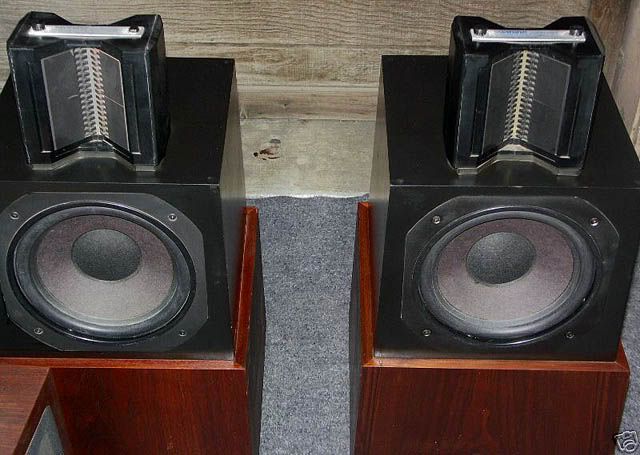
I tend to agree with you. These speakers get something of am undeservedly "bad rap". You'd think from the way some people talk that they were so bad on the low end as to be almost intolerable. That is just not true. It's more like the mid-high end is so very good, so nearly perfect, that the inherent limitations of more "regular" speakers on the low end become more evident.
It is a difficult challenge to begin with: a cone is inherently slower, and the crossover points are not ideal musically, so there have to be compromises and the result is not perfect... but it is also not horrific to listen to, either --not by a LONG shot!

The same low end, matched with a suitable midrange and, say, soft dome tweeters, would probably be praised for its warm, balanced sound (or something like that). It's a bit like the way very good speakers can show up the weaknesses in a stereo system: the AMTs are so incredibly good that they reveal the limitations of the cones thumping away beneath them.
On SOME music, YES, you CAN really hear this "weakness" that people talk about. As soon as you stop being mesmerized by how good the high end sounds, you start noticing the limitations lower down - IF you are listening to them, and especially if you are listening FOR them. On a few pieces, it does bug me just a little. With MUCH music, though, unless you are wearing "ultra-audiophile" ears, these things simply sound great!
No speakers are perfect, including the ESS speakers with the AMTs. Even then, the strengths of the AMTs put these qualitatively well past most other speakers --certainly most at sub-stratospheric prices-- at least in the mid-high range, which adds a lot to the overall musical impression. They are still VERY GOOD speakers, imperfections notwithstanding.
Half the time, I think people are just parroting what they have heard others say about these, hoping to appear knowledgable/sophisticated, so an audiophile's picky criticisms have become "mainstream knowledge" and probably exaggerated somewhat in the process. I wonder how many people who say these things have spent much (if any) time listening to these speakers?
Perhaps what people should be saying is, "with today's knowledge and developments in lower-end transducers, we cam take this already very-good, albeit not perfect, speaker and make it even better. We can choose a different compromise than ESS chose, to make what (we hope/believe) will bring us a little closer to the tantalizing near-perfection that the Heil units dangle before our ears. An already great but slightly flawed speaker can be made less flawed, more nearly perfect."
In that spirit, I'll probably be experimenting in the future with the Heil AMT by matching it up with other, faster and more acoustically-similar speakers, in line with what others have been doing with them in recent years. You know: the relentless pursuit of audio perfection; the search for acoustic Nirvana, and all that.

Technology has improved on the lower end since the Heil was invented, although arguably nothing has since beat it on the high end (!), so there is room for improvement overall. The Heil AMT is such an outstanding upper-end transducer that it deserves to have the very best lower-end to balance it as well as is technologicaly possible. ESS did a VERY GOOD job of making their speakers, just not a uniformly outstanding, let alone perfect one. No one ever has, to my knowledge, made the perfect speaker, and the ones who have come any closer, like the Infinity IRS Vs and the Von Schweikerts (spelling?) are so ungodly rare and expensive as to be out of reach of most of us mere mortals. For all their admitted imperfection, the ESS AMT speakers still represent one of the best bargains -- and arguably some of the best speakers -- in audio, period.