
• The move to the new server is done. There are some software and database maintenance updates in process. This has us passing the hat around to help out. We appreciate any donations. Seriously, even a dollar helps. The payment page may be found here - https://www.audiokarma.org/support.html

Excessive gain / volume

nottingham365

New Member
Guys/Ladies:

I have a couple of mid-fi setups with the same problem. I barely turn the volume control (a few millimeters) on the preamp and it gets pretty loud, making the volume control essentially useless. I would like to be able to make minor volume adjustments through most of the volume dial settings. Current sources are CD players exclusively. I have read that I could have a tech install one of the following: 1) resistor (voltage) dividing network before the pots in the preamp OR 2) attenuation circuit at the volume control in the preamp. I want the reduction to be effective for all line inputs. Would these options be effective? Would either be less sonically detrimental?

Any info is appreciated.

Ross


Systems:

harman/kardon hk 870 amp with harman/kardon hk 825 preamp

Adcom GFA-555 II amp with Adcom GFP-565 preamp

various CD players (Denon, NAD)

Monitor Audio GR20 speakers (pretty efficient) for both setups
 
Register to hide this ad
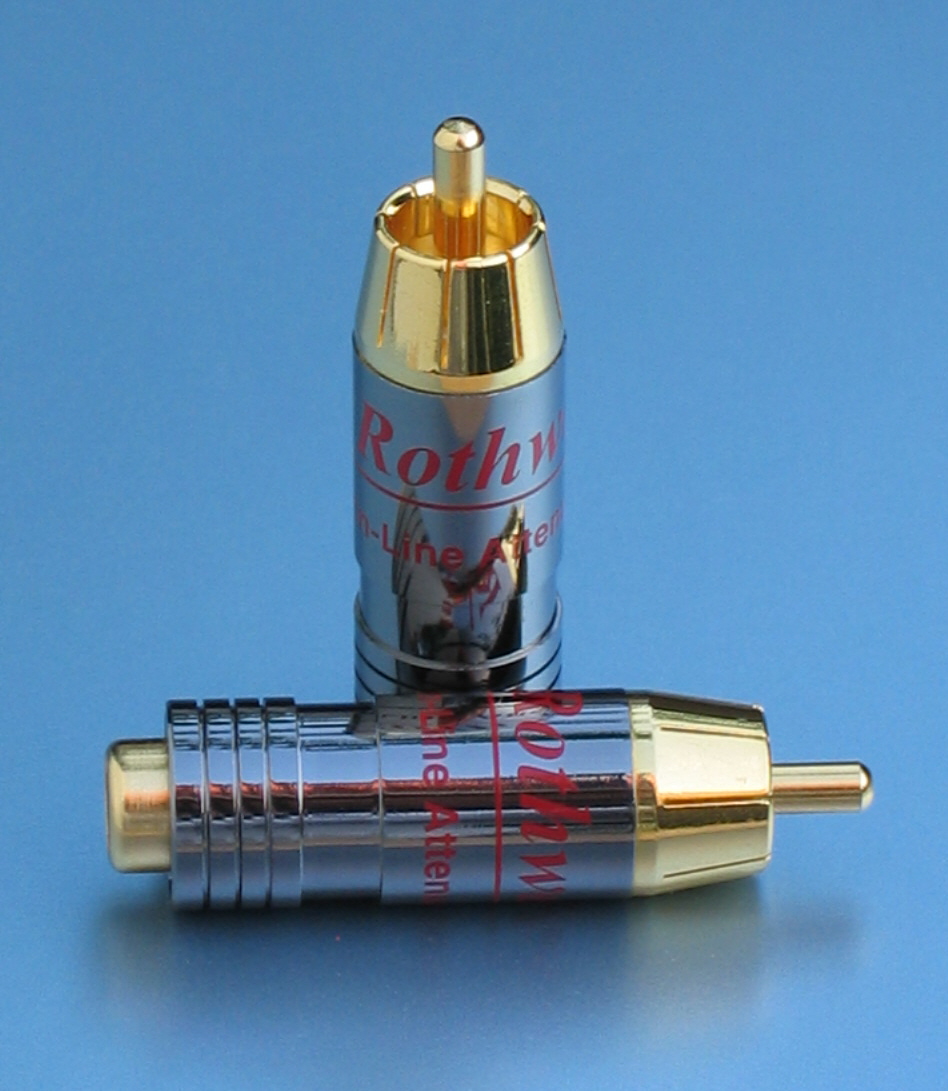
Or you could use these:
attenuator.JPG

http://www.rothwellaudioproducts.co.uk/html/attenuators.html
Btw, I know that the correct abbreviation for decibel is dB, not DB.
 
Since you're running from preamp to power amp, you'll be well served by using a pair of these at the input to the power amp. An advantage is that you'll be able to do it yourself and will leave your gear unmodified. They're available with different degrees of insertion loss.

https://www.amazon.com/Harrison-Labs-Line-Level-Attenuator/dp/B0006N41B0

Potential problem with this. If the signal levels are so high that the volume control is effectively useless, then turning it up ahead of an attenuator could drive the preamp into clipping. I'd go with resistors in series with the input terminal of the volume control. Might need to experiment for the optimum value because the resistance curve on the volume pot is most likely a log (audio) taper. Of course, if they messed up the design and used a linear taper volume pot, that itself could cause the problem.

CD players generally have notoriously high output compared to other sources. You could use the inline attenuators where the CD connects to the preamp.
 
Potential problem with this. If the signal levels are so high that the volume control is effectively useless, then turning it up ahead of an attenuator could drive the preamp into clipping.
Yes, the preamp works with a higher output level for the same listening SPL, that's true.
I'd go with resistors in series with the input terminal of the volume control.
That's doing exactly the same thing with exactly same potential problem.
Edit - you're right, it isn't doing exactly the same thing (depending on the design of the system).
We need to know what the OP's amp is. Is it even a pre/power?
 
Last edited:
Ahh, a lot more.
Yes, but you don't get a spelling mistake on the side of mine :rflmao:
Seriously though, you can email me with details of your equipment and ask for advice. I can make custom attenuators if necessary. I even answer the telephone :thumbsup:
Will you get that from Amazon?
 
Guys/Ladies:

I have a couple of mid-fi setups with the same problem. I barely turn the volume control (a few millimeters) on the preamp and it gets pretty loud, making the volume control essentially useless. I would like to be able to make minor volume adjustments through most of the volume dial settings. Current sources are CD players exclusively. I have read that I could have a tech install one of the following: 1) resistor (voltage) dividing network before the pots in the preamp OR 2) attenuation circuit at the volume control in the preamp. I want the reduction to be effective for all line inputs. Would these options be effective? Would either be less sonically detrimental?

Any info is appreciated.

Ross


Systems:

harman/kardon hk 870 amp with harman/kardon hk 825 preamp

Adcom GFA-555 II amp with Adcom GFP-565 preamp

various CD players (Denon, NAD)

Monitor Audio GR20 speakers (pretty efficient) for both setups
Sounds to me like you might have things routed through the tape loop, which on some preamps can boost the signal. I have extensive experience with an Adcom GFP-565 feeding to a GFA-555 Mk II and NEVER had an issue such as you describe.
 
I've had the same problems with some preamps with CDP's connected. My main preamp has a gain control for each channel plus a master volume control, so I can just turn the gain controls down. Another integrated amp I have has a "Perfect Level" control. Its the same thing on a dual gang pot. For the rest I use inline attenuaters. I had to go pretty high though. Why CDP's have to have such a hot output us beyond me. Another solution is to just get a CDP with level controls on the back so you can adjust the output.
 
Guys/Ladies:

I have a couple of mid-fi setups with the same problem. I barely turn the volume control (a few millimeters) on the preamp and it gets pretty loud, making the volume control essentially useless. I would like to be able to make minor volume adjustments through most of the volume dial settings. Current sources are CD players exclusively. I have read that I could have a tech install one of the following: 1) resistor (voltage) dividing network before the pots in the preamp OR 2) attenuation circuit at the volume control in the preamp. I want the reduction to be effective for all line inputs. Would these options be effective? Would either be less sonically detrimental?

Any info is appreciated.

Ross


Systems:

harman/kardon hk 870 amp with harman/kardon hk 825 preamp

Adcom GFA-555 II amp with Adcom GFP-565 preamp

various CD players (Denon, NAD)

Monitor Audio GR20 speakers (pretty efficient) for both setups
Does your CD player have level adjustments on the back?
 
Yes, but you don't get a spelling mistake on the side of mine :rflmao:
Seriously though, you can email me with details of your equipment and ask for advice. I can make custom attenuators if necessary. I even answer the telephone :thumbsup:
Will you get that from Amazon?

At almost twice as much, I would take my chances.
 
... I have extensive experience with an Adcom GFP-565 feeding to a GFA-555 Mk II and NEVER had an issue such as you describe.

I think the issue is that he does not like the way normal volume controls work on preamps, where, with most sources and in most situations, one typically never turns the volume up more than about halfway, thus making it seem like the second half of it is useless. Of course, if he had an unusually low level signal, he may then use that part of the range of the control and not feel like there is a problem.

He might like a feature on some of the old preamps (as separates or as part of integrated amplifiers or receivers), that is a switch that reduces the volume by a set amount (often, 20dB, but it can be another amount), and then one would have more flexibility in how one turns the volume knob. Typically, the feature was used to reduce the volume when the phone rings or someone comes to the door, so that one could speak with someone over the sound while not completely shutting off the sound, and then one could easily restore the volume to the original level when one was done talking. It is a nice feature on my old Pioneer SX-1250 (the switch is on the far right, right next to the volume control, making it easy to find), that I very much like for that sort of purpose. But one could engage the reduction so that one could turn the volume knob higher, if that is what one wanted to do. Of course, then one would want to be careful not to accidentally flip the switch and increase the volume setting by 20dB when was listening to loud music.

Remember, he regards the volume control as a problem on both of his preamps, which makes it exceedingly unlikely that we are dealing with a malfunctioning unit, and are instead dealing with someone who does not like how preamps are generally made.
 
I think it's just weird that it is happening to both preamps and power amplifiers at the same time. Kinda rare that two different systems/brands exhibit the same problems. :idea:

I have never really encountered this problem unless I was accidentally using the phono inputs. :rflmao:

Is it possible to show us your set up and how it is connected?
 
Any info is appreciated.

Well, Ross, I know that problem, as I encountered it with my own hk825/870 over 30 years ago. Basically, if one doesn't want to modify one's equipment (or have it modified), one has two to four alternatives, where to apply the external voltage division/attenuation:

- between each line-level source and pre-amp; main advantages: pretty fool-proof operation, customisable voltage division/attenuation per source & no loss of inputs; main disadvantages: as many voltage dividers/attenuators (or respectively voltage divider/attenuator cables, 'cause personally I prefer to integrate the voltage division/attenuation (= 2 resistors per channel max. - or 1 resistor per channel, if one can work with the input impedance of the target device) right into the interconnect in order to avoid extra adaptors...) as "too hot" sources required & not easily defeatable;

- between pre- and power-amp; main advantages: pretty fool-proof operation, works for all inputs & no loss of inputs; main disadvantage: not easily defeatable;

- into a free tape-loop; main advantages: easily defeatable & works for all inputs; main disadvantages: loss of one tape-loop, not quite as fool-proof operation, requires either a classic tape-loop with monitorng funtion or a classic record selector design & may not work in combination with every pre-amp function (like for example a source-direct function, that disables the tape-outs);

- into a free processor-loop; main advantage: works for all inputs; main disadvantages: not easily defeatable in case of a non-switchable processor-loop, not quite as fool-proof operation in case of a switchable processor-loop, loss of the processor-loop & and may also not work in combination with every pre-amp function (like for example a source-direct function, that disables the processor-loop)

Quite possible disadvantage (compared to a device modification for lower gain) in any case: increased output impedance.

In my own case back then I chose to make a custom interconnect with integrated voltage division to go between the hk825 and hk870, as I needed both tape-loops for other devices and the attenuation to also work for the phono inputs.

Greetings from Munich!

Manfred / lini
 
I barely turn the volume control (a few millimeters) on the preamp and it gets pretty loud, making the volume control essentially useless...

harman/kardon hk 870 amp with harman/kardon hk 825 preamp
I checked the specs for that pre/power and the power amp's input sensitivity is quoted as 1V. The preamp's line input sensitivity is quoted as 130mV for 1V output. A CD's player's output is 2V, which is 24dB more than 130mV.
You could use a pair of attenuators at the inputs of the power amp to get more usable travel on the volume control. Alternatively, you could use a pair of attenuators on the line inputs to the preamp and also get more usable travel on the volume control.
The first way will give you a slightly improved signal-to-noise ratio but reduce headroom in the preamp. The second will maintain the preamp's headroom and may even extend it, depending on how the preamp is designed. I suggest you try the attenuators in both locations to see which you prefer.
 
If the problem were just with the HK set, I might be inclined to think that it may have something to do with the rated 1 volt output on the HK825. But he also does not like the Adcom with the 2 volt rated output:

https://www.manualslib.com/manual/206154/Adcom-Gfp-565.html?page=15#manual

Also, although the HK is rated at 1 volt output, it is also rated as having a maximum of 10 volts output:

https://www.manualslib.com/manual/279105/Harman-Kardon-Hk825.html?page=3#manual

So the problem isn't simply an issue of what HK did with their gear (as otherwise, the Adcom would be fine). So I really think he does not like the way preamp volume controls typically function.


Regardless, the solution has already been given, in adding attenuation either between the sources and the preamp, or between the preamp and the power amp, either fixed, as has been suggested by others, or variable, with something like this:

https://www.parts-express.com/axxess-axllc-2-ch-remote-level-controller--266-008

An additional option is to put some of the attenuation between the source and preamp and some between the preamp and power amp, which, depending on how much attenuation he wants, might work best. (If he wants a lot of attenuation, this is probably the way to go.)

Since the HK, I believe, has dB markings on the volume control, he could pick a fixed reduction based on how far up he wants to be able to turn the volume beyond where he does at present. He could ask for advice for what the values for the attenuators would be for whatever dB reduction he wants.


Of course, adding attenuation will reduce the signal to noise ratio and may make it impossible to get the maximum power out of the power amps, but he may not care about these things.

(It will reduce the signal to noise ratio because it will reduce the signal, making it closer to the noise floor of the equipment. And if the signal is reduced enough, the power amp will not have a sufficient input to get it to reach its maximum output capability.)
 
I had issues with my Sansui AU-719 and Klipsch Khorn speakers. One "click" on the volume was too loud for background listening. My SE-7 graphic equalizer solved the problem. Connected to the tape in-out, it had it's own output level control, or you could use the individual band slides to make adjustments. If you don't need it, you can just bypass it.
 
Back
Top Bottom