• The move to the new server is done. There are some software and database maintenance updates in process. This has us passing the hat around to help out. We appreciate any donations. Seriously, even a dollar helps. The payment page may be found here - https://www.audiokarma.org/support.html

Extra long basic FM T Shaped Dipole Antenna?

I'll second the roof or attic antenna. Most of our radio stations broadcast from the same location on a hill in the city, so a directional antenna can just be aimed there and left alone. Unfortunately, the best antenna in the world can't seem to improve the available program quality.
With a directional Yagi, the signal-to-noise ratio is much better. I used to listen to low-powered college stations for jazz. The vibe was so much better than the high-pressure commercial stations — a more eclectic selection of music. :thumbsup:
 
Last edited:
@gadget73 "skip the 75 to 300 at the back of the set since its just going 300 back to 75 inside". How do I do that? Are there coax to twin leads adapters that don't transform 75 to 300?

no, twin lead is 300, coax is 75. What I was trying to get at, if the tuner has a 75 ohm input on the back of it, use that instead of converting from the 75 ohm cable to 300 ohm twin lead since its just going back the other way inside the box.
 
no, twin lead is 300, coax is 75. What I was trying to get at, if the tuner has a 75 ohm input on the back of it, use that instead of converting from the 75 ohm cable to 300 ohm twin lead since its just going back the other way inside the box.
Yes, if it has a 75 ohm input. Some don't...
 
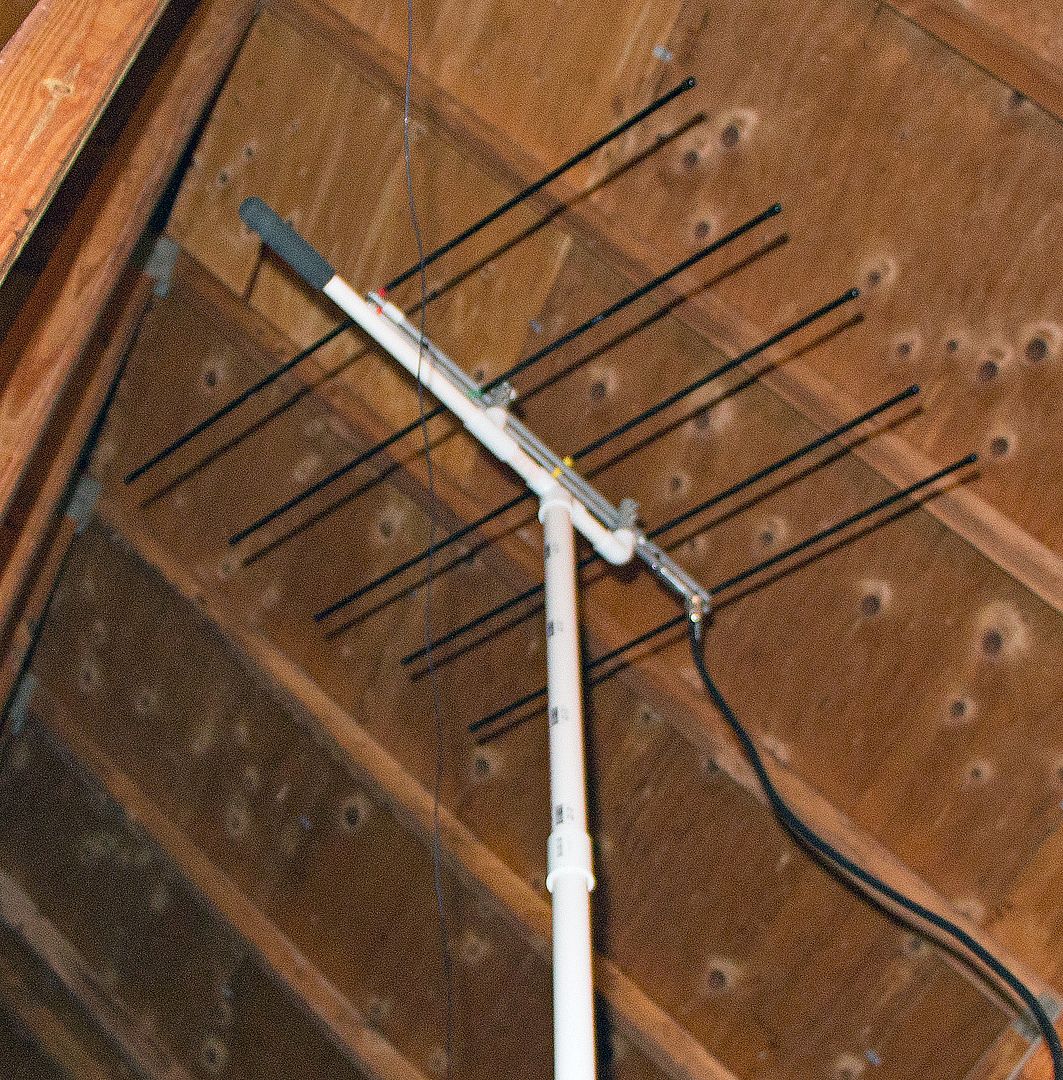
You need a roof antenna. Consider a Yagi in the attic if you can't place one on the roof. It's way better than any wire dipole for distant or weak stations. You can DIY one. :thumbsup:

31a466db-a647-4db2-8e37-a48c707fba07.jpg


DIY Yagi.
Yagi on a rotator, along with an omnidirectional, different feedlines into a coax switchbox feeding the tuner/ receiver. Find your desired station via the omni, home in on it with the yagi. You'd be surprised at what's available. In an urban area with lots of strong stations, this might be overkill though.
 
I was thinking I could get one of those 75Ω-300Ω balun adapters, then a coax cable, then another adapter that would connect the coax back to the dipole antenna :D but is that stupid hahaha
This will produce about 6 dB of loss, 3 dB per matching transformer. Not a big deal when dealing with strong signals, but for the moderate-to-weak ones, could be counterproductive.
 
Yagi on a rotator, along with an omnidirectional, different feedlines into a coax switchbox feeding the tuner/ receiver. Find your desired station via the omni, home in on it with the yagi. You'd be surprised at what's available. In an urban area with lots of strong stations, this might be overkill though.
That's why a directional antenna with good side rejection is nice. Rejection helps minimize overload from strong signals when receiving weak ones. :)

https://www.iw5edi.com/ham-radio/2514/antenna-basics-directional-antennas
 
Last edited:
When you connect the 300 Ohm Balun to the antenna, cut off the down lead on the antenna to about 2" length, strip it and connect it there, the down lead will pick up multipath signals and reflections. That's why you want to use coax instead of twin lead.
 
Rabbit ears are great for their adjustability. You don't always have to have them in a "T" formation. You can play around with them and sometimes get better reception.
 
This will produce about 6 dB of loss, 3 dB per matching transformer. Not a big deal when dealing with strong signals, but for the moderate-to-weak ones, could be counterproductive.
Where did you get the 3dB figure from? Typical 4:1 balun has <1dB loss. I’ve never measured one of the FM types, but 3dB seems excessive.
 
Where did you get the 3dB figure from? Typical 4:1 balun has <1dB loss. I’ve never measured one of the FM types, but 3dB seems excessive.
I've seen it marked right on them. Some are -2db, some are -3, they all have some loss. Some have much higher loss figures (multi-port splitter/ combiners), these are often used to tame too-hot signal levels in catv & other amplified closed video systems.
 
Last edited:
I've seen it marked right on them. Some are -2db, some are -3, they all have some loss. Some have much higher loss figures (multi-port splitter/ combiners), these are often used to tame too-hot signal levels in catv & other amplified closed video systems.
I’ve never looked that closely at any. I can see the use of a splitter as an attenuator, but a balun as an attenuator is odd.
 
I’ve never looked that closely at any. I can see the use of a splitter as an attenuator, but a balun as an attenuator is odd.
You'd expect a loss using a choke or transformer to go from a balanced to an unbalanced line. And vice versa. :idea:
 
Last edited:
Most big box home stores have good ol' twin lead available for pretty cheap, Soldering pencils and solder, too:) One thing to remember is that nearly all FM stations use a circularly-polarized transmitting antenna. This provides an optimum signal for vertical "stick" receiving antennas as well as those oriented horizontally. Placing a simple T antenna horizontally turns it into an antenna with the best reception perpendicular to its orientation. Placing the "T" in a vertical plane essentially turns it into an omnidirectional antenna. Placement and orientation is super-important.
 
Back
Top Bottom