• The move to the new server is done. There are some software and database maintenance updates in process. This has us passing the hat around to help out. We appreciate any donations. Seriously, even a dollar helps. The payment page may be found here - https://www.audiokarma.org/support.html

Fisher 500c Left channel buzz

Transformer hum is a different issue from hum in the speakers. Transformer hum can be anything from loose mounting bolts to loose through bolts, to a loose coil form inside the transformer.

As for the hum from the speakers, the information regarding the Aux input is confusing. So:

With nothing connected to the Aux input, the Aux input selected, and the volume advanced, there should be little if any hum at all. Is there? Or is there not? Let's get this established first before moving on to the phono section.

Dave

Yes, sorry that was confusing. I was all worked up and should've slowed down. It's a little vexing because the symptoms seem to shift each time I power it on and listen for a while. I'll try again. There is very little humm with nothing connected to aux, aux input selected, and volume advanced. There is a very small amount, but not enough to concern me at all. This is consistent with what was happening earlier.

It's the level of the phono humm that was bothering me, along with the pitter-pattering sound. I noticed upon running through things again that this sputtering is now happening in both channels, and they both stop doing it when I touch tube V16. It was just the right channel before, and I had made a special note of that. The sound is very slight, and I can only hear it when volume knob is around 11-o-clock position. It increases as volume increases. This rapid sputtering happens with or without a turntable connected to the phono input.

The phono humm goes away with no turntable connected to the phono input. Does that suggest a grounding issue with the turntable and the receiver? I tried to eliminate a ground loop as an option by switching turntables, but it was present with either connected. However, now the humm is not as noticeable even with the originally-offending turntable connected. It is still there, just much lower level, and now not really enough to bother me. I did move some power cords around my entertainment system, so perhaps the humm was just being picked up by the RCA cords of my turntables? I thought I had eliminated a ground loop, but that may be all that is causing the humm now.

I suppose this is still a little confusing since the humm has been moving and changing, but perhaps some of my troubleshooting helped the humm. The sputtering sound that I hear with the phono input selected is still a little concerning to me. Thanks again.
 
Transformer hum is a different issue from hum in the speakers. Transformer hum can be anything from loose mounting bolts to loose through bolts, to a loose coil form inside the transformer.

As for the hum from the speakers, the information regarding the Aux input is confusing. So:

With nothing connected to the Aux input, the Aux input selected, and the volume advanced, there should be little if any hum at all. Is there? Or is there not? Let's get this established first before moving on to the phono section.

Dave

Dave, sorry I am a novice at this and have not been able to provide you with consistent symptoms to help you diagnose my issue. Your advice has been invaluable so far. I have been monitoring the system over the past few days to see what has been consistent and which symptoms are moving. Here is what I have found:

1. The auxilliary input is very quiet. There is a small amount of noise, but nothing I would notice without putting my face to the speaker. So I think that is fine.

2. The phono input produces a volume-dependent humm in both channels with a turntable connected (I tried my Dual and a Technics, and the humm remains for both). However, the humm seems to be louder during some uses of the receiver and go away during other sessions. There is no humm with the phono input at all when there is nothing connected to the inputs. This humm could be described as more of a buzzing sound that is higher-pitched than the humm I was experiencing previously.

3. The phono input also produces a sputtering sound with or without a turntable connected. The sputtering comes solely from the woofer and sounds like someone is tapping their fingers on the woofer lightly. It isn't noticeable when listening, but I can hear it when I increase the volume moderately with nothing playing. The sputtering only happens with the phono input, not any others. The sputtering was initially only in the right channel, then I noticed it in both channels, and now it is back to only the right channel.

4. I have noted another symptom that occurs while I have been swapping some of the tubes around, namely the 12AX7's in V14, V15, V16, and V17. After pull and replace these tubes, when I power the receiver on, the right speaker emits a whistling/whooping sound, even if the volume is at zero. The sound comes just before the relay light clicks off. This happens only the first time I power on the receiver and then is fine as long as I leave the tubes where they are. Swapping the tubes has made no perceptible difference in the phono humm and sputtering, by the way.

The buzzing and sputtering in the phono section do not really bother me when listening, but I am worried that they are symptoms of something that could cause damage to the receiver if not rectified. Thank you again for your help. Brent
 
The phono hum sounds like dirty RCA phono jacks on the back of the receiver. Use Deoxit to clean the jacks up good, and make sure there is a good motor frame ground connection from your TT to the Fisher chassis. This is the separate ground lead from your TT that should be connected to one of the bottom cover screws -- on the side away from the power transformer.

The sputtering could very possibly be the coupling caps in the phono section (2 per channel). If they haven't been replaced, they should be for good measure anyway, and will likely solve your problem there.

Can you move the tubes around to stop the whistle? Or does the right channel do it regardless of which tube is installed in its phase inverter position?

Dave
 
The phono hum sounds like dirty RCA phono jacks on the back of the receiver. Use Deoxit to clean the jacks up good, and make sure there is a good motor frame ground connection from your TT to the Fisher chassis. This is the separate ground lead from your TT that should be connected to one of the bottom cover screws -- on the side away from the power transformer.

The sputtering could very possibly be the coupling caps in the phono section (2 per channel). If they haven't been replaced, they should be for good measure anyway, and will likely solve your problem there.

Can you move the tubes around to stop the whistle? Or does the right channel do it regardless of which tube is installed in its phase inverter position?

Dave

Dave,

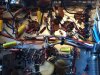
I will give the jacks a good cleaning and see if that helps with the buzz. As far as the coupling caps go, I will have to open it up tonight when I get home to be sure. But from looking at the photos I have, I see one smaller ceramic disc capacitor on each socket. Here is a photo where you can see socket V17 near the bottom of the picture. I believe the smaller ceramic disc is one of the coupling caps, but I don't know for sure which is the second coupling cap for V17.

I took a look at the schematic, and the capacitors on V17 seem to be Capacitor 14 on the parts list, the .01uf ceramic capacitor, and Capacitor 17 which is spec'd as a mylar cap .022 uf. I don't see an original mylar capacitor, so I believe the second coupling cap is the yellow film cap that reads 223k (.022uf), which has been replaced already. This should be the same for the other channel.

Trying to do my homework on this before I get home to open it up. It looks like the mylar .022 uf caps have been replaced by new film caps on both channels. Do you think I should just look at replacing the .01uf ceramic cap on each phono tube socket to deal with the sputtering? I will inspect the film caps as well. Do you see any other issues with V17? I can get better photos of each phono tube socket. I have also noticed that the larger ceramic disc at the very bottom of the photo in the shadows has a little chip out of it around one of the leads. Is that something I should replace as well? Thanks again for your help.
IMG_5440.JPG
 
The yellow cap is the second coupling cap, and with the first one being ceramic, they can both be eliminated from the list of possible culprits. The larger ceramic cap with the chipped lead is just fine.

About the only other things to look at would be noisy plate and cathode resistors, and possibly an issues with the decoupling/filter cap that serves the phono preamp tubes. Otherwise, outside of an outside influence injecting a signal into the phono circuits, there's little that can cause any noise. Does it ever make the noise in both channels at once?

Dave
 
The yellow cap is the second coupling cap, and with the first one being ceramic, they can both be eliminated from the list of possible culprits. The larger ceramic cap with the chipped lead is just fine.

About the only other things to look at would be noisy plate and cathode resistors, and possibly an issues with the decoupling/filter cap that serves the phono preamp tubes. Otherwise, outside of an outside influence injecting a signal into the phono circuits, there's little that can cause any noise. Does it ever make the noise in both channels at once?

Dave

Dave,

It has made the sputtering noise in both channels at once, but that has not been consistent. I first noticed in in just the right channel. A few hours later and it was sputtering in both channels. Last night as I was using it, it was only sputtering in the right channel again. It always does it in the right channel, but I noted it in both channels at one point. As far as the decoupling filter cap you mention, I am not sure specifically which cap that is.

When I get home, I am going to pull the receiver and inspect all of the elements around the phono tube sockets. If I am looking for a bad resistor, is there something I should look for visually, or do I need to rely on my DMM? I am also going to note the symptoms that occur right when I turn it on, play some music for a while to let it warm up, and then note if the symptoms have changed regarding the sputtering. I'll let you know what I find.

Brent
 
The yellow cap is the second coupling cap, and with the first one being ceramic, they can both be eliminated from the list of possible culprits. The larger ceramic cap with the chipped lead is just fine.

About the only other things to look at would be noisy plate and cathode resistors, and possibly an issues with the decoupling/filter cap that serves the phono preamp tubes. Otherwise, outside of an outside influence injecting a signal into the phono circuits, there's little that can cause any noise. Does it ever make the noise in both channels at once?

Dave

Dave,

I turned the receiver on when I got home, and the sputtering was coming from both channels again. I moved tubes around, but sputtering remained. After running it for a little bit, it still sputtered in both channels, with or without anything connected to the phono input.

I cleaned the RCA jacks for the phono input. I also noticed some corrosion/dirt on the source selector stack when I was following the phono input wires. I Deoxit-cleaned this pretty well and was able to remove some gunk. This cleaning helped the buzzing I was getting in the phono input. There is still more noise in the phono input than in aux, but that seems like it would be normal since there is extra amplification needed for the phono signal.

I visually inspected all resistors, and they all look perfectly fine. I also noted that all of the old caps in the receiver have been replaced by new film caps (or new electrolytics in just a few places where I suppose polarized caps were needed?). The sputtering noise from the woofers is still present, but to me it does not sound as punctuated as it did before my cleaning. I let it sit overnight, and the sputtering was still improved this morning. Do you think cleaning the source selector could have helped with the sputtering? It's still a bit sputtery, but it sounds smoother now, just like general noise from the woofer.
 
It is quite normal for you to hear a "rushing" sound when you advance the volume with the phono setting selected -- and particularly so with no input connected. But the noise should be rather constant in nature. It will be a stereo noise (just select mono phono and you'll see what I mean), but should be constant in amplitude and timbre. If the tube sockets have been cleaned good, you should be able to wiggle the phono preamp tubes in their sockets and hear nothing when doing this but possibly the microphonics of the tubes themselves, that virtually all tubes will display in these positions. On the other hand, if the phono preamp tube sockets are not properly cleaned, it can cause all manner of rumbling and woofer movement that will come and go, and be unique to each channel when it happens.

Beyond this, it is hard to go further without hearing the actual specific nature of what you mean by "sputtering". You are basically saying that the preamps are both working fine -- and identically -- in terms of their requirement to amplify and equalize the cartridge signal, that they produce no abnormal noise under normal use and listening conditions, and that these characteristics remain constant regardless of the tubes used. Therefore, it makes it hard to chase what may not be a problem at all, other than your own learning curve. Please don't take that as a dig back at you, but rather, since you say you are rather new to troubleshooting, and possibly new to troubleshooting vacuum tube equipment, it may be that you are not familiar with the sound of vacuum tube amplification at extreme levels, which will always display more, and a wider variety of noise than similar SS equipment will at the same levels of amplification.

Dave
 
It is quite normal for you to hear a "rushing" sound when you advance the volume with the phono setting selected -- and particularly so with no input connected. But the noise should be rather constant in nature. It will be a stereo noise (just select mono phono and you'll see what I mean), but should be constant in amplitude and timbre. If the tube sockets have been cleaned good, you should be able to wiggle the phono preamp tubes in their sockets and hear nothing when doing this but possibly the microphonics of the tubes themselves, that virtually all tubes will display in these positions. On the other hand, if the phono preamp tube sockets are not properly cleaned, it can cause all manner of rumbling and woofer movement that will come and go, and be unique to each channel when it happens.

Beyond this, it is hard to go further without hearing the actual specific nature of what you mean by "sputtering". You are basically saying that the preamps are both working fine -- and identically -- in terms of their requirement to amplify and equalize the cartridge signal, that they produce no abnormal noise under normal use and listening conditions, and that these characteristics remain constant regardless of the tubes used. Therefore, it makes it hard to chase what may not be a problem at all, other than your own learning curve. Please don't take that as a dig back at you, but rather, since you say you are rather new to troubleshooting, and possibly new to troubleshooting vacuum tube equipment, it may be that you are not familiar with the sound of vacuum tube amplification at extreme levels, which will always display more, and a wider variety of noise than similar SS equipment will at the same levels of amplification.

Dave

Dave, you are absolutely correct about my experience level with tube equipment. I am very new to it, so I appreciate your patience. I have learned an immense amount about tube gear, and I love it! What I am hearing now is mostly just "normal" tube amplification noise I bet. You mention cleaning the tube sockets, which I have not tried to do yet. I will do some research on that topic to make sure I don't do anything to damage them, and hopefully that will help with the undesirable sputtering noise. It's already gotten better, so perhaps simply removing and replacing the tubes several times has already started to clean the sockets. Thanks again. Brent
 
Deoxit is your friend when cleaning tube sockets. The product not only de-oxidizes the contacts, but also works to return contact resistance to the lowest possible levels virtually instantly. To get an absolutely solid contact, I've sometimes had to actually scrape the pins of the tube itself as well.

Dave
 
Deoxit is your friend when cleaning tube sockets. The product not only de-oxidizes the contacts, but also works to return contact resistance to the lowest possible levels virtually instantly. To get an absolutely solid contact, I've sometimes had to actually scrape the pins of the tube itself as well.

Dave
Dave, I gave the phono preamp sockets a good cleaning today, and they are much quieter! The sputtering I was referring to is basically gone. I think switching the tubes around probably started cleaning the sockets and improved the noise some yesterday. Then the DeOxit did the rest of the job. Thanks again for the help.
 
Set your meter to DCV, and then put a lead on each end of the 10ohm resistor on pin 5 of each tube in turn. This will give you the reading in mv. take the reading and move the decimal 1 place to the left. FOR EXAMPLE your meter reads 0.350 (350mv). Move the decimal to the left one place and you get 0.035. This is the reading in ma. INSULATE THE PROBE LEADS with tape or heatshrink all the way to the tip. You just want the tip of the probe showing so you lessen the chance of a short circuit if you for example sneeze, or the probe slips.

Take those readings and write them down. Now put the black probe on a clean shiny part of the chassis and clamp it there(If your meter came with alligator clips even better!). Take the red probe and get a reading on the plate of each tube (pin 3).

To get the Wattage for each tube you multiply the pin 3 reading by the ma. NOT the mv. So for example you get 430v on pin 3, and your ma are .035. 430x.035=15.05 This is about as high as you want to take it with 80% being 15.2w.

Then there is the screen draw of between 2 and 3 ma to consider. Subtract the screen draw ( I use 3ma for safety purposes) and you get 12.05w.

SUBSTITUTE your Numbers in place of the example's numbers and you'll get your tube output's.


Larry,

I have had my Fisher 500c out of rotation for a bit, as I have been planning to replace the coupling caps and grid resistors with the recommended updates. 0.1 uf for the coupling caps and 200k ohm for the resistors. I got around to doing so and was taking readings as you had instructed me several weeks ago so I could adjust the bias with the new parts installed. I got some interesting results that I hope you might be able to help me with. Here are the readings I got for the four output tubes:

V8 - around 26 V on 10ohm resistor on pin 5, 484 V on pin 3 = 1,258.4 w! (the 26 V is VOLTS! Not mv, but VOLTS! This is the one that alarms me)
V9 - .272 V on 10ohm resistor on pin 5, 481 V on pin 3 = 13.08w
V10 - .425V on 10ohm resistor on pin 5, 480 V on pin 3 = 20.40w
V11 - .171V on 10ohm resistor on pin 5, 480 V on pin 3 = 8.21w

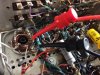
IMG_5718.JPG IMG_5717.JPG

So it seems my plate voltages are consistent between tubes, but the bias current readings are all over the place. My main concern is the 26 volts on V8 and the disparity between readings on the other tubes. My Fisher has just a single bias pot that adjusts all four tubes simultaneously, and turning it does affect the readings from pin 5, even the 26V reading.

Other observations:
1. I get good clean sound from both channels with no undesirable noise to speak of.
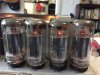
2. The Tube in V8 does not glow as brightly or get as hot as the other three tubes. You can see this in the photo below. Tubes V9, V10, and V11 are too hot to touch once they get warmed up, but V8 is just kindof warm, not super hot.
IMG_5720.JPG

Do I have bad/mismatched tubes in the unit? They came with it when I bought it and are EH 7591A's. No idea if they are well matched, but it doesn't seem to be so...

Any help is greatly appreciated. I'm going to put the unit to the side until I can get this sorted out.
 
Last edited:
As one more test, I swapped tubes V8 and V9 and got the following readings:

V8 (used to be in V9) - 14.7 V
V9 (used to be in V8) - .104V

So it seems my problem may lie somewhere in the wiring of socket V8? Still looks like I need some better matched tubes in order to bias them correctly with my single pot either way, correct?
 
The cathode resistor on pin 5 of V8 is open, causing the whonky readings for that socket. You will need to replace that resistor first before the readings will normalize again.

Dave
 
The cathode resistor on pin 5 of V8 is open, causing the whonky readings for that socket. You will need to replace that resistor first before the readings will normalize again.

Dave
Dave, I was just back looking at it, and you're right. Shoulda caught that as it's pretty obvious, even in that photo you can see some damage. I'll replace with a new 10 ohm resistor. It looks like it was a 1% metal film resistor, but what wattage does it need to be? 1/2 watt?

Do you anticipate that the readings just for that socket will normalize or are you saying that it will help the readings from the other tubes be more consistent as well? Even once I replace the open resistor, I am still concerned about the differences in readings I am getting for the other tubes since I only have a single bias pot. V10 and V11 were pretty far apart at .425v and .171v respectively on the cathode resistors.
 
A .25 watt or 0.5 watt resistor is fine, with the lower wattage piece offering slightly more protection, since it will burn out quicker if need be.

Repairing the resistors will then produce accurate readings at all tube sockets, assuming nothing else is amiss. With accurate readings, then you can decide about the match of the tubes you have.

Dave
 
Last edited:
Dave, thanks again for the help with this unit. I'm starting to actually understand how tubes work by making these fixes! I do not think the EH tubes that came in this unit are very well matched. I plan on upgrading to some of the tung sol 7591's and getting a quad from Jim mcshane sometime soon before I put this fisher back in a permanent place in my system.
 
A .25 watt or 0.5 watt resistor is fine, with the lower wattage piece offering slightly more protection, since it will burn out quicker if need be.

Repairing the resistors will then produce accurate readings at all tube sockets, assuming nothing else is amiss. With accurate readings, then you can decide about the match of the tubes you have.

Dave

I replaced the 10 ohm cathode resistor and took new readings. They were fairly unbalanced, so I switched tubes around a couple of times to experiment, took new readings, and I ended up with three tubes with very close readings and one tube with low reading after adjusting bias to hit approx. 15w per tube. As I have the tubes now:

V8 - 0.031a on cathode x 480v on plate = 14.88w
V9 - 0.030a on cathode x 480v on plate = 14.4w
V10 - 0.013a on cathode x 480v on plate = 6.24w (this is the tube that used to be in V8 with the open cathode resistor)
V11 - .030a on cathode x 480v on plate = 14.4w

So now I am wondering if the tube in V10 putting out only 6.24w is bad. This was the tube in the socket with the open resistor. Did that cause this tube to go bad? May be time for those new tubes unless you have any suggestions. Thanks again.
 
If it popped the cathode resistor, that's not a good sign, but the only way to know is to measure its power output capability. There's a chance it could just be a tube that requires lower than normal grid bias voltage, and so draws notably less current than other more typical tubes at more typical grid bias voltages. Physical appearance can help make a determination as well. Typically if the getter flash has all but evaporated, its a sign that a tube is well spent. But that doesn't mean its necessarily bad, either -- just near the end of its useful life.

Dave
 
Back
Top Bottom