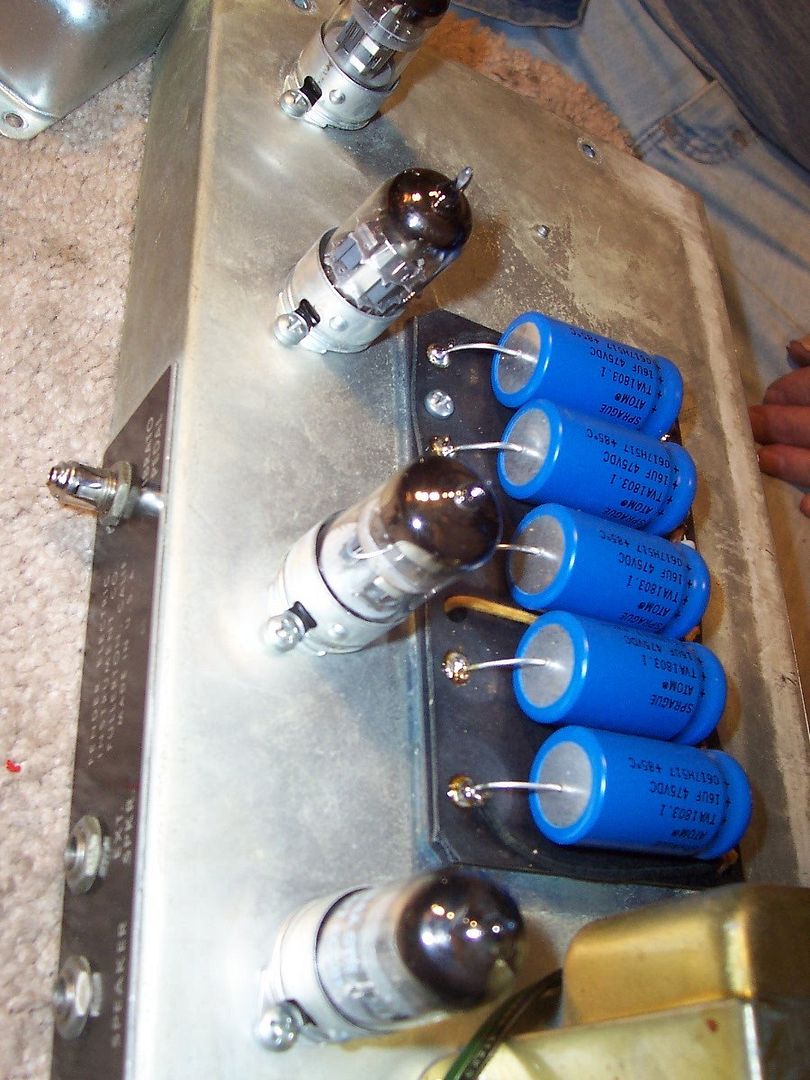
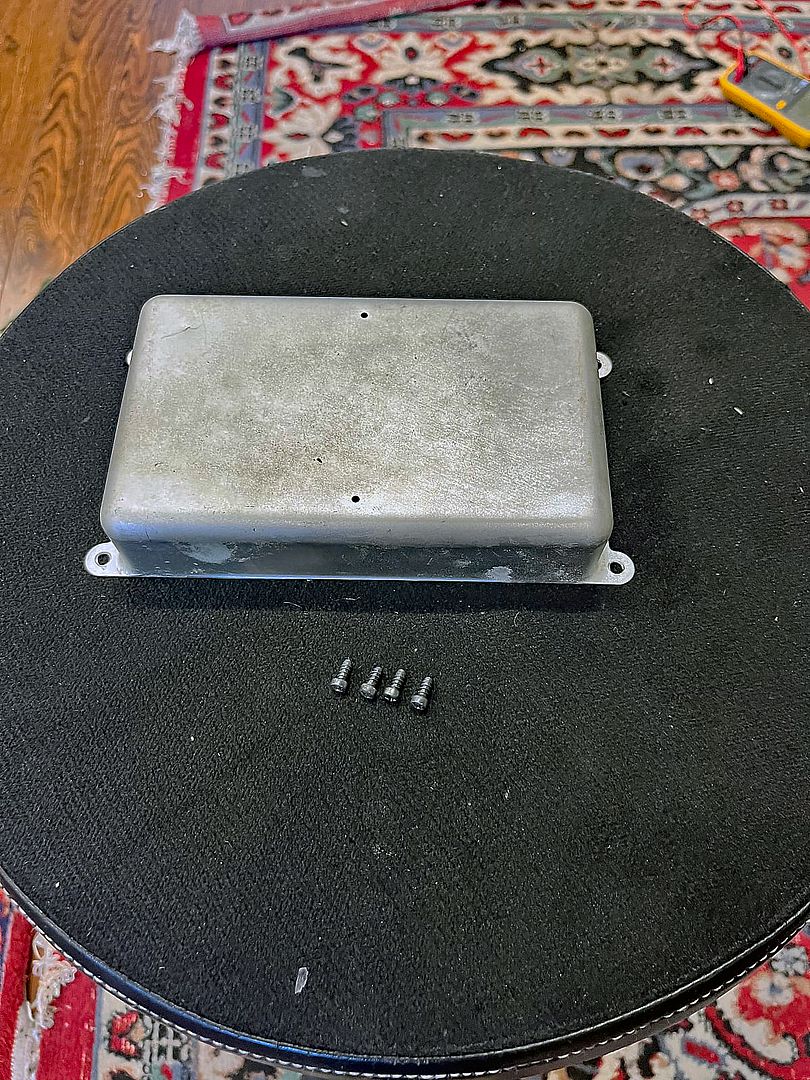
Yes. Regardless of 60Hz or 120Hz hum, the cap cans need replacing.The other big reason I question the caps is it sure looks like one of them is beginning to ooze.



Yes. Regardless of 60Hz or 120Hz hum, the cap cans need replacing.The other big reason I question the caps is it sure looks like one of them is beginning to ooze.

thank you for identifying this capacitor leak.Pretty sure the bias cap has been replaced though, I see two modern blue caps under the deck where the old dual can would live. 35v, 2200uf seems like a reasonable sub for the original 35v, 1000uf parts. also frankly they don't make sense for much of anything else.
these don't have hum pots, it uses a pair of fixed resistors to ground
the others maybe, but equal in both channels just doesn't seem so likely to me.
The other big reason I question the caps is it sure looks like one of them is beginning to ooze.
the bottom of the can basically center of the pic. That should be the black one.

yes sir! given that the leakage from these can capacitors, I'll try to find a tech locally here in SoCal that can replace them. I definitely won't be doing this on my own.Yes. Regardless of 60Hz or 120Hz hum, the cap cans need replacing.
Best to get a couple of estimates. Here's a price list to help with parts.yes sir! given that the leakage from these can capacitors, I'll try to find a tech locally here in SoCal that can replace them. I definitely won't be doing this on my own.
sorry about another follow up question here. how much should I expect (in terms of $USD) if I take this to a tech and have the two can caps replaced?
these caps don't look cheap to me.
thank you for the speedy reply Mr.Boochie.Best to get a couple of estimates. Here's a price list to help with parts.
Labor usually is a set hourly rate.
Electrolytic caps differ in construction versus non-polar poly coupling caps. You can buy individual electrolytic caps, but the cost will probably be the same as multisection cap cans. Plus, chassis space will become an issue unless you have the cans restuffed or use Hayseed-stuffed ones.thank you for the speedy reply Mr.Boochie.
dang, these are quite expensive but still affordable. whatever it takes to get this 800c back in working order. I'm relying on my old Fisher RS-1052 (solid state) amp meanwhile and I miss 800c's tube sound daily.
another dumb question just for my learning. why are these can caps so large/expensive compared to polypropylene capacitors? (for example the dayton ones are like a couple bucks each at most). although I've seen some Solen or Jantzen ones go for like 30-40 bucks.
are these can caps filled with some special material perhaps? do they house many mini capacitors inside?

yea. I can't absolutely guarantee just by looking at it that its bad, but I've never had one visibly leaking that was not electrically in bad shape.thank you for identifying this capacitor leak.
I've learned a ton from you guys and from this discussion. I'd like to learn more about capacitor leakage.
are you referring to this brown bulge in the middle of these 4 connection?
View attachment 3444485

 hayseedhamfest.com
I replace all cap cans on vintage units. You can bet they sweat all their electrolytic fluid.yea. I can't absolutely guarantee just by looking at it that its bad, but I've never had one visibly leaking that was not electrically in bad shape.

If you want to save yourself some money, identify the sections of the can that are bad, disconnect them from the circuit and replace them by undermounting them. Refer to the service manual for the values.You can keep the original can in place for aesthetics. It’s the easiest and cheapest solution, assuming you have the tools and skill set.
On the 800c, the most complicated can has 4 caps; the simplest has only one.
I'm betting the hum is 60Hz, not 120Hz, from the video. Usually, dried out filter caps = 120Hz. We'll find out.As a matter of course, I ALWAYS replace those cans, whether needed or not. All I’m suggesting is that they may not be the cause of the hum.
Transformers normally vibrate and, over time, the potting hardens and the bolts loosen resulting in a soft, almost imperceptible hum or buzz. Mechanically tightening things up corrects that issue. That said, I never trust the cans and re-stuff them in every single Fisher that I’ve owned, no questions asked.
While we’re on the subject of cans: if the can with the black ooze is the cardboard covered can, then the black gunk is not electrolytic but the tar used to attach the cardboard cover to the can. When you dissect a bad can cap, you won’t find anything black but, rather a white pasty electrolytic encased in foil paper together with several metal conductive strips that end with the can’s terminals. An electrically “leaky” cap can definitively be determined only with an appropriate tester. Again, whenever I purchase a Fisher unit, I don’t bother to test for leakage. I take the position that they’re done due to age and replace them.


Sounds like a 60Hz hum. That's from either the power transformer or the tube's heater supply line of the power transformer. For reference, I posted both a 60Hz and a 120Hz video. 120Hz hum is from other (post-rectified) sources. That could be a bad filter cap(s), ground loop, or bad layout of wiring leading to hum induction.
You could try swapping 12AX7 tubes around and see if the hum changes. It could be a noisy heater within a tube. That would be an easy fix — a new tube. Otherwise, the amp will probably need to go onto a tech's bench to narrow down the culprit(s).
They're large and expensive because they are made to the correct form factor for tube amplification. The reason they are mounted above chassis is ho keep them away from heat.thank you for the speedy reply Mr.Boochie.
dang, these are quite expensive but still affordable. whatever it takes to get this 800c back in working order. I'm relying on my old Fisher RS-1052 (solid state) amp meanwhile and I miss 800c's tube sound daily.
another dumb question just for my learning. why are these can caps so large/expensive compared to polypropylene capacitors? (for example the dayton ones are like a couple bucks each at most). although I've seen some Solen or Jantzen ones go for like 30-40 bucks.
are these can caps filled with some special material perhaps? do they house many mini capacitors inside?
Plus, placing all the electrolytic caps under the hood may interfere with the wiring layout.More recently I've given in to buying the more expensive cans that just drop in with no fuss. I balance it against time and effort involved, and what it looks like at the end of the day. Winging caps in something is easy, having it not look like you just winged caps into something is a bit harder. Flying splices and unsupported components are asking for problems down the road.
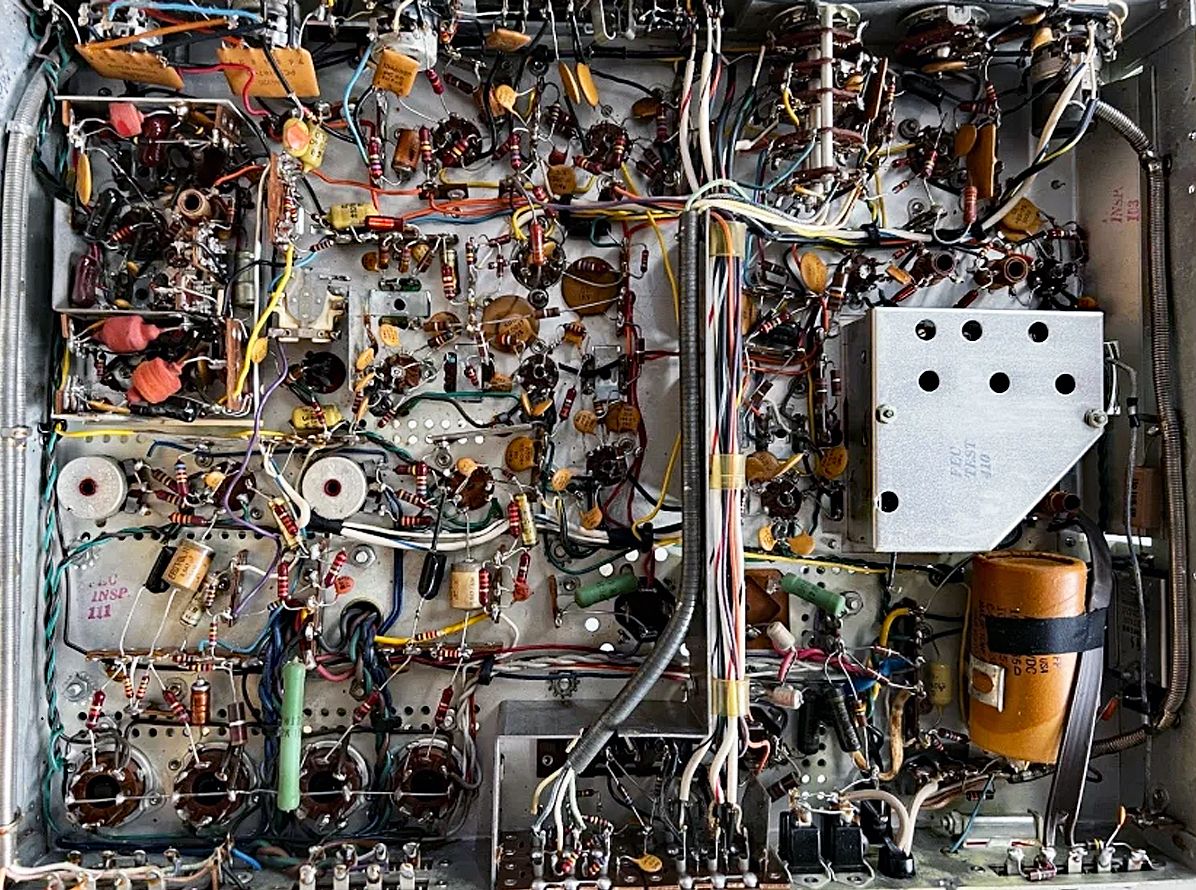
These companies should have done what Fender did, putting the cap under a doghouse on top of the chassis. Replacing these caps is so easy.yeah these things are busy inside. That can cap underneath can go and it gives more room. Someone was making a board that basically occupied that entire back corner for the caps but it really fills the space up.
I restuffed the caps when I did my Sherwood S-7000, that was pretty much the last time I restuffed caps because I decided I just didn't enjoy the process at all. No space in those things to stick caps underneath.