• The move to the new server is done. There are some software and database maintenance updates in process. This has us passing the hat around to help out. We appreciate any donations. Seriously, even a dollar helps. The payment page may be found here - https://www.audiokarma.org/support.html

Fisher bias vs. Mod pot bias ?

Gary Mattis

Active Member
I had a thought about tube matching and separate bias pots vs. Fishers factory all bias the same set up , which is better ? , Is the output power match more critical then trying to bias match the ma readings through negative bias methods with separate pots ?, sure separate pots cures one problem but dosen't it create another entirely different set of worse problems ? Symmetrical ones ? , It seems like Fisher designers chose to allow ma variation's with matched outputs within a certain range, one much higher then the common 20 % that is the norm, when you lower or raise a bias voltage everything changes and there is no longer a balance except for in ma readings, seems like a bad mod and big mistake to me ! , there are others who agree with me including Fishers engineers. I would like to understand why ma. Readings run the show without other considerations ?. Are not the caps and resistors able to easily handle the milliamps variances to some extent considering they are rated in voltage and resistance. I would think the designers had this thought in consideration in their designs. Maybe when power outputs match ma variation can go as high as 50 % in the Fisher 400's case at 425 plate voltage. Or 405 plate at 117 volts. This seems to be the way Fisher made their amps. 49 years working like that on the original tubes is a hard case to argue against.
 
Last edited:
Register to hide this ad
Without adjustable bias then using matched tubes provides better performance in pretty much every category. One can use unmatched tubes and most units will still work and maybe even within specification. However, "in spec" isn't necessarily synonymous with optimally.

Adjustable bias is a way to largely, but not fully, account for unmatched tubes and to dial in matched tubes even better.

Sometimes things are done or not done, for reasons other than purely technical matters. The decision could have been one of cost, one of complexity, one of fear of KTBs (knob-turning bastards), or some combination of them all and or others.

Engineers at companies don't often have the luxury to do everything they think is best. Sometimes, due to forces beyond their controls like the Management, they have to do what will get the job done adequately, rather than ideally/perfectly/optimally.
 
Without adjustable bias then using matched tubes provides better performance in pretty much every category. One can use unmatched tubes and most units will still work and maybe even within specification. However, "in spec" isn't necessarily synonymous with optimally.

Adjustable bias is a way to largely, but not fully, account for unmatched tubes and to dial in matched tubes even better.

Sometimes things are done or not done, for reasons other than purely technical matters. The decision could have been one of cost, one of complexity, one of fear of KTBs (knob-turning bastards), or some combination of them all and or others.

Engineers at companies don't often have the luxury to do everything they think is best. Sometimes, due to forces beyond their controls like the Management, they have to do what will get the job done adequately, rather than ideally/perfectly/optimally.
But doesn't separate bias pots / voltages throw the amp out of balance ? , here is a mechanical example, setting valve lash different on each cylinder in a race engine with a solid camshaft , one cylinder would pull harder and another less , out of balance or tune basically . The PT is the engine , the OT the camshaft , the tubes are the lifters in between, thus the tubes act like a hydraulic lifter on their own to some extent. Adjusting them differently is what sepatate bias pots do ! , Now the whole amplifier is thrown out of balance ! , not just the tubes that are capable of changing and working with each other !
 
Last edited:
Your always better off using as closely matched tubes as possible.

Your analogy is incorrect.

A better analogy would be adding weights to a wheel when you have your tires balanced. It is a correction for an imbalance rather than upsetting something that is already in balance.

In the case of mismatched tubes is it more like restoring balance.

By adjusting the bias correctly, you help to insure that each tube is operating equally, much in the same way that using matched tubes help to insure that each tube is operating equally.
 
How does uneven bias adjustments restore balance to what is not a wheel but is a constant flat design ?, but I agree better tubes are the best solution. Is it that important to have equal tubes ? I do not think it matters that much in push pull as long as both work properly, even the OT ohms are not the same ! , Equal output does not require equal ma. In a PP amplifier. I do not think we can ever make 2 tubes or 2 electrons act the same way no matter how hard we try ! , If your tubes are so bad that your amplifier rejects them , is it the amplifier or tube makers fault ? Maybe like water poured from one barrel into another PP tubes are able to create their own balance with a fixed negative bias and do not need our help ? Electrons are pretty fast ! . plus it is not a fixed wave form by any means but a constantly changing wave and output form, it seems to me that the pre amp is actually in control of most everything except for total output wattage and the actual output tube tone.
 
Last edited:
Adjusting the bias in an amplifier is about setting the correct operating point for the vacuum tube and trying to insure that the operation of the tubes is a close as possible.

In rereading your post, I see an issue with your interpretation of bias adjustment.

Even though the position of the pots used to adjust the bias may be different and the amount of resistance may be different, it is these differences that help to correct the imbalance of mismatched tubes.

Remember that the goal it to have the same amount of current flowing in the tubes when the amplifier is at idle (not playing music). Adjusting the bias help allow this to happen.

The fact that there is a different amount of voltage on the screens of the different tubes when the bias is adjusted is not an imbalance it is correction, leading to a closer balance in the operation of the tubes.

This thread could turn into an engineering course, but that will not be needed if you just stop and think about what is happening.

The balance (or matching) is the fact that the same amount of current is flowing in the tubes when the amplifier is not playing music.

It has nothing to do with other components being able to handle the mA (current) as you mentioned.

As previously mentioned there are trade offs between what engineers want and the end product for a variety of reasons.

Here is another way to think of it, you take a telescope outside to look at the stars and you want it to be level (balanced in terms of this discussion),

So you adjust the legs of the tripod so the telescope is level and one leg of the tripod ends up being longer than the other, nothing is out of balance in terms of the operation of the telescope even though one leg of the tripod is longer than the other.

We can debate the engineering practices of Fisher and the final product, but that does not change the discussion.

Some feel it it is worthwhile to make certain modifications and others use their equipment bone stock.
 
Adjusting the bias in an amplifier is about setting the correct operating point for the vacuum tube and trying to insure that the operation of the tubes is a close as possible.

In rereading your post, I see an issue with your interpretation of bias adjustment.

Even though the position of the pots used to adjust the bias may be different and the amount of resistance may be different, it is these differences that help to correct the imbalance of mismatched tubes.

Remember that the goal it to have the same amount of current flowing in the tubes when the amplifier is at idle (not playing music). Adjusting the bias help allow this to happen.

The fact that there is a different amount of voltage on the screens of the different tubes when the bias is adjusted is not an imbalance it is correction, leading to a closer balance in the operation of the tubes.

This thread could turn into an engineering course, but that will not be needed if you just stop and think about what is happening.

The balance (or matching) is the fact that the same amount of current is flowing in the tubes when the amplifier is not playing music.

It has nothing to do with other components being able to handle the mA (current) as you mentioned.

As previously mentioned there are trade offs between what engineers want and the end product for a variety of reasons.

Here is another way to think of it, you take a telescope outside to look at the stars and you want it to be level (balanced in terms of this discussion),

So you adjust the legs of the tripod so the telescope is level and one leg of the tripod ends up being longer than the other, nothing is out of balance in terms of the operation of the telescope even though one leg of the tripod is longer than the other.

We can debate the engineering practices of Fisher and the final product, but that does not change the discussion.

Some feel it it is worthwhile to make certain modifications and others use their equipment bone stock.
How do you know it stays right with tube wear and break in ? If all are the same there is a set limit or a boundary , with different resistance it would change the constants and dynamic range of the amplifier I would think ? Plus heater reaction to different resistance on the screen can upset the tubes linear frequency range. After hearing the 400 Fisher with stock tubes on a instrumental solo with the stock grid bias with a not very good factory tube match on either side, I have to say this , It sounded fantastic to me ! , It did everything just right sound wise as far as my ears could tell . The tubes were as linear as I have ever heard ! , I have a 75 watt linear EL 34 amplifier and I know what a tube linear sounds like and being 100 %/stock The Fisher did it , isn't that the goal in audio to get the tubes into their linear path ? This amp has 6 Telefunken smooth plates, 3 box plate Sylvania's , 4 Sylvania Outputs.
 
Last edited:
I did not say that it stays the same with tube wear, in fact it does not, tubes wear out, that is why it is adjustable, because it does change and that is why it is a good idea to have well matched tubes, especially if the bias is not adjustable.

Again, will an amplifier operate with mismatched tubes and possibly even meet it spec, it is possible. It is possible that an amplifier with operate better with matched tubes or using adjustable bias, yes it is.

There are a large number of threads on AK about the advisability of periodically checking the bias of a tube type amplifier, especially in this day and age where a person of necessity may be buying used vacuum tubes. Even though a set of vacuum tubes may be matched, there is no way to know how may hours of use and at what filament voltage (high filament voltage may shorten the life of a vacuum tube). There are a lot of variables in play.

The impact on sound quality of various parts and types of parts and adjustments in a circuit is much debated on AK. It is another can of worms.

I went back and read your edited post "If your tubes are so bad that your amplifier rejects them , is it the amplifier or tube makers fault".

I have no idea what this means or what it has to do with this discussion. Tubes, like other things wear out. It is not the fault of the amplifier (although a defective or misadjusted amplifier may damage a vacuum tube) or the vacuum tube maker, unless the vacuum tube maker is supplying junk.

If you feel that implementing adjustable bias in a tube type amplifier is a bad thing, do not do it. If you feel that it is okay to operate a tube type amplifier with mismatched output tubes, feel free to do so. If you have what you feel is a better design, by all means let us know about it and why you feel that it is better.

Then give us some math, some numbers and some measurements to support your position. A number of people on AK have made some great engineering changes to various amplifiers and shared the information.
 
I did not say that it stays the same with tube wear, in fact it does not, tubes wear out, that is why it is adjustable, because it does change and that is why it is a good idea to have well matched tubes, especially if the bias is not adjustable.

Again, will an amplifier operate with mismatched tubes and possibly even meet it spec, it is possible. It is possible that an amplifier with operate better with matched tubes or using adjustable bias, yes it is.

There are a large number of threads on AK about the advisability of periodically checking the bias of a tube type amplifier, especially in this day and age where a person of necessity may be buying used vacuum tubes. Even though a set of vacuum tubes may be matched, there is no way to know how may hours of use and at what filament voltage (high filament voltage may shorten the life of a vacuum tube). There are a lot of variables in play.

The impact on sound quality of various parts and types of parts and adjustments in a circuit is much debated on AK. It is another can of worms.

I went back and read your edited post "If your tubes are so bad that your amplifier rejects them , is it the amplifier or tube makers fault".

I have no idea what this means or what it has to do with this discussion. Tubes, like other things wear out. It is not the fault of the amplifier (although a defective or misadjusted amplifier may damage a vacuum tube) or the vacuum tube maker, unless the vacuum tube maker is supplying junk.

If you feel that implementing adjustable bias in a tube type amplifier is a bad thing, do not do it. If you feel that it is okay to operate a tube type amplifier with mismatched output tubes, feel free to do so. If you have what you feel is a better design, by all means let us know about it and why you feel that it is better.

Then give us some math, some numbers and some measurements to support your position. A number of people on AK have made some great engineering changes to various amplifiers and shared the information.
Maybe it helps them and maybe it hurts them, but with separate adjustable bias it would be hard to tell with no real standard to judge the math from to begin with, with a fixed point or a single pot at least there is a way to judge it, I do not see how a half push can be judged with 4. Separate adjustments and resistances, not even with a scope unless you could record the ma readings on each with the wave swing and read linear patterns at the same time and play it back in slo motion, then maybe it could be seen. It comes back to the ear and how anal you are about bias. I guess ? Funny how you could not understand my tube and amp maker remark also !
 
I'm confused by your actions. You ask for help/advise, but seemingly doubt and cast dispersion on nearly all of it.

What gives?
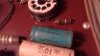
Its not that important to me the bias issue as long as the amp runs and sounds OK , just trying to understand why changing it is so important to some people, no one has said for tone or linear reasons, that was what I would of expected from audio files. Anyway I have a more pressing issue trying to identify polarity on a great Britten e cap, nothing on line about it see pic
 

Attachments

  • IMG_20160627_231720170.jpg
    IMG_20160627_231720170.jpg
    52.3 KB · Views: 24
Last edited:
They have said several reasons why bias and tube balance are important.

I don't know you so I'm trying hard not to be too critical but you have received advice from some very smart and experienced people (and I'm not including myself at their level). I suggest being more open minded to that experience and knowledge rather than seeming to fight/oppose it. Maybe I read it all wrong, but that's what it seems like to me. :dunno:
 
It beyond the scope of this thread but there are methods to determine what you mention and the math to quantify it. It is how engineers design things and measure their operation.

What are you judging with a fixed point or a single pot and how are you judging it?

Understanding the operation of the particular circuit in question will go along ways to answering your questions.

It is true that there is debate and experimentation here regarding the preferred topologies of amplifier design. By understanding the operation of a circuit, the math can give us an insight to the instantaneous operation of the circuit in the time domain. Other math can tell us what is happening in the frequency domain.

One can characterize the operation of an amplifier in the time domain, frequency domain, with relationship to phase versus frequency, with relationship to group delays and so on. These characterizations among other things can tell us if we are getting in the ball park with our design or if an amplifier is close to operating correctly.

We know in a general way, based on the information supplied by the vacuum tube manufactures, electronic theory and experience, how a vacuum tube will behave in a certain circuit with certain applied voltages and certain amounts of current flowing through the vacuum tube. It is called the transfer function of the vacuum tube and the circuit in which it is used.

This is how we can arrive at the basic design.

Its not that important to me the bias issue as long as the amp runs and sounds OK , just trying to understand why changing it is so important to some people, no one has said for tone or linear reasons, that was what I would of expected from audio files.

To quote myself

The impact on sound quality of various parts and types of parts and adjustments in a circuit is much debated on AK. It is another can of worms.

Adjusting the bias in an amplifier is about setting the correct operating point for the vacuum tube

In general we set the operating point of a vacuum tube so that it will operate in the most linear portion of its forward transfer function curve in the circuit. That is will help insure the the output signal is as close to the input signal as possible, in other words it is the most linear. You mentioned something about setting the current flow in a vacuum tube in your first post as being an incorrect thing to do What do you believe the correct thing to do? The goal is to set the operating point of the vacuum tube in the circuit that it is in so that it is operating in the most linear part of its forward transfer function in the circuit. There may be reasons to move the operating point a little and that is another topic that is open to debate.

So your contention that no one mentioned it is not correct. The perception of sound quality is subjective and there may be no clear agreement on the definition of what sounds the best or even the changes in sound quality with various changes in adjustments, whether the adjustments are made to a fixed point or are variable.

Anyway, why did you claim that I had not mentioned it?

The design of an amplifier on its technical merits is one discussion. The merits of its sound quality are another although related discussion.

When a thread starts from a technical perspective it is safe to say that most will respond in a technical nature, especially in the Fisher forum.

Up until you edited at least one of your posts (I looked back, you have edited most of your posts), you had made no mention of tone (sound quality?).

Again, we can debate the relative merits of various designs in term of sound quality until the cows come home and that is okay, but it does not change the basic tenants of amplifier design, characterization and operation.

BTW, it does not help those that are trying to answer your questions when you go back and make major changes to your posts. Most of use are not going to go back and read a persons posts from the beginning to see if there have been major edits. Why are you changing your original posts so much?

Again, the debate about sound quality is subjective and an amplifier does not operate all by its self. There will be other electronics, speakers and room acoustics involved. The particular changes in sound quality as described by the listener will technically only be valid for that listener. This may result in some saying that a particular change makes the sound brighter or duller or whatever and another person may say the opposite.

This a a discussion that we can have, but it is not the discussion that you started.

Again you have edited one of your posts and added a question and a picture. If there are more post to this thread, it is likely that people are not going to go back and re-read your posts to see if they have been edited.

I could tell you what it appears to be, but and I am trying to be nice, I do not want to argue about it. A quick look at the circuit will tell if if it needs to polarized, non-polarized or that it does not matter. In term of tone quality as you call it (sound quality?) there are plenty of debates about capacitor types and the replacement and upgrading of capacitors.

 
Its not that important to me the bias issue as long as the amp runs and sounds OK , just trying to understand why changing it is so important to some people, no one has said for tone or linear reasons, that was what I would of expected from audio files. Anyway I have a more pressing issue trying to identify polarity on a great Britten e cap, nothing on line about it see pic

Adjustable bias is not essential to operation or SQ in these. Running fixed bias is perfectly acceptable, provided the idle current is within range. An adjustable bias allows the use of mismatched tubes, and gives the user something to tweak as the tubes age and drift. Good tubes shouldn't drift all that much until the very end.

Matched pairs are a good idea for any arrangement. But an adjustable bias will allow a little more flexibility for a rogue tube. It's an added adjustment tool. Like any other tool, haphazard use can cause problems.

The fixed bias was never an issue in years past. Today, some others now feel differently, and like the flexibility of bias pots. The early 7591/7868 new production out of the Eastern Bloc in the '90s was not the best, and people starting applying measures to the instruments to account for the issues.

I still run fixed bias in these. I also run old production outputs in most. They measure perfectly fine decades out. But so do the latest Tung Sols after many hours. All have good sound (the old Westinghouses the best). I'm not changing, as I have no need to do so.

Do what you believe right for your situation.
 
They have said several reasons why bias and tube balance are important.

I don't know you so I'm trying hard not to be too critical but you have received advice from some very smart and experienced people (and I'm not including myself at their level). I suggest being more open minded to that experience and knowledge rather than seeming to fight/oppose it. Maybe I read it all wrong, but that's what it seems like to me. :dunno:
Like Tesla I challenge everything I hear and see to some extent, the whole world lies in wickedness and many are on their way to destruction, why blindly just follow people without seeing any real proof ? Anyone can follow blindly that takes no courage ! , I understand these men have years of experience , and I am greatful they share it with us all on this forum, but that does not make them right on every issue or smarter then those who designed these units in the first place. I just think there is too much follow the leaders going on in tube audio ,there is not much thinking for other ways ! Don't I have a right to dispute and disagree with installing separate bias pots ? Or do I lose the right to free speech just because they agree with eachother and have more bench time ? When Tesla saved the electric grid for Edison in Philadelphia no one knew who Tesla was ! , most people still do not know who he was ! . Most of my edits are after I proof read it, not a long time afterwards. Back to the subject , it seems like you are trying to make class B into class A by changing the bias point ? Am I correct in this assumption ? , here is my reply , the further forward you move that point the further it has to come back to go negative and positive again in the push pull arrangement. I read a lot more then just what is on the AK forum.
 
Last edited:
Nothing wrong with questions and healthy skepticisim, but there is a point where it goes beyond healthy.

As well, there is context. Bear in mind you're not dealing with used car salesmen (sorry used car salesmen, I'm compelled to use the sterotype here). You're receiving advice from fellow hobbyists, in some cases industry professionals/experts, with no vested interest in steering you wrong. Quite the opposite actually, their vested interest is in your success as a matter of personal pride and satisfaction.
 
Last edited:
These run AB1.

The adjustment is simply to make sure it is at the correct operating point. Plug in a dozen different tubes and you'll get a dozen different current draws despite identical bias supply voltages. Its just the nature of how variable tubes can be. Having an adjustment allows you to correct for the variables in the tubes and make them operate the way that the Fisher engineers intended.

An example from my own world. I have a Sherwood S-5500II, which is roughly comparable to the Fisher's amplifier section. I bought a NOS set of 4 Sylvania 7868 tubes for it. In stock form, it had a single adjustment pot to control the bias voltage fed to all 4 tubes. Those tubes are so different in behavior that I could not get the lowest current tube to idle at a reasonable current without having the high current tube overheat. There is something like 20ma of difference from highest to lowest. The only way I could make it behave was to build a bias adjustment board to tune them individually.

Were this 1965, I'd expect that a set of 4 tubes from the dealer would match a lot better than this. I did not buy these as a matched set or anything, it was just 4 NOS tubes from some random guy in Canada.
 
Gary,

Like I mentioned before, you do what you believe best for your situation.

Absent crossing a bona fide safety line, there are few hard rights and wrongs, just different approaches with different results.

I've been doing this too long to fight the periodic reinvention of the wheel in these matters.

Some wheels are rounder than others. But all will carry the cart.

There has always been a herd mentality in enthusiast audio. It comes with the 'community' turf. In this era, adjustable bias mods appear the rage with these. It has its benefits. That doesn't mean you are required to follow the herd. Goodness knows I don't. I'm more of a purist and preservationist and have the ability to pursue that tack. Commercial service techs who were on the clock never pondered these matters (many would probably laugh).

I run fixed bias. But I think you run your bias hotter than I would. It eats up the tubes faster. Good tubes aren't cheap anymore. That's only my opinion.

But again, you do what you think best for your situation. People here can only give advice, not commandments.
 
These run AB1.

The adjustment is simply to make sure it is at the correct operating point. Plug in a dozen different tubes and you'll get a dozen different current draws despite identical bias supply voltages. Its just the nature of how variable tubes can be. Having an adjustment allows you to correct for the variables in the tubes and make them operate the way that the Fisher engineers intended.

An example from my own world. I have a Sherwood S-5500II, which is roughly comparable to the Fisher's amplifier section. I bought a NOS set of 4 Sylvania 7868 tubes for it. In stock form, it had a single adjustment pot to control the bias voltage fed to all 4 tubes. Those tubes are so different in behavior that I could not get the lowest current tube to idle at a reasonable current without having the high current tube overheat. There is something like 20ma of difference from highest to lowest. The only way I could make it behave was to build a bias adjustment board to tune them individually.

Were this 1965, I'd expect that a set of 4 tubes from the dealer would match a lot better than this. I did not buy these as a matched set or anything, it was just 4 NOS tubes from some random guy in Canada.
I know we get the bottom of the barrel now with NOS and used vintage tubes for the most part and we have to deal with unmatched high prices , I have four 45 tubes that read 25%,50%,75%,and 100% so I can't even use them for anything until I find some more, and who knows what the ma's will read until I build a amp to run them in ? .
 
The tester doesn't always tell you everything either. All of those Sylvania tubes I have read between 110 and 115%. I have other old production Amperex 7189 tubes that all test under 30%, yet operate perfectly fine in the amp. They aren't even close to matched either, but I can get them to work together well enough. Power output is what it should be even though the tester says to file them in the circular bin. I've had others that test fine, but sound bad in the amp and power output is measurably down from where it belongs. There are better testers than mine that can tell more of the story, but the amplifier tells me what I really need to find out.
 
Back
Top Bottom