
• The move to the new server is done. There are some software and database maintenance updates in process. This has us passing the hat around to help out. We appreciate any donations. Seriously, even a dollar helps. The payment page may be found here - https://www.audiokarma.org/support.html

Fisher bias vs. Mod pot bias ?

The graph below explains all of this. When a person understands this graph, they understand tube bias.

As can be seen for the operation point of this vacuum tube circuit, the voltage swing for the grid circuit is the same for the both sides of the sine wave (balanced it you will).

When you look at the resulting grid circuit and plate circuit wave forms, you can see that both sides of the sine wave are not the same. As one can see, this allows us to know what is happening as the waveform swings so to speak.

Again, how much is audible is subjective and not part of a technical discussion all though we can have that discussion.

Some people will adjust the bias to sweet spot in terms of the subjective sound quality, for a particular amplifier or particular brand/type of vacuum tube and that is okay for that person as long as it is not injurious to the vacuum tube or the amplifier.

The vacuum tube used for this graph is not the most linear vacuum tube, but it serves its purpose for this discussion.
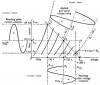


VACUUM TUBE OPERATING GRAPH 1.JPG
 
In The amplifier is the bottom line in tube testing ! , Seems like in audio there is a second slope or dropping, climbing slope tube data charts fail to address.
 
Last edited:
The graph below explains all of this. When a person understands this graph, they understand tube bias.

As can be seen for the operation point of this vacuum tube circuit, the voltage swing for the grid circuit is the same for the both sides of the sine wave (balanced it you will).

When you look at the resulting grid circuit and plate circuit wave forms, you can see that both sides of the sine wave are not the same. As one can see, this allows us to know what is happening as the waveform swings so to speak.

Again, how much is audible is subjective and not part of a technical discussion all though we can have that discussion.

Some people will adjust the bias to sweet spot in terms of the subjective sound quality, for a particular amplifier or particular brand/type of vacuum tube and that is okay for that person as long as it is not injurious to the vacuum tube or the amplifier.

The vacuum tube used for this graph is not the most linear vacuum tube, but it serves its purpose for this discussion.


View attachment 754993
It seems to me over the years working on tube amps and design that two things surface over and over again to my ears, input voltages and tube bias tone as I call it, guitar amps seem really sensitive to this playing clean with a low MV input signal, many use a wah wah pedal or something else similar to increase the input signal and to adjust the tone with, it certainly works to some extent if the tubes are not totally flat sounding, audio amps do not seem to suffer nearly as much from this with vintage tubes and with higher input voltages. Usually I notice this in higher powered amps 40 watts and up , though I have seen a few 5 watt amps suffer from it as well but some say that is a just a worn out OT and is not in the tubes or in the bias. I tend to agree with them on this. Class A uses only the positive swing and it sounds better , hotter tubes and shorter tube life. PP cancels some PT humm that is always a problem child and a basic flaw in tube amp design, If only some tube of isolation could replace PT's and their noise somehow ? , Bogen came the closest to eliminating it with the DB230A Golden, and after his accomplishment with GE 6AV5GA tubes no one else did much to explore that area of tube amp research. Those amps certainly have found the sweet spot of tone and Idle quality especially with good tubes installed in them. Bias does affect tone , there is no argument there, but so does input signal voltage another area where Bogen saw the problem and fixed it or controlled it with a voltage regulator tube. Most Fisher amps came with what are today high dollar vintage tubes, Bogen also offered those tubes as options not standard trying to reduce the purchase price and letting the consumer decide how much it would cost them. The yo yo swing of PP still has to complete the cycle no matter where you set it, taking it from one place and setting it at another is all the listeners subjective, another person may not like it there. All our ears are different , some like bass others trebles, I just think there is cause and effect going on sound wise when you change bias where you gain some sound and lose some other sounds ! , You do not always or ever get both things, you decide what you gain for what you lose, factory settings are a tone bass middle ground considering tube quality and deficiencies. The bias can help speakers and units lack of both as a entire sound system , but they never really fix bad mixes of equipment, they only put a band aid over the wound.
 
Last edited:
It seems to me over the years working on tube amps and design that two things surface over and over again to my ears, input voltages and tube bias tone as I call it, guitar amps seem really sensitive to this playing clean with a low MV input signal, many use a wah wah pedal or something else similar to increase the input signal and to adjust the tone with, it certainly works to some extent if the tubes are not totally flat sounding, audio amps do not seem to suffer nearly as much from this with vintage tubes and with higher input voltages. Usually I notice this in higher powered amps 40 watts and up , though I have seen a few 5 watt amps suffer from it as well but some say that is a just a worn out OT and is not in the tubes or in the bias. I tend to agree with them on this. Class A uses only the positive swing and it sounds better , hotter tubes and shorter tube life. PP cancels some PT humm that is always a problem child and a basic flaw in tube amp design, If only some tube of isolation could replace PT's and their noise somehow ? , Bogen came the closest to eliminating it with the DB230A Golden, and after his accomplishment with GE 6AV5GA tubes no one else did much to explore that area of tube amp research. Those amps certainly have found the sweet spot of tone and Idle quality especially with good tubes installed in them. Bias does affect tone , there is no argument there, but so does input signal voltage another area where Bogen saw the problem and fixed it or controlled it with a voltage regulator tube. Most Fisher amps came with what are today high dollar vintage tubes, Bogen also offered those tubes as options not standard trying to reduce the purchase price and letting the consumer decide how much it would cost them. The yo yo swing of PP still has to complete the cycle no matter where you set it, taking it from one place and setting it at another is all the listeners subjective, another person may not like it there. All our ears are different , some like bass others trebles, I just think there is cause and effect going on sound wise when you change bias where you gain some sound and lose some other sounds ! , You do not always or ever get both things, you decide what you gain for what you lose, factory settings are a tone bass middle ground considering tube quality and deficiencies. The bias can help speakers and units lack of both as a entire sound system , but they never really fix bad mixes of equipment, they only put a band aid over the wound.

Gary,

Everything in audio is a compromise. Balancing the strengths and weaknesses of every element to arrive at the sweet spot is the art of it.

Think of it like good cooking. A careful recipe is often more important than the ingredients themselves. That last dash sometimes makes all the difference between wonderful and average.

A vintage Fisher can be both a horrid sounding unit, or a magically musical one, depending on what you pair it with, and its internal complement of elements. Everything plays a function.

I do agree, in the final analysis I value tone more than anything else at this point. I will sacrifice a lot of 'resolution' and extension for a more natural, musical tone.

As the years have passed, I tend to take greater issue with 'scope listeners'. Some of the worst-sounding systems I ever heard looked perfectly beautiful on a Tek.

The ears are still a more precise tool for some things.
 
Back
Top Bottom