• The move to the new server is done. There are some software and database maintenance updates in process. This has us passing the hat around to help out. We appreciate any donations. Seriously, even a dollar helps. The payment page may be found here - https://www.audiokarma.org/support.html

Fisher Loudness Contour - Modify to Reduce Bass Boost

BGME

BGME
I would like to experiment with modifying my Fisher 500b to reduce the amount of bass boost provided by the Loudness switch. I like the Loudness feature for certain types of music, but the amount of bass boost provided by the switch on my Fisher is way too much and muddies the sound, even with the Bass tone knob turned down. I suppose I could just stop using the Loudness switch and get about the same results by turning up the Bass, Treble, and Volume to taste, but then I wouldn't get to spend money on parts and smell solder.

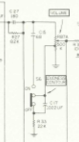
The Loudness circuit is simple: a 68 pf capacitor from input to the center (4th) tap on the Volume pot, and a .02 uf capacitor and 22K resistor from the center tap on the Volume pot to Ground. I believe this is the same circuit used in the Fisher 500c and 400 and is almost identical to the circuit used in some Scott amps.

My understanding is that the two capacitors when combined have the effect of rolling off mids but leaving lows and highs, resulting in a relative boost of lows and highs at lower volumes. So maybe changing the .02 uf capacitor to a higher value would roll off more lows?

Has anyone experimented with this type of modification? Any suggestions?
 
Register to hide this ad
Not quite -- It's the other way around. The midrange frequencies are left unaffected, while the lows and highs are in fact boosted. The highs are boosted by the 68 pf (the bigger the value, the greater the boost), while the 22K and .02 determine the bass boost. Here are some guidelines to help you with your adjustments on the low end:

1. If you increase the value of the .02, you effectively lower the frequency range, or window of low frequencies that is boosted. Lowering the value of the cap will raise the window.

2. The 22K does work in conjunction with the .02 to determine the window of frequencies boosted, but primarily determines the amount of boost provided. Raising the value of this resistor will reduce the amount of boost. Lowering it will increase the amount of boost.

It was not uncommon for loudness circuits to provide as much as 14 db of bass boost back in the day, because records and recording styles were not conducive to transferring large amounts of bass energy to that medium. Today, with seemingly unlimited LF energy available from modern sources, scaling back the loudness boost makes perfect sense.

Dave
 
Last edited:
Thank you Dave, very helpful! I will use these guidelines to try some modifications and will post my findings.
 
I cut ldns connect out of the circuit completely.
no effect on sound on any of the amps I have.
but thats just me.
 
I really need to look into this on my TA-600 and on my Pilot preamp. Both have a somewhat over-zealous loudness boost. The one on the Pilot boosts frequencies that are a bit too high, and the Fisher just boosts too much. I'll map it out before I change anything though just so I know what exactly its doing.
 
Reporting back on the results of some modifications:

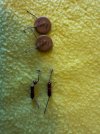
I increased the value of the 22K resistor, and I am very happy with the results. I experimented with a few different values, and I settled on adding a 5.6K resistor (increasing the total value to 27.6K) in each channel. To my ears and on my system, this provided the right amount of bass and treble boost for the types of music and recordings that benefit from the loudness circuit. The result is a nice increase in presence and energy without muddiness or bass overload.

After I found the resistance value that sounded the best, I did some primitive audio spectrum testing.
  • Bass: At my normal listening volume, with the 27.6K resistors, bass frequencies were boosted by 11-13 dB with the loudness circuit on, which is 2-4 dB less than the amount of boost provided by the original 22K resistor. Interestingly, I was surprised to see the amount of measured harmonic distortion in bass frequencies with the loudness circuit on, particularly with the original 22K resistor. For those of you in the "no loudness" camp, this supports your position. But using the 27.6K resistors did greatly decrease the measured harmonic distortion of bass frequencies compared to the 22K resistors.
  • Midrange: For midrange, the dB's were about the same with or without the loudness circuit on and for both resistor values.
  • Treble: High treble frequencies increased by about 5-6 dBs with the 27.6K resistors over the 22K resistor, so there is a noticeable treble boost with the higher value resistors, which, to me, was a favorable change. But if anyone is looking to decrease both the bass and treble boost provided by the loudness circuit, changing just the resistor value is probably not for you, and you would need to experiment with changing the cap values as well.
I also tried resistors of 33.2K and 44K, and the result was a sound that was too trebly/glassy, to my ears. I did not have proper value capacitors on hand to experiment with changing the value of the caps. I am very happy with the 27.6K mod and have kept these resistors in place for some extended listening tests.
 
Back
Top Bottom