• The move to the new server is done. There are some software and database maintenance updates in process. This has us passing the hat around to help out. We appreciate any donations. Seriously, even a dollar helps. The payment page may be found here - https://www.audiokarma.org/support.html

Fisher x-101-st Project Amp

Chadrick

New Member
I recently bought a Fisher x-101-st integrated amp as a project. It was pulled from a console, and totally working, but with modifications. The volume knob "off" switch had stopped working at some point, and the loudness switch was repurposed as the on/off switch. It seems the loudness circuit was hardwired always on, because the bass and treble are outrageous. Other than that, I love the sound of the little thing driving my NS-1000s, and I must have it.

Anyway, I decided that the easiest way to get to the sound of the tubes was to attempt to separate the preamp and amp sections, then drive the amp section with my existing preamp, rather than getting into the jumble of preamp/filter circuitry to figure out how it was hacked.

I'm a complete newb.

I started by downloading the service manual, flipping the amp over, and taking off the bottom cover. After studying the circuit, it seemed that the last "preamp" component was the balance knob, which is connected to the 12ax7 with a 68k resistor. I confirmed the values of a few resistors and capacitors with my multimeter to make sure I was using the right schematic.

It seemed like the easiest way to substitute my signal for the preamp signal would be to take the wires from the balance knob and connect them to the (unused, by me) tape output jacks - turning those into the power amp inputs. I desoldered the tape out wires from the jacks and taped those apart and out of the way. I then desoldered the wires from the balance knob and routed them to the former tape out jacks.

This did not work ;)

I now get a loud hum from both channels after things heat up, and if I leave it going for more than a few seconds, the phono preamp tube filaments start into some sort of unnatural glowing situation which makes me turn it off immediately.

Are there any kind souls out there that could help me get closer to my goal, or at least not start a fire?
 
Register to hide this ad
Let's see the schematic. Usually an external preamp would be in putted at the 12AX7 AF amp/phase inverter at pin #2 of each channel. Put it back the way you had it originally, and then do this.
 
Well, I tried this morning to wire everything back up the way I had it, turned it on, and no hum, but the phono tubes still displayed the unnatural glowing, so I bailed and turned it off again. I pulled the phono preamp tubes, and turned it on again. This time I waited until everything heated up completely, things were fairly quiet - no hum, but a little bit of hiss that might have been there before without music playing - but I could not hear the music through the speakers.

Within less than two minutes, something started smoking heavily, forcefully spewing smoke out of the bottom of the chassis. After turning it off and unplugging it, I examined the parts that I could see and nothing seemed scorched or burned, so I assume it was the can capacitor forcing smoke through one of the small ventilation holes in the chassis.

So I guess I am in the position now of trying to trace the entire amplifier circuit to make sure I didn't screw up something else. There are only 19 parts on each channel from what I can see, including the output transformers, so it should not be too difficult. The preamp on the other hand is an unmanageable rat's nest, and I'd like to leave it alone for now.

I am hoping, however, that somebody can help me understand the following concepts before I do something really dumb.

1) The frying capacitor - does this indicate miswiring, or did I do something really stupid by removing the phono preamp tubes and running it?
2) It seems like disconnecting the preamp circuitry from the audio signal caused many more problems than the "minor" modification I thought it was. Do I need to disconnect power from the preamp section or do something else to make the amp section work without the preamp?
3) The schematic indicates that the grid of the AF amp side of the 12ax7 is on pin 7, while the phase inverter side is pin 2. Am I right that an external preamp input would be connected to the grid of the AF amp, therefore pin 7?
4) I did leave the tape out wires disconnected when I rewired the balance knob this morning. The wires are no longer connected to ground (channel B tape out was never connected to ground that I can see, but it does indicate that ground connection in the schematic). Could this have caused the can capacitor to smoke?
 
Hi Chadrick. I glanced at the thread, as I have the exact same amp. I wish I could answer the last questions you have posed but I'm not a tech. Based on the smoke and disassembly questions, I would recommend professional help. My amp was restored locally, sounds beautiful and is a keeper. Don't know where you are located but would respectfully suggest a hand off to a qualified tube technician. Perhaps someone can answer your four questions and best of luck.

TS
 
After additional inspection, the 100 mfd capacitor "C5" blew, as there is an obvious spray of white waxy residue in the inside of the chassis and on my desk emanating from the "+" end of the capacitor. This is in the circuit with the phono preamp tubes, so I am still not sure if the capacitor blowing is due to a miswiring, or due to trying to run it without the tubes. When the tubes were in, they started to glow like lightbulbs at the base of the tube, so something was wrong before I pulled them also, I guess.

The strange thing is that this capacitor still reads 100 uF on my multimeter. Is it toast? Or can I still use it?
 
Change it, and then try the phono tubes again. Also you might want to go thru th whole unit and replace ALL of the electrolytic's.
 
Thanks very much for the response. If I am reading this schematic right, there are only three electrolytics in the entire amp, other than the power supply can capacitors C1 and C2 on top (how the heck do you replace those?). The smoking 100 uF C5 which is in the 24/12 volt AC supply, which looks like it is used to heat the phono preamp tubes and provide the "Z" power source, and two others C3 and C4 that are deep in the preamp mess, which I'd like to leave alone for now, if possible.

I replaced the phono tubes V1 and V6 to try again, no smoking, spewing capacitor anymore, but they are still glowing bright like a lightbulb, I do not remember them being like that and am afraid they will burn out if I leave the amp on. However, I realize now looking at the schematic that these are heated by 24/12V AC instead of 6.3V, and that at least one of these tubes seems to be needed for the amp section ("Z" power supply?), am I wrong? Can I bypass these tubes somehow and rest easier?

I'd like to just disconnect and power down all of the preamp circuitry to make sure it is not giving me problems. It seems like I can disconnect the 10K resistor R86, right after the 305V DC source, which would kill power to everything in the preamp but the phono tube filaments, which are on this 24/12V AC source. But then how can I turn off or bypass the filaments of the phono tubes, and do I need them for "Z" power source?
 
The phono tubes (I'm still trying to find a compatible manual) tubes are part of the cathode BIAS circuit, in that their heaters are used for the resistance to get 24V for CATHODE BIAS. Any of these tubes out or disconnected will affect the output tube bias, possibly causing redplating of the output tubes and subsequent replacement of same. DO NOT REMOVE THE PHONO TUBES AND TRY TO RUN THE UNIT.

Your C-3, C-4, C-5 id does not correspond to electrolytic's in any of the X-101 type manuals that I have. The closest manual to the X-101-ST is for the EXECUTIVE V Console with the X-1000 which is the console designation for the X-101-ST. Suggest you look that one over.
http://www.fisherconsoles.com/executive V and VI.html

Suggest you ask for this thread to be moved to the FISHER FORUM. The FISHER GURU's are more accessible there.
 
Last edited:
Which manual are you using????? You need to use the EXECUTIVE V CONSOLE Service Manual for the X-101-ST. The console version is the X-1000. As there is NO X-101-ST manual available use the EXECUTIVE V MANUAL. http://www.fisherconsoles.com/executive V and VI.html And we need the serial @ off your X-101-ST. There are a couple of changes between the X-101 and the X-101-ST that are covered in the Executive manual.
 
I was also going to mention the phono tubes being the cathode resistor. If the coupling caps are leaky, you will have problems with excess voltage on the phono heater circuit. On the Sams schematic linked, these are C29, C30, C52, C53.

Even if thats not the exact right schematic, the coupling caps will be in the same general area and do the same task.

Honestly I'd make it work correctly in stock configuration first, then consider making changes. At the moment you don't know if the problems are pre-existing or have been introduced by modification so it would help to minimize any variables.

There are at least 6 electrolytic caps in here just with a quick glance. C5 on the cathode circuit of the phono tubes, the other 5 are in the high voltage supply, most likely in the form of multi-section cap or caps. There may be another few in here someplace but I didn't take a lot of time to study the schematic. Expect those to be fairly small value, probably tied off a cathode of a small signal tube, and not absolutely critical for basic function without letting out the smoke. They should be replaced to make sure everything works as it should though.
 
Depending on which version you have, the cap almost certainly blew because you operated the unit without the phono tubes installed. Replace the cap and reinstall the tubes. But also follow Larry's restoration advice as well.

Your approach to injecting a signal into the power amp section should work. It's not ideal, but should work for you to carry out your experiment -- although I would also add a 1 meg resistor to ground at each power amp input jack as well to ensure a DC return path for the driver tube grid (which may or may not actually be necessary depending on which version you have, but cannot hurt in any event). As for any other problems, they could easily be due to the quality of work: The tape output jacks on this unit are located in the power supply and output stage area. If not neatly done, a modification of this type could easily result in hum and or feedback problems.

I hope this helps!

Dave
 
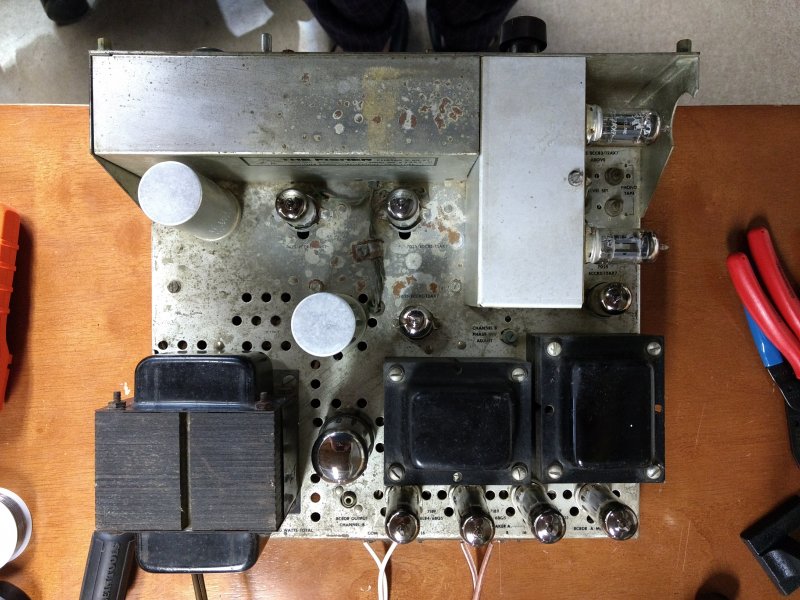
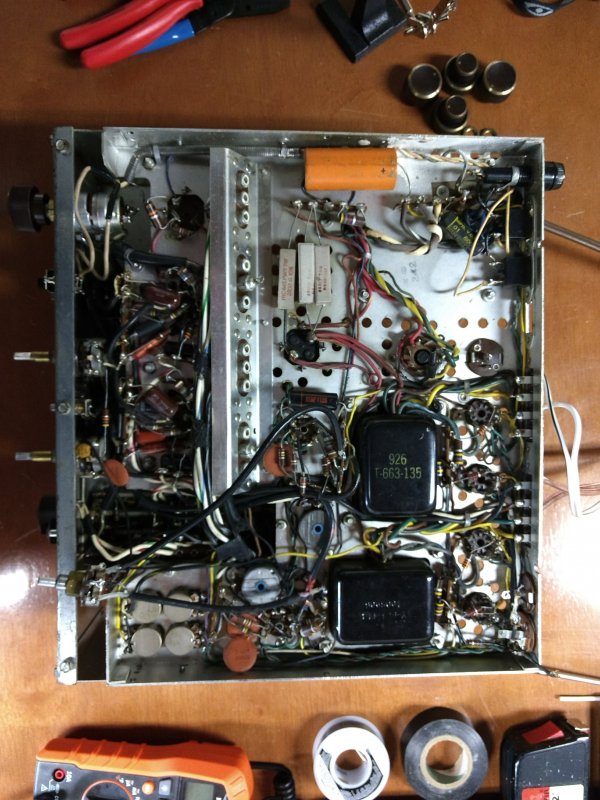
Can you take a couple of overall pics of top and bottom so we can positively ID this amp, please.
 
I found both of these also:

http://www.fisherconsoles.com/service manuals/executive v sm.pdf
http://www.fisherconsoles.com/non console manuals/fisher x101 10001 29999 sm.pdf

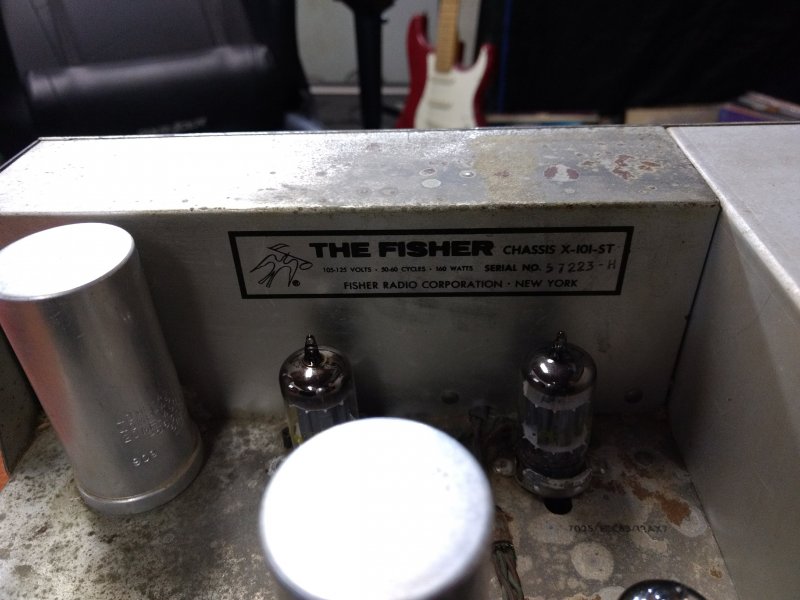
Thank you Larry, the Executive V makes a lot more sense, as there is a missing resistor in my amp, compared with the other two X-101-ST service manuals I've found (also linked in this thread). The manual I was using was really close, and I was unable to tell if the "minor" differences were the result of a wrong schematic or of modifications. The serial number of my amp is 57223-H.

The smoking resistor, according to the Executive V schematic, is C29 not C5. The main difference in this area, which was confusing me, was the absence of the 920 ohm resistor in parallel with this capacitor, which doesn't exist in the X-101-ST schematics - instead my amp (and this schematic) have a couple of composition resistors, a 10K and 6.8 K, instead. The Executive V is definitely the right schematic, and it seems despite the other modifications with power switch and loudness circuit, this part of the circuit is original.

While my confidence in getting the amp section working on its own may be misguided, my lack of confidence working in the preamp section is the barrier to bringing this thing back to original condition. It is a real rat's nest of wires and parts in there, and since I have a very nice Sony TA-1130 integrated which has a (convenient) switch to separate the amp and preamp sections, I figured I'd use that to drive the amp section of the Fisher, and get the preamp section working another day, after I've gained confidence with the amp.

If the capacitor in this position is leaky, would it cause the symptom I am describing in the phono tubes where they glow like lightbulbs? Can I replace the tubes in this circuit with a resistor instead (after I replace the leaky capacitor) since I don't need the triodes for the audio signal? I am going to replace the capacitor and try again with the phono tubes in place, but would like to pull these out of the circuit entirely if possible, as I ultimately plan to assemble the amp in a new chassis and completely rewire it, as soon as I get it working properly again, and I don't want to have two extra 12ax7 on top just to be resistors. The final amp should have (4) 7189s, a GZ34, and (2) 12ax7s, along with the can capacitors (which I might replace with multiple new electrolytics underneath?) and transformers, if I am thinking straight.

This is the capacitor I was thinking of getting: https://www.mouser.com/ProductDetail/Illinois-Capacitor-CDE/107TTA450M?qs=sGAEpiMZZMsh%2b1woXyUXj6tSaZI%2bOgx/BoRY4ic0sZ0=. Is that suitable? At $1.13 each it is a value, but would something more expensive be better here? How does one choose which capacitor to replace with?

If I decide to replace one of these composition resistors because it has drifted in value, what type of resistor should it be replaced with?

Also, I lol'd at this "DO NOT REMOVE THE PHONO TUBES AND TRY TO RUN THE UNIT." I am pretty sure that is what caused this capacitor to blow chunks. I'm a newb, but should have tried harder to understand the schematic before doing that.
 
Last edited:
Yep! That's the X-1000's non-console brother. Here's an option. You want to make a straight amp with a gz/34,2-12ax7's, and a quad of 7189's. Why don't you pick up a 480A, 481A, or 490A amp out of a 63 to 64 Custom Electra Console. The only difference is the Rectifier which isa 6x4 IIRC, and it only needs a 270ohm 10W resistor and a couple of caps to make it standalone. Then work on the X-101-ST at your leisure.

This way you've got the best of both worlds. You don't have to frankenstein the X-101-ST, and you've got a good amp with enough power to do what you want to do.
 
It's obvious even to me at this point that any sort of standalone power amp would have made this situation a lot easier, but it has taken me forever just to find this rat's nest baby at a price I can afford to risk chopping it up myself. Fisher stuff is usually really expensive even on Craigslist, and I'd want a pro to work on it if I had spent significant money on it. I do have my Sony integrated playing right now while I work on this, so I'm not in any emergency at this point (Maybe a solid state emergency?) I paid a low parts only price for it, knowing it worked, but not much else.

I normally wouldn't have done what I've done here, but the amp was already modified to the point it was kind of unusable because of the loudness being hardwired in.
 
It's obvious even to me at this point that any sort of standalone power amp would have made this situation a lot easier, but it has taken me forever just to find this rat's nest baby at a price I can afford to risk chopping it up myself. Fisher stuff is usually really expensive even on Craigslist, and I'd want a pro to work on it if I had spent significant money on it. I do have my Sony integrated playing right now while I work on this, so I'm not in any emergency at this point (Maybe a solid state emergency?) I paid a low parts only price for it, knowing it worked, but not much else.

I normally wouldn't have done what I've done here, but the amp was already modified to the point it was kind of unusable because of the loudness being hardwired in.
Yeah, my only comment is actually for those other tube novitiates who read this. And that it is not a good idea to experiment with a stock circuit unless you are willing to accept that there is a very good chance that bad things can and will happen. This can not help you, but if it helps others this cautionary tale is most helpful. I hope you can get this back to normal as it is a good amp and actually rarer than most Fisher amps. regards, Primo
 
I feel a bit judged right now, so I'll defend myself again by saying the circuit was already modified before I bought it, LOL. I guess I'm like the guy who cuts up a Ferrari to find out how a car works, but at least when I finish I'll have a really nice amp. Going through all this and ending up with poor quality output transformers, etc. would have been a bummer. Also, I couldn't have bought a kit of any quality level for the little money I put into this amp. While the dumb move with the phono tubes destroyed the capacitor, I actually did anticipate a period of time where the amp would not work, before I made it work, and anticipated that I would have to replace several parts to get everything sailing smoothly again. When I get through this, I may get the courage to try to convert the remaining pieces into a preamp, so I don't intend to chuck that part.

I do really appreciate the help from this forum, and hope that the forum content helps other newbies either avoid my situation, or jump into it, if that's what they want.
 
Hey I got one of those. Real good tuner. Good enough for Saul MARANTZ to use until they got the Model 10 out on the street. Here's the link to one story about it.

http://www.classic-audio.com/marantz/mfisher.html
f101ra.jpg

Chadrick;
I'm NOT judging you I'm just questioning WHY not get an 480a, 481A, 490A amplifier as that's literally what you'd end up building by separating the amp from the preamp. Then you can work on the X-101-ST(which is damned near as rare as hens teeth!) at your leisure and fix it right. 95% chance is good, that you could re-sell the straight amp later for a profit.

Check around on CL for 1963 or 64 Custom electra consoles. Or even look around on BARTERTOWN, which is a subscriber only section for the amps. Get the rattiest console, and gut it saving the amp and possibly the Turntable. Convert the amp to Standalone. I picked up a damned near pristine 64 Early American Custom Electra for FREE today. Another AK'er(Buglegirl) hooked me up to it and I contacted the owner very early. 2 hour drive to Lancaster Pa, load it up, and back home. Replace 2 missing EL-84's and DBT it. Works fine, but scratchy.. This is the 2nd FREE '64 C.E. I've snagged Since December. You can look on CL in surrounding areas and other large metropolitan areas. If you find one that's free, get on the horn, lease, sell, or rent your soul, and get it. No matter if you have to drive 150miles one way. The supply of FISHER Amps is finite and audiophoo uuhhhhh Audiophiles are getting these amps and converting them to standalone. Some are doing this to flip and gouging the prices.

Larry
 
Last edited:
Back
Top Bottom