

You are using an out of date browser. It may not display this or other websites correctly.
You should upgrade or use an alternative browser.
You should upgrade or use an alternative browser.


bzenic
Active Member
I tested one cheap STK from ebay paired with an original STK.
I wasn't going crazy with volume, and the impression is pretty good.
The thing I was excited about the most was that the ebay STK was playing much cooler than the original.
Just to add, they both were mounted on bare metal, I did not bother putting heat compound at this stage.
I wasn't going crazy with volume, and the impression is pretty good.
The thing I was excited about the most was that the ebay STK was playing much cooler than the original.
Just to add, they both were mounted on bare metal, I did not bother putting heat compound at this stage.

you're playing with fire by not using any compound on those STK's, even for short time testing. They DO heat up quick, and without compound, Not enough heat transfer between the backing and the heatsink. You don't need much; like Brylcreem, a little dab'll do ya.. Best practice for STK's and Heatsink compound is; "All the time, EVERY TIME"!
Bias is preset in the chip at the factory, so it's not adjustable. Sometimes you get a HOT one, sometimes a cold one.
Bias is preset in the chip at the factory, so it's not adjustable. Sometimes you get a HOT one, sometimes a cold one.
bzenic
Active Member
Still trying to fix the issue with FM stereo.
I replaced PA1001, two infamous transistors 726 with 992s and a bunch of electrolytic caps in tuner (3 x 220 uF, 2 x 4.7 uF and one 6.8 uF) but still have a problem on one channel: as soon as I turn the volume up above certain level one channel becomes very noisy, crackling and interrupting.
The other channel seems to work ok.
There is no any issue when playing CD on AUX, both channels work well.
Can anybody advise?
I replaced PA1001, two infamous transistors 726 with 992s and a bunch of electrolytic caps in tuner (3 x 220 uF, 2 x 4.7 uF and one 6.8 uF) but still have a problem on one channel: as soon as I turn the volume up above certain level one channel becomes very noisy, crackling and interrupting.
The other channel seems to work ok.
There is no any issue when playing CD on AUX, both channels work well.
Can anybody advise?

Yes, there is a muting gate on the FM tuner output, that's why pins 4 & 5 of the AWE-099 tuner board have NO coupling capacitors, Pioneer WANTS a 5v DC bias on these lines. Q28 (left, 2sk34) and Q29 (right, 2sk34) are turned on and off by Q30 (2sc945). There are various switching functions where mute is pulsed when the function switch is moved.
first check pins 4 & 5 of the tuner for 5v dc on each.
then I would swap Q28 & Q29 and see if the problem moves to the other channel (a bad Q2x)
or if it stays put, Qx is blameless and the rest of the circuit around Qx needs work.
You DO need to differentiate which channel, not just "one channel" or "the other channel".
you said it was volume related - it sounds like the DC for this circuit is getting to the volume control. That's C401, C402, C403 & C404. The effects may be "backflowing" from the (impedance of) volume control to these jfet circuits.
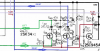
first check pins 4 & 5 of the tuner for 5v dc on each.
then I would swap Q28 & Q29 and see if the problem moves to the other channel (a bad Q2x)
or if it stays put, Qx is blameless and the rest of the circuit around Qx needs work.
You DO need to differentiate which channel, not just "one channel" or "the other channel".
you said it was volume related - it sounds like the DC for this circuit is getting to the volume control. That's C401, C402, C403 & C404. The effects may be "backflowing" from the (impedance of) volume control to these jfet circuits.
Last edited:
bzenic
Active Member
@markthefixer, this was amazingly helpful!
Voltage at tuner board pins 4 and 5 was ok, about 5.1 V.
One thing was solved by replacing all four 0.47uF caps with Wima film caps: there is no more intermittency.
I also swapped Q28 and Q29 but the problem with crackling noise above certain volume level persists on the RIGHT channel, the same channel that was problematic before swapping FETs.
One more thing to add: a lot of noise is generated if I touch and hold metal shaft of the volume pot. I've just noticed this, the noise is generated even at MONO FM on both channels.
I had already cleaned volume pot with DEOXIT.
What should I try next?
Voltage at tuner board pins 4 and 5 was ok, about 5.1 V.
One thing was solved by replacing all four 0.47uF caps with Wima film caps: there is no more intermittency.
I also swapped Q28 and Q29 but the problem with crackling noise above certain volume level persists on the RIGHT channel, the same channel that was problematic before swapping FETs.
One more thing to add: a lot of noise is generated if I touch and hold metal shaft of the volume pot. I've just noticed this, the noise is generated even at MONO FM on both channels.
I had already cleaned volume pot with DEOXIT.
What should I try next?
Last edited:

I fixed the "noisy pot" problem by replacing the caps C217, C218, C207, C208.
Unfortunately the main issue still persists: with increasing volume on FM STEREO the right channel becomes noisy, with a lot of crackling.
Just to be sure - "increasing volume" means YOU are physically turning the volume up, correct?
But it does not happen on AUX or PHONO? (at that point all three should be treated the same, there's nothing to distinguish them from each other.)
under 2 sets of conditions:
A: empty air no AUX or PHONO input..i.e.quiet
B: program audio flowing through, with external influences able to control their volume
??
bzenic
Active Member
Yes, slowly turning the volume knob.Just to be sure - "increasing volume" means YOU are physically turning the volume up, correct?
I'm not sure I completely understand this.But it does not happen on AUX or PHONO? (at that point all three should be treated the same, there's nothing to distinguish them from each other.)
under 2 sets of conditions:
A: empty air no AUX or PHONO input..i.e.quiet
The distinction is that CD @AUX works fine on both channels when the volume is turned up
but when nothing is connected to AUX or PHONO and only FM STEREO is playing then the noise occurs abruptly on the right channel when turning the volume up.
Yes. FM STEREO sound on the LEFT channel can be turned up and does not ever produce noise.B: program audio flowing through, with external influences able to control their volume
??
Turning the balance completely to the RIGHT channel and turning VOLUME up starts to produce crackling, noise and interrupting.
It's possible that the low noise is present even at lower volumes, but there is no crackling, and then it explodes above a certain volume level, with a lot of crackling and popping sounds.
Last edited:
bzenic
Active Member
Further developments:
Today I tried using my SX-650 as a tuner, connected SX-650 REC to SX-780 AUX and confirmed that the problem is on the SX-780 amplifier, not the tuner.
Then I replaced a bunch of caps: C324, C325, C326, C327 and C310 in SX-780.
The final result is that crackling and noise almost disappeared on the right channel STEREO FM but I still get interrupting on the right or both channels when I play it louder.
Could it be possible that some diode is bad?
Today I tried using my SX-650 as a tuner, connected SX-650 REC to SX-780 AUX and confirmed that the problem is on the SX-780 amplifier, not the tuner.
Then I replaced a bunch of caps: C324, C325, C326, C327 and C310 in SX-780.
The final result is that crackling and noise almost disappeared on the right channel STEREO FM but I still get interrupting on the right or both channels when I play it louder.
Could it be possible that some diode is bad?
note to self: C324, C325, C326, C327 are meter capacitors.
C310 is neg regulator f/b
try replacing C207, C208, C213, C214, C217, C218.
The right OR BOTH?? channels when you play it louder.
another investigation:
sx-780 volume control position on quiet, sx-780 volume control with audio, or just volume of the audio?
C310 is neg regulator f/b
try replacing C207, C208, C213, C214, C217, C218.
The right OR BOTH?? channels when you play it louder.
another investigation:
sx-780 volume control position on quiet, sx-780 volume control with audio, or just volume of the audio?
Question was to isolate whether it was signal amplitude related, or volume control position related. Volume control can present different impedances to the op-amp circuit. IF DC leakage is getting through....
Just replace C207, C208, C213, C214, C217, C218.
Bad cap, inappropriate DC on the op-amp - disturbs power to both op amps when bad enough.
Just replace C207, C208, C213, C214, C217, C218.
Bad cap, inappropriate DC on the op-amp - disturbs power to both op amps when bad enough.
Last edited:
bzenic
Active Member
you're playing with fire by not using any compound on those STK's, even for short time testing. They DO heat up quick, and without compound, Not enough heat transfer between the backing and the heatsink. You don't need much; like Brylcreem, a little dab'll do ya.. Best practice for STK's and Heatsink compound is; "All the time, EVERY TIME"!
Bias is preset in the chip at the factory, so it's not adjustable. Sometimes you get a HOT one, sometimes a cold one.
@larryderouin
I got what you're saying but all the time I was testing this SX-780 both original and ebay STK-0050 were hardly noticeable warm on touch, with the original definitely a little warmer. The only reason I did not apply some thermal paste is the mess I would have definitely made.
bzenic
Active Member
No luck with replacing all the capacitors around op amps with Wima film caps except the two 47 uF 6.3 V, which were also replaced.
From all the testing so far I would assume that some faulty transistor must be responsible for this crackling on the right channel. What would be the most likely culprit?
From all the testing so far I would assume that some faulty transistor must be responsible for this crackling on the right channel. What would be the most likely culprit?
Last edited:

messes cost vitually nothing to clean up. taking the chance is not worth it to me.@larryderouin
I got what you're saying but all the time I was testing this SX-780 both original and ebay STK-0050 were hardly noticeable warm on touch, with the original definitely a little warmer. The only reason I did not apply some thermal paste is the mess I would have definitely made.
It's probably the Q3(left) or Q4(right) TA7136p chips. ESPECIALLY when the effect translates to the other channel.No luck with replacing all the capacitors around op amps with Wima film caps except the two 47 uF 6.3 V, which were also replaced.
From all the testing so far I would assume that some faulty transistor must be responsible for this crackling on the right channel. What would be the most likely culprit?
after that it's all power amp parts.
Try swapping the op-amps U3 & U4, see if the initial presentation
moves to the other (left) channel.Turning up the volume first causes interruption on the right channel only and after that, intermittently, both channels interrupt.