
• The move to the new server is done. There are some software and database maintenance updates in process. This has us passing the hat around to help out. We appreciate any donations. Seriously, even a dollar helps. The payment page may be found here - https://www.audiokarma.org/support.html

Fixing snapped capacitor lead

Mat86

Active Member
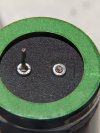
So long (stupid) story short, was bending the lead of a filter cap (manufacturer recommendation!) and went for one final nudge to line things up nice and it snapped off at the base. First instinct is to solder on a more flexible lead from a donor cap, but just wanted to make sure before I potentially make things worse

The cap in question has 1.2mm leads, and the untinned lead copper is exposed at the base where it snapped. The donor leads I have are 0.8mm diameter, if that matters.
 

Attachments

  • PXL_20231014_024354325.jpg
    PXL_20231014_024354325.jpg
    123.4 KB · Views: 21
Register to hide this ad
What I'm confused about is, if soldering a new lead on would be damaging, why did they previously recommend bridging the leads to convert 4 to 2 pins? That would involve, I imagine, either soldering at all the bases, or bending two over (ahh!) and soldering as well
 
You can try soldering a pigtail onto the stub. I just have my doubts that the solder will even stick to the stub and be a reliable connection.
 
You can try soldering a pigtail onto the stub. I just have my doubts that the solder will even stick to the stub and be a reliable connection.
If I was to try I would use flux, and use a spade tip and the highest melting temp solder I had. When I soldered the cap to the board I would use the lowest temp solder I had, hoping that the tacked on lead would hold up. You might also be able lay the lead down a bit on the board and get your solder point a little bit further away from the hole (and your tack job). Before you even install on the board I would give it a serious tug, if it doesn't hold up to a good tug it's not worth putting on a board.

All this stuff takes time, and it might just be easier to get a new one.
 
You can try soldering a pigtail onto the stub. I just have my doubts that the solder will even stick to the stub and be a reliable connection.

Why wouldn't it stick to the lead stub? I thought it was an excess heat issue holding the fix back (suggested above)

All this stuff takes time, and it might just be easier to get a new one.

true, and I've already filed the RMA today so won't get to try this now unless I wind up right back here (knock on wood) o_O
 
What I'm confused about is, if soldering a new lead on would be damaging, why did they previously recommend bridging the leads to convert 4 to 2 pins? That would involve, I imagine, either soldering at all the bases, or bending two over (ahh!) and soldering as well
I would think that these are primarily intended for use in PCB's, hence any jumpering from 4 -> 2 pins can/should be done on the PCB? - but in any case this shouldn't need/require the use of bending those leads.
 
Though you can try soldering/welding a new wire to the stub I'm more concerned about melting the plastic seal there... do it fast or do put it in the trash :(
I would not try to use high melting point solder here, have to spot weld if you have the tools (still very hard to do!), else try to solder as fast as possible before the seal melts, this is the job for low melting point solder. Also note if planning to "solder" a wire straight onto where the other broke off, that won't work, you'll likely have to solder a loop of wire around the whole stub so you get mechanical strength, plus solder is quite resistive compared to copper. Make sure all surfaces are clean, get your file/sandpaper out!

The other thing that will help depending on how much inductance/resistance/physical area is acceptable is to solder longer leads so that you have more thermal resistance when soldering one end of the wire. But this depends on the circuit you're using it in whether the resistance/inductance is acceptable. The longer leads also allow you to temporarily add heat sinking clips to help not melt solder in the wrong place... but you will have a gap if you're soldering to a pcb.
 
There is also the risk of cooking and thus breaking down the rubber seal`s long term integrity around the old lead pass through, plus cooking the capacitor`s internal electrolytic paste from the struggle to try to get a solid soldered connection, IMO/E !
 
Back
Top Bottom