• The move to the new server is done. There are some software and database maintenance updates in process. This has us passing the hat around to help out. We appreciate any donations. Seriously, even a dollar helps. The payment page may be found here - https://www.audiokarma.org/support.html

FM Dipoling For Fun. I Have Some Questions.

I have stuff at work that I can use- broom handle, meterstick, PVC, and the like so I will try the hot spot search. You suggestion makes it easy to do from the floor rather than my being in contact with it and moving around. I know that metal near the antenna is problematic as it will detune the antenna via changing its electrical length, among other things. But I also thought that free space mounting is optimal- insulator have an effect as well on any antenna. Correct?
 
I missed your edit when I replied to your previous question. But maybe my explanation will help others that are interested.

"But I also thought that free space mounting is optimal- insulator have an effect as well on any antenna. Correct?"

I am not sure what you mean by this.

Free space mounting is good, if possible.

Do you mean insulator as in insulation on the wire, insulators for the antenna elements, center and or end, or open air and spacing as an insulator?

In general what I have said will apply to "any antenna", however saying any antenna is painting with a broad brush. Not all antennae are created equal.

Good luck with your signal hunting. :D
 
I missed your edit when I replied to your previous question. But maybe my explanation will help others that are interested.

"But I also thought that free space mounting is optimal- insulator have an effect as well on any antenna. Correct?"

I am not sure what you mean by this.

Free space mounting is good, if possible.

Do you mean insulator as in insulation on the wire, insulators for the antenna elements, center and or end, or open air and spacing as an insulator?

In general what I have said will apply to "any antenna", however saying any antenna is painting with a broad brush. Not all antennae are created equal.

Good luck with your signal hunting. :D
By free space, I meant that the antenna is mounted in 'free space', away from anything- including insulating objects.
 
OK, I understand.

That would be the goal in a perfect world, because some things that we might consider insulating objects might not have the best dialectic properties.

For instance, there is a variation in PVC dielectric constants - from as little as just over 1 to over 5 is possible with PVC.

IIRC, white schedule 40 PVC pipe does not contain any metal filler.

Of course this would have a greater effect at FM broadcast band frequencies.

Fiberglass may be your your best material for your signal hunting antenna.
 
Last edited:
OK. I mounted the antenna outside- hot glued to a stone wall (the only option for attachment), broadside to station, horizontal, and 10' off of the ground. It's only a bit quieter that when inside, and still- only one LED signal strength. I have the coils right at the feed point and have only enough coax feed to make it to the receiver; i.e. the shortest run that I can have given the locations of antenna and receiver.

Any options beyond what's been suggested? Perhaps the stone has metal in it (I don't know what kind of stone it is). But I will NOT be able to set up a standoff from the wall.
 
OK. I mounted the antenna outside- hot glued to a stone wall (the only option for attachment), broadside to station, horizontal, and 10' off of the ground. It's only a bit quieter that when inside, and still- only one LED signal strength. I have the coils right at the feed point and have only enough coax feed to make it to the receiver; i.e. the shortest run that I can have given the locations of antenna and receiver.

Any options beyond what's been suggested? Perhaps the stone has metal in it (I don't know what kind of stone it is). But I will NOT be able to set up a standoff from the wall.

Was that an RF hotspot during your test? What were the results of your search for an RF hotspot?

Did you check the reception with the antenna in that location, but not against the wall?

Does horizontal orientation provide the most signal?

Have you tried a different tuner? Is your tuner section up to snuff?

As I mentioned in a previous post, the very strong signal may be driving the RF AGC in your receiver. A different tuner section may respond differently.

If you take a portable radio to the same location as your antenna, so that its antenna is in the same place, what is the quality of the reception. Walk around the building inside and out and see if there is anywhere that provides good reception.

At this point you need to determine if it is tuner related, antenna related, location related or RF field strength related.

All of that being said, I did a little on line research for you.

Your receiver, if working up to par needs about 40 microvolts of signal at the antenna terminals for about 50 dB of quieting.

I took a look a the predicted RF field strength for your station in your general location location. With reception it is location, location, location and I only have your general location.

It looks likes Towson is less than 500 feet AMSL. Any large hills. buildings or other obstruction between you and the and the radio station?

That said, with a receive antenna at 50 feet HAAT the expected RF field strength is only about 75 microvolts.

These are just rough conversions of dBf, dBm and microvolts.

Below 50 ft the station fell off of the charts. It did not show up on the charts with a receiving antenna HAAT of 25 feet.

Again it is location, location, location, you may be able to find a location for your antenna that will provide adequate reception, the RF hot spot.

The use of a very low noise RF preamplifier may be problematic due to the high RF field from your strong local station.

Depending on what you find, you may be looking at rooftop, the higher the better, directional antenna.

BTW, how well are you able to receive this station on your car radio? Is the signal strength constant an you drive around the location where you are are trying to receive this station?

With out actually being in you location, most of this is just generalizations and questions.

 
I set up a t-shaped device and looked around for hot spots. The best seemed to be outside one of my windows and 12" out from the wall that is lined with metal frameworking around the 7' tall, split frame window. I tried different orientations and horizontal gave two LED strength. The location that I chose was simultaneously higher, further away from metal, and further away from electrical noise sources. I did not specifically check the mounted location, but assumed that it would be at least as good as the lower, closer to metalwork situation. But it's not.

I believe that the tuner is up to snuff- there is no low signal problem from more local stations. Having said that, it has not had an alignment but again, it does not seem like it 'requires' one.

Thanks for researching. It receives on my car radio well but not perfectly. I do get multipath at certain intersections in Towson (near 100-200' buildings). But it is free of that at the school's location and there are no large structures other than trees and a small part of my building to the east of the antenna. But it was the case too when just outside my window.

If you look at this image, you'll see the 6 white-roofed trailers. To the NW of that is an addition to the main bldg. My room is on the first floor of the NW corner of that addition (dark cars parked at my windows) with one floor above me. I mounted the dipole with broadside E-W on the very NW corner (in the pic, on the left-facing wall in front of the open parking space).
ScreenShot2013-08-19at74527PM_zpsd9f597b9.png

The north side (in shadow) is a large iron fire escape stairway and in not suited for an antenna- I tried it with the hot spot locator.

Well, I guess that i'll need to decide whether to purchase 100' of coax to run this to the roof now, as I'm sure that you're right that it may be an elevation issue at this point. That is, unless you see something else to try now that you can see the local environment.

Tyler
 
You antenna locations are surrounded by structures that eat RF. :D

Remember, according to the online (may or may not be very accurate) RF field strength estimator for your location, the field strength at 50 ft AMSL (when looking at RF field strength it is not a bad idea to take into account surrounding structures) is just only marginally acceptable. Add in the loss in 100 feet of coax and it may still be a little iffy as they say. And this is with the antenna 50 feet in the air and in the open.

How much higher is the main building than the rooftop of your building?

Will a rooftop antenna be higher than the main building?

An antenna with a fair amount of gain will help, but may make the issue with the strong local station worse.

Use the lowest loss coax that you can and pay attention to correct installation of the F-59 style connectors (weather proof at the antenna end) if you install your own and use a high quality, weatherproof balun transformer at the antenna if required.

You could be looking at best half to three quarters of a dB loss in a balun matching transformer and at best over a 1.5 dB of loss in 100 feet of RG-6 coax.

In simple terms you can think of an antenna with a true gain over a dipole of 3 dB as gathering enough signal to make or almost make up for these losses. I would go with an antenna with more gain if possible.

At this point all you can do is try.

Before you permanently install the rooftop antenna and run the coax, it would not be a bad idea to give it try first. Mount the antenna on a broomstick take it to the rooftop and have someone aim it for the best reception. Again, look for an RF hotspot if possible.

Another thing to remember for an outside antenna is correct grounding. Look up the NEC requirements. A definite requirement in your situation.

My recommendations of climbing on a roof and working with the antenna are at your own risk.

In your situation, no guarantees on the final result.
 
"IMO receiving antenna design isn't as fussy as transmitting."

Contrary to popular believe, the construction of receiving antennae is just as important as for transmitting antennae.

The physics of antenna design does not change.

Absolutely true, but as a practical matter most receiving antennas seem to be mounted in sub-optimal locations, locations where one would never think of putting a transmitting antenna, hand-held FM rigs of course not considered. "Optimizing" most receiving antennas to the nth degree doesn't usually buy much because it isn't the antenna that's the problem. It's the surrounding environment that needs to be worked around, as you've well stated.
 
I'm pretty sure that getting the dipole to the top of my building will solve the problem. This morning before dawn, I put it higher and that helped. Moving the dipole so that one leg of it extends out beyond the corner of the wall mentioned two posts ago in the building pic brought signal strength to two LED's. Interestingly, and a bit perplexing to me, is that as the afternoon wears on, the signal gets weaker. Why would that be?

To answer your questions, the rest of the buildings are three-story- mine is two. I am not going to buy a Yagi or something like that- it will just be the dipole mounted somewhere.

Thanks again JBL. And you don't need to add the disclaimer at the bottom- I'm not one of THOSE people!
 
I'm pretty sure that getting the dipole to the top of my building will solve the problem. This morning before dawn, I put it higher and that helped. Moving the dipole so that one leg of it extends out beyond the corner of the wall mentioned two posts ago in the building pic brought signal strength to two LED's. Interestingly, and a bit perplexing to me, is that as the afternoon wears on, the signal gets weaker. Why would that be?

To answer your questions, the rest of the buildings are three-story- mine is two. I am not going to buy a Yagi or something like that- it will just be the dipole mounted somewhere.

Thanks again JBL. And you don't need to add the disclaimer at the bottom- I'm not one of THOSE people!

Difficult to know.

Changes in the atmosphere, dispersion and or absorption, may result in changes in the overall path loss.

The sensitivity of your receiver may change the longer that it is on.

I hope the gain in antenna height is enough to overcome your additional losses. Since you will be using your dipole, the signal will not incur the balun transformer losses, that will save about three quarters of a dB in signal loss.

Will you be able to have the antenna on a mast?

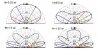
The pick up pattern of a dipole antenna, its radiation or take of pattern as it is sometimes referred to, will vary in relationship to the height of the antenna above ground (may be the actual ground or any conductors below the antenna.

See the picture below.

Changing the relative height of the antenna and the angle of the antenna from horizontal may provide some signal gain due to the lobbing of the antenna pattern.


Be sure to weatherproof your feed line connection at the antenna.

Good luck and let us know how it turns out.
 

Attachments

  • DIPOLE ANTENNA SIGNAL ELEVATION PATTERNS.JPG
    DIPOLE ANTENNA SIGNAL ELEVATION PATTERNS.JPG
    43.4 KB · Views: 17
OK, now the epilogue:

I mounted the dipole on a bamboo pole with zipties, did the coil, ran about 70' of RG59 up to the second story roof above me. Placed the dipole on the 18" raised ledge in a NW/SE horizontal configuration with the NW half cantilevered out over the corner edge of the wall as seen in that satellite image prior. It's getting me as good a signal strength indications as I've ever had, and seems quieter at the moment.

Tyler
 
Glad that you made some progress.

How much did the signal strength improve?

Is the station full quieting?

Of course we know that RF is an acronym for really fun. :yes:

Or maybe it is an acronym for really frustrating. :D
 
It was a marginal gain in strength but is not at full quieting. I'll just have to put up with that I suppose.
 
I have an am fm receiver in my garage, when I turn on the flouresent ceiling lights it drops some stations. I was using a common dipole and later went to a "tune trapper", the problem is still there. Is this a situation where a choke or clamp on magnet will solve the problem? thanks
 
I have an am fm receiver in my garage, when I turn on the flouresent ceiling lights it drops some stations. I was using a common dipole and later went to a "tune trapper", the problem is still there. Is this a situation where a choke or clamp on magnet will solve the problem? thanks

I'm interested in his question ^^^ :scratch2:
 
When you dropping stations, to you mean that there is interference or noise that is blocking and causing poor sound quality?

It is not unusual for florescent lights to cause RF interference.

I would be helpful to know if it is reaching your radio via the power line or if it is being radiated.

It may be one or the other or both.

Use a battery powered radio to see if the problem is better, worse or the same.

Things the check.

Be sure the pins on the lamps are clean and fit tightly in the sockets.

Be sure all connections to the light are clean and tight.

Be sure the switch is in good condition.

Be sure the lamps are in good shape.

And be sure that the ballast is not failing.

Be sure the light is correctly grounded and that all ground connections are clean and tight.


That said, there are two types of ballasts. One is rated for commercial use and one is rated for residential use and the ballast number will have an R in it.

The residential ballasts are supposed to be quieter, that is generate less RF interference.

There are filters that can be used on the lamp. Common mode and differential mode.

If a battery powered radio works OK, that would indicate that most if not all the interference is being conducted by the power line. You could try a power line filer at your radio, although best practices would suggest doing the filtering at the light.

Is RF interference present when the antenna is not connected to the receiver?

First step it using a batter powered radio in the same place as your antenna, and try it next to the light switch if it is wall mounted and close to the power cord of your receiver, but with the receiver turned off.

Are the stations that are being interfered with strong signal or weak signal stations?

Is an outside antenna a viable option?

The clamp on filters are not actually magnets, although they resemble magnets.

They are called ferrite filters. Ferrite is the material they are made of.

They only help if the interference is being conducted by the wires that they are placed on, that is why it is helpful to determine how the interference it making it way the the receiver. That is the purpose of the tests with the battery powered radio.

Tune the batter powered radio from one end of the dial to the other, you may find that some frequencies are worse than others. If you do hear the noise on the battery radio, use a frequency were you can hear the noise, but not necessarily the frequency with the strongest noise.

You need to be able to determine if the noise becomes stronger or weaker as you look for it.
 
Just out of curiosity, are you still experiencing the time variant changes in signal strength/quality?

Not sure what you mean by time variant.

EDIT: Ooops- duh. Got it now; I was thinking short-term time variation. Yes, the signal strength drops as I move into afternoon. The signal is a bit less quiet but still very useable, but I am not sure why atmospherics might figure in appreciable to FM signals. Might ground conductivity play a role? Not sure why that would be the case either.
 
Last edited:
Thanks Jbl Guy, very comprehensive trouble shooting. I will do the testing and post back. The florescents seem to take out the weaker signals and by taking out I mean replacing the signal with static.
 
Back
Top Bottom