• The move to the new server is done. There are some software and database maintenance updates in process. This has us passing the hat around to help out. We appreciate any donations. Seriously, even a dollar helps. The payment page may be found here - https://www.audiokarma.org/support.html

Foam or Rubber surround replacement? Opinion Corner ...

tgmartin

AK Subscriber
Subscriber
I've set myself up with both foam and butyl rubber replacement surrounds for a pair of Speakerlab DAS2 5 1/4" woofers that came to me with deteriorated foam.

SpeakerlabDAS2_1.JPGSpeakerlabDAS2_2.JPG

Anybody want to take a guess on whether the butyl rubber surround would be a reasonable candidate for installation?
I haven't ever had a chance to actually hear these things in a working state.
All things being equal (is that even possible?) I think I'd prefer to use rubber so that I'd never have to mess with them again but I suppose it's probable that foam might outlast me anyway ...
I can imagine that the critical specifications would be somewhat different between these two types of materials but wonder how they may impact the end result. So far, I can see that the rubber weighs more than twice what the foam does but I'm unsure whether that's really a "critical" difference.
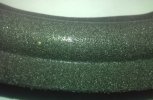
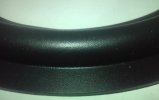
FoamSurround_2.JPGFoamSurround_3.JPGRubberSurround_2.JPGRubberSurround_3.JPG


Currently, I'm anticipating having to do one of each and then re-do the one that loses in the SUBJECTIVE SHOOT-OUT.
If I can stir up an overwhelming reaction from others that may have already gone down this road, it could save me from some needless wheel spinning.

What Say You? and THANKS!
 
Register to hide this ad
Foam is more efficient because there is less cone edge energy absorbed.

But Rubber sounds better because it absorbs cone edge distortions.

Just installed some Butyl surrounds I found on the bay for my Radio Shack Lineaum woofers and they sound superb!

95% of all high end speakers have Always used Butyl and the ones I own from the 70's and 80's are all still good!
 
Last edited:
All of my rubber surround speaker systems eventually were sold as the rubber slowly hardens and changes the characteristics of the speakers (except one pair … on which I decided to replace the surrounds, was a total PITA to remove the butyl-rubber surrounds as I had to cut carefully around the cones and leave a ring of rubber on the cones, changing their mass slightly of course with adding new surrounds to the existing ring of rubber,) I FAR prefer foam that can be serviced!

Don’t believe for a moment that rubber surrounds don’t change over time, it just doesn’t usually fall apart like foam, just gets harder and eventually cracks. The surround terminates the cone which is sonically significant, in addition to suspending it in the frame/coil. As the vibrations travel radially along the cone material any vibration/energy that is not damped reflects back down the cone, which is part of tuning the driver, best to leave as-designed unless you have the knowledge and instrumentation to improve the design (IME/IMO) or don’t have any other option.

I would go with the same mass and damping as original, which in this case is foam. Modern foam surrounds will likely last many years unless you are exposing them to lots of UV and/or ozone.

Whether you’ll ever hear a difference is TBD, go with what you want to install.
 
Last edited:
All of my rubber surround speaker systems eventually were sold as the rubber slowly hardens and changes the characteristics of the speakers (except one pair … on which I decided to replace the surrounds, was a total PITA to remove the butyl-rubber surrounds as I had to cut carefully around the cones and leave a ring of rubber on the cones, changing their mass slightly of course with adding new surrounds to the existing ring of rubber,) I FAR prefer foam that can be serviced!

Don’t believe for a moment that rubber surrounds don’t change over time, it just doesn’t usually fall apart like foam, just gets harder and eventually cracks. The surround terminates the cone which is sonically significant, in addition to suspending it in the frame/coil. As the vibrations travel radially along the cone material any vibration/energy that is not damped reflects back down the cone, which is part of tuning the driver, best to leave as-designed unless you have the knowledge and instrumentation to improve the design (IME/IMO) or don’t have any other option.

I would go with the same mass and damping as original, which in this case is foam. Modern foam surrounds will likely last many years unless you are exposing them to lots of UV and/or ozone.

Whether you’ll ever hear a difference is TBD, go with what you want to install.
I haven't had any of the rubber surrounds on the various speakers I have harden. These are various brands from the 70's too. With the bigger cone speakers like 10"-15", they can sag over time and that can cause voice coil rub. But all I had to do was rotate the speaker 180° and problem solved.
If anything a few seem to have gotten a little looser. Many of the foam surrounds rotted out over time. Doped cloth surrounds can harden up over time from drying out. I'm not saying rubber surrojnds cant harden over time from outp gassing, but I just haven't had a problem with that happening personally.
 
My personal experience in this that I can recall at the moment includes Polk, ESS, and PSB. All hardened enough to reduce bass response measurably, and in two cases started to crack. These are from the early ‘80s through ‘90s. I know there were more, can’t recall at the moment though, I believe that most people don’t notice the change and think they were always that durometer.

My preference has become folded cloth surrounds (un-doped) as in the JBL 2216ND-1, but IME everything in a speaker drifts over time including even cabinet density and pulp cone properties with age, exposure to normal humidity levels, temperature swings, UV, Ozone / Oxygen, etc., etc. and it might matter very little, the only refuge would be to continue buying new which is where some of us more obsessive end up because of the little voices in our heads.

To the OP though, given the choice to replace a surround with something that is close to the same mass, density, damping, compliance, etc. of the original vs a completely different material I would choose original, … it’ll probably last a decade or more before changing measurably.

YMMV of course.
 
Last edited:
I would stick with foam if it originally had foam so that its performance would most closely resemble original afterwards. At the same time, foam is destined to rot eventually. Rubber lasts a very long time and may be stiffer than some foam types. At the same time, it could impact or change bass response characteristics over time somewhat with higher damping/ lower compliance that may increase as the material invisibly hardens over time as it relates to its specific chemistry or thickness which may vary from one rubber surround to the next. I had a pair of Vandersteen 2Ce whose active acoustic coupler surrounds on back hardened to a point they became stiff and were no longer as functional or effective as they once were and had to be replaced because of it.
 
Last edited:
Some years ago a driver designer from Jensen, which was still a going concern in Chicago at the time, came to a speaker building club i belonged to. He preferred foam to rubber and demonstrated how foam was superior to rubber at damping resonances from the cone.
 
We have learned a lot in 50 years.

I cannot think of a single Jensen that uses Butyl, So of course he's going to talk up Foam.

All you need to do is "Thump" a Foamed driver and the sound is resonant "Bonk"...

When you Thump a Butyl driver the sound is a low Thud...

The guy brought measuring equipment, several motors and cones, both paper and aluminum, and both rubber and foam surrounds. On the spot he put together various combinations of cones and surrounds and showed the effects on the measurements. It was a convincing demonstration.
 
All of my rubber surround speaker systems eventually were sold as the rubber slowly hardens and changes the characteristics of the speakers (except one pair … on which I decided to replace the surrounds, was a total PITA to remove the butyl-rubber surrounds as I had to cut carefully around the cones and leave a ring of rubber on the cones, changing their mass slightly of course with adding new surrounds to the existing ring of rubber,) I FAR prefer foam that can be serviced! ....

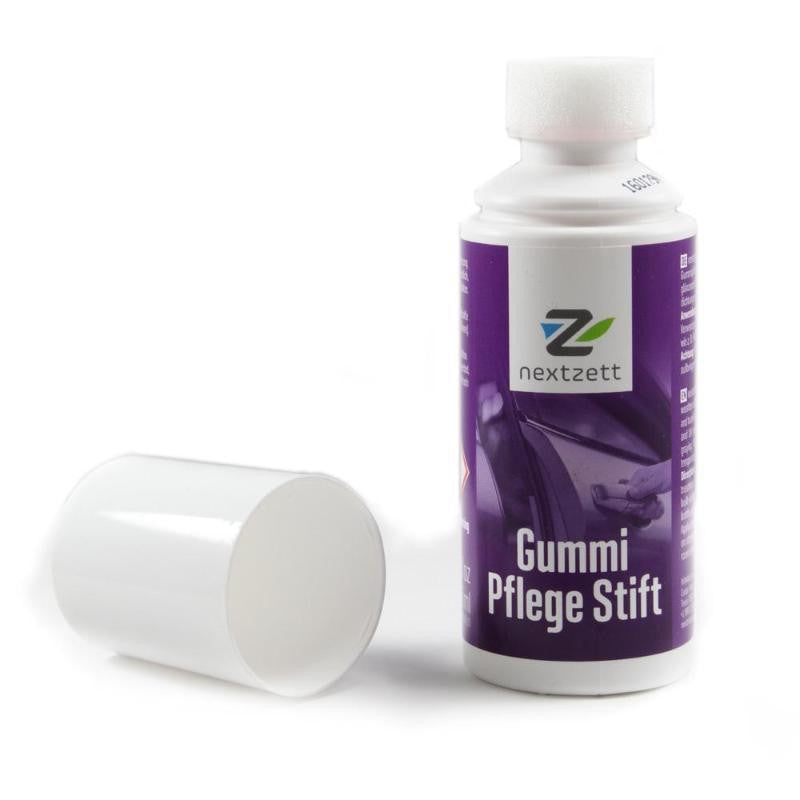
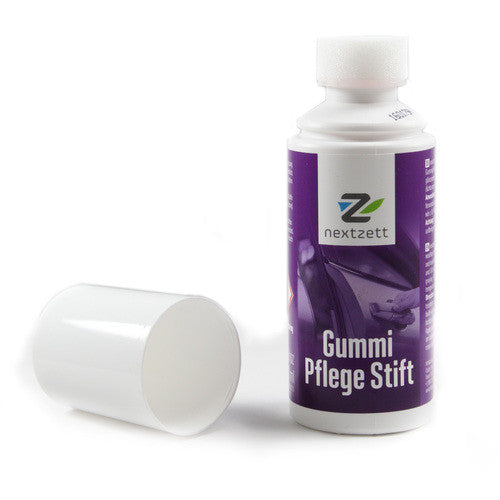
The stuff below will keep the rubber pliable for life. I have original door seals on a car that is 60 years old and still feels like new. I use it on all rubber speaker surrounds and they are as pliable as new (some 40+ years old). The Gummi Pfege is sold out everywhere currently, but the website says it will be back in stock 7/22/26. Amazon usually has it -- presumably it will be available there after 7/22.


g_ba901d93-1c46-4153-88fe-7d657aac5f02_500x500.jpg
 
We have learned a lot in 50 years.

I cannot think of a single Jensen that uses Butyl, So of course he's going to talk up Foam.

All you need to do is "Thump" a Foamed driver and the sound is resonant "Bonk"...

When you Thump a Butyl driver the sound is a low Thud...

Too much damping, especially in one place, is not a good thing, in many cases. It's actually worse than not enough damping, IME, in most cases. Once you damp out part of the sound waveform, you can't get it back... it can be a loss of detail. That's one thing a LOT of speaker designers in the late 1970s through the 1990s, had to learn the hard way.

I have rebuilt many EPI woofers over the last 30 years. To a one- the ones rebuilt with foam have blended better with the tweeter, than the ones rebuilt with rubber. There's a noticeable "hole" in the response between the woofer and tweerer, with rubber surrounds on those. The foam comes much closer to a smooth, seamless, transition between woofer and tweeter. That's just one example, of many.

A dull "thud" isn't a great thing, when you're trying to reproduce the "crack" of a snare drum or the "bong" of a piano note.

Regards,
Gordon.
 
Thanks for the input, PeteB!

And peterp1, Thanks for the contact for rubber renew stick! I have a number of speakers with STOCK rubber surrounds and this might be good to have on hand. I wonder if it would help, or hinder, the kind of decay that causes rubber stuff to turn into jelly-like goop rather than hardening. Any experience?
 
I ended up using the foam surrounds and they sound good! During cleaning off of the old foam, the "doping" or treatment on the plastic cones peeled off. In the 1986 Speakerlab catalog the image for this model seems to show this treatment but it's kind of hard to tell. In looking at pics on the web of this model it seems that later versions abandoned this treatment. I suppose it may be that the spec of the cone changed as well. If anybody has any factual info about whether or not Speakerlab applied this (what appears to be PVA or Elmer's Glue type) treatment to these cones and what it's intended purpose was, I'd love to hear about it. Otherwise, That's The Story!
 
Back
Top Bottom