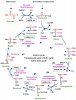
OK - what was not clear to me was the relationship of the elements in the upper left box - now I understand there isn't any intended, they are just the available elements. So, that is indicated by the jumbled placement. (Right?) Personally, I would not have got that idea without your later explanation. So, why not just list the elements and say "The elements, in no particular order:"
Also, I now think I understand that this page doesn't say anywhere what the verb forms 1, 2, and 3 are. I think that would have been much clearer to us if you told us it was explained elsewhere in your class material. In fact, I think the content of the box would be much clearer if instead of the note outside the box that the numbers 1, 2, 3 are the verb forms, you put in the box three parenthetical phrases (verb form 1) (verb form 2) (verb form 3).
Now to the lower left box: Are A, B, and C just for enumeration of the constructions? I kept looking for the meaning of A, B, and C. I think you intend to convey that there are three basic constructions, perfect, passive and continuous. If so, why don't you use a colon instead of a bullet:
A: have + 3 ...(perfect construction)
Thanks for the feedback!
I was wondering how this would be seen as a standalone item without me leading a student through it.
The elements are mixed up so a student has to look for them as they crop up in discussion, spending more time looking at them all and getting the point that we don't use many elements to construct verb tenses. I don't use this system with beginners, but usually with youngsters who are midway through high school and struggling with the material.
Regarding the '1 2 3' representation of the verb forms, I tell the students what's going on with this, but for a standalone it would be better to incorporate your suggestion.
I have no idea why I used a bullet

. A colon would be better, or maybe an = symbol.
I will edit the picture and upload it soon, taking into account your suggestions.
The main aim of this is to give a student a proper perspective on how the tenses are constructed. I feel that a student who has covered all this at school would be able to make sense of it as it stands, but there's always room for improvement.
I get them to look for a verb construction in their school book, or any book in English, and then check that ALL of the elements of that construction are in my system picture.....they ALWAYS are, so the student starts looking at the subject in a different way. Very quickly, referring to the diagram, they can tell me for example the construction of the present perfect passive of, say, the verb 'to paint'. I ask them to make a sentence using this tense using the subject "My house":
My house has been painted (
have+3 with
be+
3, an
A+B construction).
(This is a good example of how English verb tenses work - "has been painted" is a combination of "has been" and "been painted", using "been" just once)
Then the same thing with the present perfect continuous tense, this time using "I" as the subject and "my house" as object:
I have been painting my house (
have+3 with
be 1-ing, an
A+C construction).
I ask them if they think all this is easy, and all eventually agree that it is. This is a great psychological boost for them, getting them to drop the notion that it's difficult.
Then we have to get down to the task of learning how to use these tenses in everyday speech. With the past simple, we generally say when something happened:
I painted my house last week.
If you're telling someone some news, and the actual time of the event is not so important, we use the present perfect in British English:
My mate Pete has bought a new car.
I have American friends who say:
I didn't do it yet.
I never hear this from fellow Brits, it's always:
I haven't done it yet
Again, many thanks for your feedback on this.