
• The move to the new server is done. There are some software and database maintenance updates in process. This has us passing the hat around to help out. We appreciate any donations. Seriously, even a dollar helps. The payment page may be found here - https://www.audiokarma.org/support.html

FYI #1: The CT-Fxx50

FYI #8: The beginning of Pioneer

Pioneer was founded in 1938, as Fukuin Shokai Denki Seisakusho (founded by Mr. Nozomu Matsumoto), and the main business was audio speakers.

Doc
 
FYI #9: Speaker Driver Dimensions

If the first 2 digits of the woofer, mid, tweeter, or super tweeter model number are numeric, they are the diameter of the cone in centimeters.

1 inch = 2.54 cm

Doc
 
Last edited:
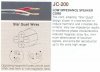
FYI #11: Pioneer Speaker Cord

Pioneer offered “Speaker Cord”, model number JC-200, with “Star-Quad” design.

Doc
 

Attachments

  • JC-200.jpg
    JC-200.jpg
    139.2 KB · Views: 203
FYI #12: Tone Arms for the PLC-590

Pioneer offered two tone arms for the PLC-590 turntable: the PA-1000 (carbon fiber) and later offered the PA-5000 (aluminum).

Doc
 
The difference between the DT-500 and the DT-510 is primarily that the CT-500 is Blue Fluoroscan display, while the DT-510 is a blue LED display. I could have that backwards, but I think I have it right. I have one of each, and I can check when I get home, if anyone thinks its important.

As a side note: the DT-510 shows a bit of cost reduction that was common at that particular time in audio history. Still a nice unit though.

Rich P
 
FYI #14: Fluroscan® meters

Fluroscan® meters began on Pioneer’s Amps, Cassettes, and Reel-to-Reels in 1979, but not on Receivers until 1980.

Doc
 
I've got one each of the DT-500 and DT-510, but immediately added them to systems as I got them, and never compared them side-to-side. I need to do that next time I move components around.
 
I had a 500, 510, and 550. Sometimes, the clock would just go bad. Not sure why. Thought it might be related to the voltage selector being incorrectly set on the back.

Anyway, I got rid of the 510 and 550, and now have 3 of the 500s. 2 in use, 1 as a spare.

Doc
 
Dr. Strangelove said:
Pioneer’s best tuners, in terms of Image Rejection or Image Response Ratio, are the F-26, F-28, SX-1980, TX-9500 II, and the TX-9800, selected from tuners and receivers that were available from 1970 to 1985.

Doc

hmm, I don´t have F-26 :no:

F-26 Tuner was so expensive, that not much been sold :no:
 
Last edited:
Dr. Strangelove said:
Fluroscan® meters began on Pioneer’s Amps, Cassettes, and Reel-to-Reels in 1979, but not on Receivers until 1980.

Doc
Sorry Doc, but as I think to know, first Fluroscan Pioneer was CT-F900 build in 1978 :scratch2:
 
Yes, some of those components were not manufactured on a strict "model year" basis. We tend to think of something only being available from January to December of a year, when the actual manufacturing cycle was different.

Kind of like buying a 2007 car in September of 2006.

Doc
 
FYI #15: HPM-100 and HPM-900 Speaker Grills

HPM-100 and HPM-900 have the same size speaker grills. If you are missing a grill, this can help with your replacement. Just keep in mind that the attachment pins are different diameters.

Doc
 
HPM-100, HPM-100M, HPM-110, HPM-110X have the same size, but different surface. HPM-100 wood - HPM-110 Matt Black
HPM-100 could handle 100 Watts,
HPM-100M and HPM-110 200 Watts.
HPM-110X ferequency response started at 50Hz instead of 30Hz all others :yes:

On the scan you can see HPM-110 and HPM-900 have the same dimension.

jojo20pq.jpg
 
FYI #16: Series 20 head shell

The Series20 PLC-590 turntable, with the PA-1000 tone arm, had its own head shell: The PP-312, also made from carbon-fiber material.

Doc
 
FYI #18: Pioneer's P-D1 CD Player

The P-D1 was Pioneer’s first commercially available CD player, and sold only in Europe and Japan, in 1982 -1984, and was Pioneer’s own design (not Hitachi, Kyocera, Sony, or Philips).

Thanks to Axel for his analysis and comparisons.

Doc
 
FYI #19: Pioneer Phono Cartridges

Phono Cartridges offered by Pioneer between 1970 and 1985 were of types MC (10 models), IM (11 models), and MM (21 models).

Doc
 
FYI #20: Pioneer's most powerful amp - The M5

The most powerful of Pioneer’s amplifiers from 1970 to 1985 was the M5 (1982 to 1984), and was available in Japan only. Also known as the Exclusive M5, it put out 300 watts per channel.

Doc
 
Back
Top Bottom