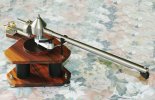
A brief explanation - most arms mount the cartridge at an offset angle and the stylus is placed at a point farther than the platter spindle (that's overhang). Exactly what angle and how much further (overhang) depends on the alignment chosen, but the idea is to minimize tracking error. A stylus in a pivoted arm travels a curved path, whereas the record was cut on a radius, so there will be error in the perpendicularity of the stylus to the groove. If you work it out with geometry, you will see that the conventional arm with overhang and offset angle has the least possible error - different alignments disagree on exactly where over the record playing area to place the least error, but they all do it the same way.
But offset angle means skating - if you look at the arm pivot and the goove where the stylus sits, you can see that the groove is at an angle to the pivot, so the arm is being dragged inward toward the spindle. This affects both distortion and stylus wear. So an outward force is typically used to counteract this, which is the antiskating mechanism on most arms.
But exactly how much force, and what part of the disc needs the most, and so on, are contentious issues, So we can fight about that too,
Meanwhile, DJs who are scratching have real problems with offset and antiskating, because when you move the record backwards, all the vectors go the wrong way and the stylus wants to jump out of the groove. And this isn't a minor consideration - the reason the Technics SL 1200 is still is production (and maybe even vinyl records themselves) is DJs. You may not think there are that many of them, but their buying power compared to that of vinyl oriented audiophiles is considerable.
Someone tried getting rid of the offset with a shorter straight arm and stylus more or less on the radius from the spindle, and it made scratching much easier (typically DJs use spherical styli which are pretty unaffected by minor tracking error - audiophiles are more likely to use elliptical or line contact styli which are much less forgiving).
In a straight arm, a stylus set at the radius at the record edge will traverse a path from zero error to quite high error and back to zero. Set at the radius in the middle of the record, it will do the reverse. A stylus set somewhat back of the radius will have half the error at the out edge, going to no error and then half the error at the middle, and then back through no error to half the error. So underhung is clearly the best compromise for DJs and, apparently, also for some audiophiles who dislike antiskating or some other aspect of conventionality. Recognize that there is skating with underhung arms, but first one way, and then the other...
There are also arms that have pivoted headshells that are underhung and claim to minimize tracking error. But they skate, just like the rigid arms - it's geometry.
Whoever said there are a variety of tastes was on to something...