justin_r_23
Active Member
When I first purchased an old aiwa XD-AX1U as a way to play CDs though my new Schiit Modi 5, I found a few strange behaviors.
First, playing through the Aiwa's internal DAC presented no problems. The internal DAC is quite nice, actually.
I've noted in my thread about the machine that the DAC is a TI PCM1742, which handles up to 24-bit/192KHz signals and converts DTS and Dolby Digital to 2-channel stereo. I like the way it sounds, and it compares well to my Pioneer CLD-D504 (which only has analog outputs and an RF output for Dolby Digital AC-3) and the Modi 5.
CDs play flawlessly. CDs with tracks with material recorded in the first second are played from the beginning. (It won't play the CD side of Talking Heads' "Speaking in Tongues", but dual-sided DVD/CDs can be tricky).
However, when playing CDs from the aiwa's optical or coaxial SPDF output to the the Modi 5, suddenly the first second is muted on the first track of a CD, or if I skip ahead.
One particular CD I have, a custom CD I bought through the company CDUCTIVE, plays badly. The first track will start playing, but drop out one minute in while the timer display continues to advance. Other tracks will play as if they have no audio signal at all. The CD has proven impossible to rip: even Exact Audio Copy chokes on it! iTunes will rip it but its error-filled!
If I switch to hear the analog outputs, all is well. If I try another DAC, I hear the music. It plays fine in my Pioneer LD player.
On other DACs, the first second of a track is not silenced.
So what was going on? I suspect that the aiwa's optical and coaxial outputs are sending digital signals that are fine, but just jittery enough that the Modi 5 just doesn't like it and mutes the signal if there are too many errors.
I have the SMSL PL-200T, and if I play the same CD on that machine and have the coaxial SPDIF output hooked up to the Modi 5, the CD plays perfectly.
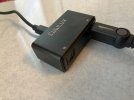
So my current experiment is to run the optical output of the aiwa into a Cubilux optical input / output. The Cubilux lets me capture SPDIF optical signals up to PCM 24-bit/192KHz.
So I have the Cubilux on my PC, and I've set it in Windows so I can listen to that input on whatever output I choose. The output is "System Default" which is currently set for the Modi 5 over the Unison USB input.
I'm effectively using my computer as a DDC / re-clocker. This has solved the playback issues: the CDUCTIVE CD plays back perfectly and the first second of tracks don't get silenced.
But it's the clunkiest way, it feels like to me.
So now I'm waiting on a Prozor DDC that can take optical or coaxial SPDIF inputs and output them over both optical and digital SPDIF. I hope this simplifies things such that I can just set up the Prozor DDC between the AIWA's coaxial SPDIF output and the Modi 5's coaxial SPDIF input and get good playback.
Other alternatives:
1. box up the Aiwa and get another SMSL PL-200T (spendy).
2. Modify my Pioneer LD player to add the missing optical output. (also potentially spendy, as I do not have soldering skills and do not want to risk killing the LD player; also, who knows if the optical output might not have the same problem the aiwa output does?).
3. Use the perfectly fine internal DAC on the Aiwa.
I thought this was an interesting problem and shows how there can be quality differences in how well some used gear outputs digital and how those signals might not work with modern gear.
Last edited: