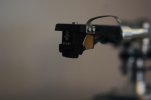
I fashioned and used a longhorn on a Grado years ago, a Prestige Blue I think it was. It looked kinda cool to me but I couldn't discern a difference in performance. The only time I've ever noticed mistracking on a Grado was with tonearm resonance tracks on one of the Shure test records. Even when the stylus wiggled/danced it continued to remain in the track to the end. Was cool to look at though!
I've only heard a Grado in three turntables. In my dad's Toshiba SR-230, it (I no longer remember which model of Grado it was) wiggled and danced spectacularly! In the Ittok LVIII/2 arm I had on an LP12, there was no visible dance with a Grado Green1, but, while chamber music was usually fine, tracking large-scale orchestral music was a bit uncertain even at Grado's 2 gram maximum (their older models had a vtf range of 1-2 grams with 1.5 grams recommended). In the damped arm of a Well Tempered Record Player, the Green1 tracked everything flawlessly at the recommended 1.5 grams.
Audio by Van Alstine re-introduced their Longhorn-modified Grados about 15 years ago, and I bought a Longhorn Green1 to try out. I don't recall hearing a marked difference in performance on the Well Tempered, but there was a nice improvement on the Linn, which now handled everything just great at 1.7 grams and with better detail retrieval and dynamics (which were already pretty darn good prior to the Longhorn). As produced by AVA, the Longhorn also included internal damping of the stylus itself and the coils inside the cartridge body.
I'd really love to try one of the new Grados but am in cheapo mode lately and own more cartridges than I can use anyway. I threw on an older Silver (maybe Silver2?) on my main rig last week but it didn't do much for me and it came off a few hours later. Sounded a bit dull and rolled off in the moment. The stylus on it has ~250 hours on it. Wonder if it would sound much better with one of the Gen3 styli.
I haven't heard any Grado newer than the Green1, but there were things I liked about it even before I had the Longhorn version. An old post said, "Despite the less than stellar tracking and the low level hum I got with the Linn as the arm approaches the innermost part of the record, I liked a lot of what the Grado Green did: (1) even at low volume levels, the tonal balance really is rich and full: bass and percussive instruments have good visceral impact, the orchestral colors of Bartok and Richard Strauss seem almost magical, and the timbre of individual instruments is well preserved, making it easier to distinguish one from another; (2) there is good stereo separation and stable focus of the stereo image; this delineation of instruments in space as well as timbre makes it easy to follow different instrumental lines; (3) the Green reveals nuances of pitch and dynamics, even for low-level background voices and instruments, that make a recording sound more like real musicians playing real instruments."
Now that I've installed the last stylus I had on hand for my VM95, I'm thinking about trying a new Grado, too, but I am a bit scared off by statements about "much better highs" in the 3 series. Years ago, people in the forums talked about getting "better" highs from the M97xE through different loading and/or after-market styli, but by better, they really meant brighter, which I wouldn't care for. The OP, though, didn't mention that kind of difference, at least not with his 3 series Sonata.