• The move to the new server is done. There are some software and database maintenance updates in process. This has us passing the hat around to help out. We appreciate any donations. Seriously, even a dollar helps. The payment page may be found here - https://www.audiokarma.org/support.html

H.H. Scott 222c Need Help

pantoramasan

AK Subscriber
Subscriber
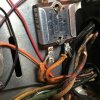
H.H. Scott 222c Need Help in identifying a problem. Picked up this amp at a yard sale without tubes. Have found all the tubes necessary to run it. Tested all tubes and they test good. Plugged into Variac and eased it up to 40 after 10 min. on 30. The TR-12-3-1 Transformer was getting very hot and I actually heard some weird gurgling sound underneath. Quickly shut off and minute later removed all tubes. I have been reading that the selenium rectifier could be the cause. Is it that simple or may I have other problems? Any info would be greatly appreciated.
 

Attachments

  • IMG_1239.jpg
    IMG_1239.jpg
    82.1 KB · Views: 39
  • IMG_1240 (1).jpg
    IMG_1240 (1).jpg
    97.6 KB · Views: 38
Register to hide this ad
If the transformer is getting hot @ 30-40V with gurgling noises underneath, either one of the can caps is shorted causing massive current thru the transformer (heating it up), or the transformer itslef has an internal short. Look for venting of black tarry substance in/around the leads on all of the MAIN CAN CAPS and the wire holes in the transformer. The weird gurgling sounds are either the transformer potting tar (if it's a potted transformer) boiling OR one or more of the Filter caps Boiling internally due to a dead short. Bets are it's a cap tho. Takes a long time and a lot of heat to get the tar boiling if the transformer is potted.

The selenium rectifier is probably NOT a culprit here, but you'll change it out for a Silicon diode bridge anyway. .

Check C201 thru C206 inclusive and C207 thru C210 inclusive for leakage and shorts. These are all of the Filter caps.

Also check the 5AR4 for shorts and gas.
 
Last edited:
I pulled the 5AR4 and brought it up on the variac and there was NO heat on the transformer this time. Ran it for about 5 minutes. I had checked all the tubes for leakage etc. None of that. All the tarry substance was on the exit holes of the transformer. None of the Main caps showed any leakage or discoloration on the wires etc. There was still an odor coming from the unit and quite a hum. That was probably due to the pulled tube i am guessing. Thanks for your help!
 
It could be that the 5AR4 is shorted, but it can also be a shorted can capacitor. Have the 5AR4 tested and if it is not shorted, It is either a can capacitor or the power transformer itself.

Just FYI, I personally don't trust a power transformer after it has been smoked. Even if the transformer was not the initial problem, if it got hot and smoked/gurgled due to a short somewhere else, it is no longer reliable.

I'm thinking that the fuse should have protected it somehow. Does it have the correct fuse?
 
Note that the 5AR4 won't start passing B+ until the line voltage is up to about 70 or 80 volts. I would be very suspicious of the filter caps.
 
The tubes all tested good with no shorts etc. I only Variaced it for 5 minutes and the transformer was not hot or warm to the touch, but 20 min later, I felt the transformer and it was definitely warm to the touch.
 
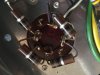
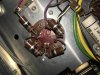
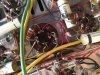
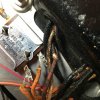
here is what the caps look like and the transformer underneath. The only wires with oil on them are coming or going directly into the transformer.
 

Attachments

  • IMG_1251.jpg
    IMG_1251.jpg
    68.3 KB · Views: 49
  • IMG_1253.jpg
    IMG_1253.jpg
    62.8 KB · Views: 46
  • IMG_1254.jpg
    IMG_1254.jpg
    125.3 KB · Views: 46
  • IMG_1257.jpg
    IMG_1257.jpg
    107.3 KB · Views: 41
I pulled the 5AR4 and brought it up on the variac and there was NO heat on the transformer this time. Ran it for about 5 minutes. I had checked all the tubes for leakage etc. None of that. All the tarry substance was on the exit holes of the transformer. None of the Main caps showed any leakage or discoloration on the wires etc. There was still an odor coming from the unit and quite a hum. That was probably due to the pulled tube i am guessing. Thanks for your help!

I returned to the unit about 20minutes later and the transformer was definitely warm. Took a while to warm up I guess. I had it on the variac for only 5 minutes and at that time it was cool to the touch.
 
When discussing capacitor leakage in this type of situation, it is electrical leakage not a goo or liquid oozing out of the capacitor. Without the 5AR4 in place, there will be no B+ voltage. If one has a leaky capacitor it will not draw current if no voltage is applied. Your transformer getting warm, not HOT, is normal if you run your unit without the 5AR4. With the power off and line cord disconnected, you could try measuring the resistance of each of the can capacitors, terminal to case. If the measurement shows a low resistance, that is a leaky capacitor.
 
Can caps are always where I start...you're going to have problems with the originals at some point, even though they visually look OK from the bottom.
Contact Tom @ hayseedhamfest.com for original type replacements. Should be about $100 or so for all of them.
 
I pulled the 5AR4...There was still an odor coming from the unit and quite a hum.

This makes me think transformer short (unfortunately). With the 5AR4 out the only power draw should be from the heaters which should not be enough to produce "quite a hum".
 
When discussing capacitor leakage in this type of situation, it is electrical leakage not a goo or liquid oozing out of the capacitor. Without the 5AR4 in place, there will be no B+ voltage. If one has a leaky capacitor it will not draw current if no voltage is applied. Your transformer getting warm, not HOT, is normal if you run your unit without the 5AR4. With the power off and line cord disconnected, you could try measuring the resistance of each of the can capacitors, terminal to case. If the measurement shows a low resistance, that is a leaky capacitor.

Thanks for the explanation.
 
You need to take a systematic approach to restoring this. The can caps and all those white ceracaps will probably need to be replaced and the selenium rectifier.

But you need to start by seeing if your power transformer is okay. Remove the rectifier tube, connect the black probe to the chassis and the red one to one of the plates of the rectifier tube (pins 4 or 6, looking at the tube socket from below), power up carefully not touching anything and see if you get a few 100 volts AC. I don't see this AC voltage on the schematic, but you will be looking for 430VDC from pin 8 later (when the rectifier is plugged in!) Even if the power transformer is toast this is still a valuable amp and can be fixed.

You can download the schematic for the 222C from the AK database. You'll need this. You can also get the assembly manual for the LK48 (kit version) on the web.
 
An update for you. I pulled the 5AR4 rectifier from my 222C and I get 338VAC between pin 4 and ground. You can do this measurement from the top, if you count the pins anticlockwise from the slot. Usually you'd count clockwise when looking at a tube socket from below--apologies if you know this already.
 
Just get your meter settings right and you should be able to do this safely. Restoring a Scott integrated amp is quite a big job for a novice. It would be good practice to start with a simpler power amp, like a Magnavox pulled from a console.

Back to your Scott. The selenium rectifier provides a negative bias voltage to enable your power tubes to work, but as larryderouin says, it probably not the problem. You can get all the electrolytic caps you need from the email in post #10, but you need to see if your power transformer is functional before that. Can you say more about the hum you hear when you power up with the rectifier tube out?
 
Back
Top Bottom