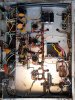
Are you missing any tube shields? Photos of the interior might be helpful.



It's worth a try, my experience is that they seem to make little difference, however your situation may be different, with some AC wiring close to the amp.I think all the 9-pin tubes in my A500 are shielded. Images on Google indicate the same is true of yours. This could be all that's wrong.

The Harman Kardon tube amps were somewhat unusual having a ground bus wire running the length of the chassis. This bus should only be grounded at one end or if you want to be really precise in the center of the bus wire.Sorry for the late reply, I've been very busy.
To resume :
-: there is a bus wire for the preamp section (going in a loop to the ground of C25 and from there back to the ground of C24 where the other side of the bus wire connects). This seemed strange practice so I tried disconnecting one side of that loop in order to prevent return current from c25 to pass through the preamp ground but that didn't change anything. All grounds than go from there to the first filter cap and from there to the center tap of the high voltage winding.
I noticed that touching v3 or v4 changed the noise quite a lot and so do the tone controls so I'm thinking the noise is generated somewhere around V3. Everything is capacitor coupled so I will try removing individual stages and see when the noise disappears.

Yeah, the A-300 definitely had shields on all the input tubes. I've also had noise issues that disappeared after the bottom cover was attached and the amp was turned right side up. Sometimes something like a fluorescent light can also be picked up by the amp circuitry.There are no shields on any of the tubes, I don't know if it ever had any.
I'll post a pic of the inside if that can help unless of course it's as simple as missing shields...
You might want to try covering the acrylic cover with something like aluminum foil. Lots of console stereo amps used a piece of foil covered cardboard between the amp chassis and the wood on the bottom of the cabinet to accomplish the same thing. Guitar amps often shielded their chassis like this too.the amp came with an acrylic transparent bottom cover so that probably won't help much.
I will start by putting the shields back on and see where that gets us.

On one or two A300 or A500 I worked had a ground loop. I was surprise bc I think they are factory wired units.
I’m not sure but I think that where the voltage doubler was grounded to chassis (the diode and second filter cap) was ALSO tied to the buss, which was then grounded at the phono inputs.
Thats right out of the Dept of Redundancy Department.
Take a look and see if yours is wired like this. If so, try it with those grounds separated.
 .
.Ok, I see that you don’t have the original PT and aren’t using a voltage doubler.
Something I recommend is to make sure your PT center tap and the first filter cap negative terminal are attached to the chassis together. And separate from the ground buss. Everything else can ‘get on the bus’.
Search Valve Wizard’s site for his article on grounding. Great stuff.
What you describe above works fine as long as there not a connection to the chassis there at the first filter cap AND a connection to the bus bar wire which is also grounded.
I connect the HT centertap and the negative of the first filter cap together at the chassis, with no other components connected there. Then everything else gets connected to the bus which is grounded at the input.
I don’t know if this will solve your issue but it is a common building practice.
http://www.valvewizard.co.uk/Grounding.pdf
believe it would be 50 or 100 in Europe, but same idea. Mains frequency is ground loop, double mains is power supply.
 . Also how normal is it for the amp to transmit mechanical noises through the speaker ? What I mean by that is that when I activate the switches it makes thumping/crackling through the speakers. First I thought it were dirty switches but than I tried just gently tapping the chassis or faceplate or transformer, anywhere really, the same noise is heard through the speakers. Is there any chance those ECC 803 tubes that are there instead of the 12AX7 are more sensible to that and are just picking up the vibration coming from the transformer ?
I have not gone through all the comments yet, but, i just wanted to mention "mu metal" as a way to block EMI, and help to control stray magnetic fields. I have seen people construct boxes that use that material which fit over the power transformer. I can't say that it will cure your problem but it may help if the hum is not the entire transformer humming.I guess these modern transformers are just emitting more EMI that is being picked up by tubes or other circuitry (I had to change the transformer in a quad 33 preamp and even though its characteristics were the same and all voltages are correct in the preamp, it now hums more than it used to and when I use the high filter, the coil in the circuit picks up the emi and buzzes like cray). I added a copper foil around the transformer (perpendicular to the lamination) which helped a little but far from what I needed. I'm going to try also adding some foil in the same direction as the lamination to see if that helps some more.