• Please note that Audiokarma will be offline briefly for updates early on Monday morning, September 28th.

Harman Kardon A300 Missing Insulated/"Hot" Can

notabot

Active Member
Hi,

I'm very new to tube audio and I'm feeling like I'm in over my head. I learned how to swim with my father throwing me into the deep end of the pool, and that's stuck with me ever since. Anyway, I can't find anything about this issue even after extensive Googling (probably not using the right terms or something).

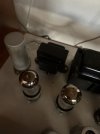
I bought an HK A300 on eBay. The pictures on eBay showed all tubes and cans installed. When it arrived, in the very back, in place of what should be a silver tube-like object, is a hole in the chassis that is sealed with a piece of metal. I've found that these metal tubes are called "cans", and this specific can is called an insulated or "hot" can, and it's wrapped in cardboard due to its high voltage. Well, it would be if it wasn't missing. I think it's supposed to be part of the power supply? I get dizzy when I look at the schematic.

Here is a picture:
IMG_1678.JPEG

I'm still waiting for the seller to respond and provide more information, but I'd like to know if I'm hurting the amp by using it while this piece is missing. I read somewhere (at least I think I did) that the modern equivalent to this can would be installed inside the chassis, which could explain why there's nothing there on the exterior. I'm too green behind the ears to open this thing up right now, though.

I've been using it intermittently over the last four days. It sounds great and it hasn't exploded yet. No weird noises; no smoke; just groovy tunes.

I'd appreciate any other insight or advice. Thank you!
 
Last edited:
Register to hide this ad
Someone most likely replaced the "hot can" capacitor, with a terminal-strip-mounted capacitor under the chassis. If that's done- there's no reason for the insulated can cap anymore.

I usually do it differently- there are can caps- made by JJ, F&T and such, that have insulated cans- the ground/negative lead is NOT the can. In these, the negative lead comes out on a separate terminal. In this case- the voltage doubler "top" cap can be wired with the negative connection connected to the center of the voltage doubler, without the can itself being at any voltage. I usually mount one of those over the hole where the insulated doubler cap was, originally. Performs the same function in the same way, without requiring a separate insulated can cover.

But, there's no reason why having a cap mounted under the chassis, is functionally any better or worse, than a can- as long as said capacitor is the right value and voltage rating...

Regards,
Gordon.
 
Someone most likely replaced the "hot can" capacitor, with a terminal-strip-mounted capacitor under the chassis. If that's done- there's no reason for the insulated can cap anymore.

I usually do it differently- there are can caps- made by JJ, F&T and such, that have insulated cans- the ground/negative lead is NOT the can. In these, the negative lead comes out on a separate terminal. In this case- the voltage doubler "top" cap can be wired with the negative connection connected to the center of the voltage doubler, without the can itself being at any voltage. I usually mount one of those over the hole where the insulated doubler cap was, originally. Performs the same function in the same way, without requiring a separate insulated can cover.

But, there's no reason why having a cap mounted under the chassis, is functionally any better or worse, than a can- as long as said capacitor is the right value and voltage rating...

Regards,
Gordon.
Awesome, thank you. Y'all are insanely knowledgeable here. So, the fact that the amp works without issue is proof enough that there's a terminal-strip-mounted cap under there?
 
Awesome, thank you. Y'all are insanely knowledgeable here. So, the fact that the amp works without issue is proof enough that there's a terminal-strip-mounted cap under there?

It would kind of have to be that way. The amp wouldn't operate at all, without some sort of cap replacing that one.

It's just a matter of whether it was done with the correct value and voltage cap, and how well the modification was done underneath, from a safety and reliability standpoint.

If they would provide pictures of the inside (remove the bottom cover and take pictures of the insides), that would verify how well things were done in there, when the repair was made.

Regards,
Gordon.
 
just me personally, if I'm not replacing the above-chassis cans with new, I abandon the old in place for visual reasons, and for laziness ones. Saves me the trouble of having to remove the thing and plug the hole.
 
just me personally, if I'm not replacing the above-chassis cans with new, I abandon the old in place for visual reasons, and for laziness ones. Saves me the trouble of having to remove the thing and plug the hole.

That's my usually operational procedure too. I've actually been known to even drive a sheet metal screw into an old can cap, to act as an anchor for a terminal strip, in awkward mounting situations. Figure as it's dead, so it's fair game for drilling a hole and using a screw through the terminal plate...

Regards,
Gordon.
 
I've found on these A300's that often that cardboard covered cap is damaged in shipping-when it is, I cover the hole as shown in the picture, with the replacement cap under the chassis.
 
That's my usually operational procedure too. I've actually been known to even drive a sheet metal screw into an old can cap, to act as an anchor for a terminal strip, in awkward mounting situations. Figure as it's dead, so it's fair game for drilling a hole and using a screw through the terminal plate...

Regards,
Gordon.
Hi Gordon,

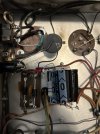
Here’s a picture of the inside with the bottom cover removed. I have no idea what I’m looking at.

IMG_1718.jpeg


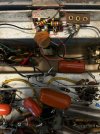
And a close-up of where that can would’ve been.

IMG_1720.jpeg


Are these supposed to be open-ended on the Countor switch?

IMG_1721.jpeg
 
Last edited:
Looks like its been re-capped with modern caps underneath and the old ones abandoned in place. I see a CL-90 thermistor to reduce inrush current and drop the voltage a wee bit. Coupling caps are a mix of orange drops and Soviet PIO caps. Power supply diodes look modern. I don't hate what I see here, but I would have preferred to see both ends of the caps landed on a terminal strip instead of just floating in space.

don't know on the contour switch question.
 
Looks like its been re-capped with modern caps underneath and the old ones abandoned in place. I see a CL-90 thermistor to reduce inrush current and drop the voltage a wee bit. Coupling caps are a mix of orange drops and Soviet PIO caps. Power supply diodes look modern. I don't hate what I see here, but I would have preferred to see both ends of the caps landed on a terminal strip instead of just floating in space.

don't know on the contour switch question.
Awesome, I greatly appreciate your time and expertise. It’s nice to know this was serviced in some capacity since it’s probably around 60 years old.
I have a few more questions and things I’d like to mention to see if they mean anything… I’m not savvy with this stuff, so any repairs will have to be done by a local outfit.

I was looking at other HK A300 threads, and I think I have the old/less desirable phono stage?

I started digging into things because both speakers make a hum that increases when I turn up the volume. At low volume, the hum is low enough to where you only hear it if you put your ear up to a speaker. I tried to pinpoint the cause and it still makes the hum even when nothing is connected except the speakers. I have a router about 16 inches next to and 2 feet above it, but there’s no fluttering or feedback like you hear when your phone is too close to your speakers.

There’s a screw that goes into the back of the chassis that’s labeled as a ground (GND). It has some remnants of copper wiring wrapped around it between the head and the chassis. Nothing is connected to the screw on the inside of the chassis. I can’t find anything about this GND.

IMG_1722.jpeg

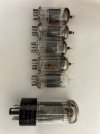
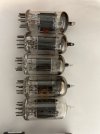
I think all of the smaller (preamp?) tubes are original. There are two 12AU7A and two 12AX7A, all made in USA. The fifth tube has the writing rubbed off to where I can’t read it at all. It’s branded RCA, but so are all the others. The insides all look the same to my untrained eyes, so I don’t know which type it is.
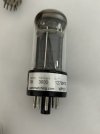
The larger (power amp?) tubes are 6V6GT TUNG-SOL, made in Russia, with the same Current and Transcond numbers.

IMG_1723.jpegIMG_1725.jpeg
 

Attachments

  • IMG_1724.jpeg
    IMG_1724.jpeg
    64.4 KB · Views: 0
There’s a screw that goes into the back of the chassis that’s labeled as a ground (GND). It has some remnants of copper wiring wrapped around it between the head and the chassis. Nothing is connected to the screw on the inside of the chassis. I can’t find anything about this GND.

The screw is to attach the ground from the turntable.
 
most turntables need their ground wire connected to the amplifier in order to not hum. If its not connected, try that and see if it quits.
 
most turntables need their ground wire connected to the amplifier in order to not hum. If it’s not connected, try that and see if it quits.
The hum is still there, but I have to put my ear right up to a speaker to hear it even when the volume is at the level I use. Is there something wrong with the amp to where it needs to be repaired, or is this like chasing down creaks and rattles in the interior of an old car?
 
Last edited:
The hum is still there, but I have to put my ear right up to a speaker to hear it even when the volume is at the level I use. Is there something wrong with the amp to where it needs to be repaired, or is this like chasing down creaks and rattles in the interior of an old car?
Is there a little wire coming off of the turntable? Its most likely green.

If so connect it to the screw on the back of the amp.
 
Is there a little wire coming off of the turntable? Its most likely green.

If so connect it to the screw on the back of the amp.
On the AR XA, the ground snakes its way through the tonearm to the sub-chassis, then gets connected to the right male connector on the RCA cable, which can be an issue if an amp has a floating ground, which I believe the HK A300 has... What do I do about that?
 
Oh, its an XA. You should be fine then. Thorens tables ground the same way. I was thinking you meant it had a ground wire like many do and it was connected to some other place.

Chassis ground and RCA jack ground are tied internally on this and it doesn't need any other tricks.


If you can barely hear any hum with your ear at the speaker thats probably about as good as it gets without driving yourself insane. Personally i wouldn't worry much about this. My criteria for hum and noise elimination is that if I can't hear it sitting in my chair, I don't need to worry about it.
 
Oh, its an XA. You should be fine then. Thorens tables ground the same way. I was thinking you meant it had a ground wire like many do and it was connected to some other place.

Chassis ground and RCA jack ground are tied internally on this and it doesn't need any other tricks.


If you can barely hear any hum with your ear at the speaker thats probably about as good as it gets without driving yourself insane. Personally i wouldn't worry much about this. My criteria for hum and noise elimination is that if I can't hear it sitting in my chair, I don't need to worry about it.
I was talking to some guys in the chat last night. The hum is there even when the volume is turned all the way down and the turntable is disconnected from the amp. They said the hum is probably caused by failing capacitors.
 
I was talking to some guys in the chat last night. The hum is there even when the volume is turned all the way down and the turntable is disconnected from the amp. They said the hum is probably caused by failing capacitors.
Think, Power Supply.
 
Unbalanced output tubes will do it too. Most push-pull amps are poorly filtered at the point the tubes connect, and rely on equal current draw through the transformer to cancel it. If its not equal it doesn't cancel and you get hum. The hum will generally not be identical levels in both channels though, unless you get tubes that are mismatched by exactly the same amount.

this has new caps in it, so unless they are bad quality or just installed wrong that wouldn't be my first thought. It would absolutely be my first thought if this were all original though.
 
Back
Top Bottom