Dswankey
Lunatic Member
Ouch!!!!Believe it or not, the noise is not coming from one channel or another, because the speakers are not even hooked up.


Ouch!!!!Believe it or not, the noise is not coming from one channel or another, because the speakers are not even hooked up.


Pics please? If the transformers haven't failed everything else can be fixed easily
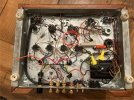
Thanks, Gadget. I just got it back home. Attched is a photo my tech friend sent. The circled capacitor – if you bypass it, the rattle and sparks do not happen. However, the capacitor itself is good, he said.a shorted rectifier could be causing this, luckily 5U4's are pretty cheap. Still some pics to rule out obvious damage would be good, then test it with the rectifier out.
also you really shouldn't run amps with no speakers connected. It can cause the tubes to arc or damage to the output transformers if something is trying to make sound and the amp is not loaded. It should be connected to a dummy load if you don't want to risk speakers.
apples and oranges, but recently, my kitten "jarred" one of the EL-84s loose on my amp, causing almost exactly what you described. in my case, since my amp is ss rectified, it took out a couple resistors in the rectifier circuit, which were easily replaced. I suspect that the recommendations to replace the rectifier tubes or the associated filter caps to be not far off the mark. take off the bottom cover of your amp and let's see the innards. Those Maggies are dead simple and it shouldn't be too hard to spot any singed resistors or caps.
The amplifier sounds tremendously unstable to me. Does it make the same sound through the speakers when they are connected? Is that without any input connected?
Dave
Thanks, Dave! As I mentioned elsewhere, if the circled cap is bypassed, the noise and sparks do not occur.apples and oranges, but recently, my kitten "jarred" one of the EL-84s loose on my amp, causing almost exactly what you described. in my case, since my amp is ss rectified, it took out a couple resistors in the rectifier circuit, which were easily replaced. I suspect that the recommendations to replace the rectifier tubes or the associated filter caps to be not far off the mark. take off the bottom cover of your amp and let's see the innards. Those Maggies are dead simple and it shouldn't be too hard to spot any singed resistors or caps.
No input was connected. And since no speakers were connected, I let it run just a second or two. I do understand that a load needs to be connected to those taps.The amplifier sounds tremendously unstable to me. Does it make the same sound through the speakers when they are connected? Is that without any input connected?
Dave

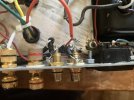
Thanks, man! You may have nailed it! That orange lead should not be connected to the input, not no way, not no how, should it?! And the orange lead is actually twisted together with the red input wire (see photo)!!! Jeez, how could that have happened? I think that red wire should be soldered to the positive terminal on the RCA input jack, and the orange wire should be completely out of the picture (the transformer has 4, 8 and 12 ohm outputs, so two of the color-coded wires should not be hooked up at all). I'll try to fix that and report back!If yoy mean bypassed to ground you're killing the signal from the 6eu7 downstream, meaning the problem is somewhere in the 6eu7 or before it.
Looks like that orange transformer lead is awful close to the input jack in the back. If thats touching it might do this.
And 0 is the amount of seconds this should operate unloaded.
It looks like an input wire got somehow twisted with a transformer wire, which seems wrong as wrong can be. So you may have pinpointed the problem. Fingers crossed . . .I don't think severely jarred would cause a can cap to go bad. Maybe some wires touching together from the jarring?