• The move to the new server is done. There are some software and database maintenance updates in process. This has us passing the hat around to help out. We appreciate any donations. Seriously, even a dollar helps. The payment page may be found here - https://www.audiokarma.org/support.html

Help identifying a speaker (Japanese from WWII)

Modified might be a mistranslation. Im guessing version or revision fits better.

But yes, late in the war things were stretched, parts bins raided...nothing let to waste.
 
Modified might be a mistranslation. Im guessing version or revision fits better.

But yes, late in the war things were stretched, parts bins raided...nothing let to waste.
I just wanted to check the translation just in case, since that’s a big part of my theory. Thanks for helping out so far!
 
I decided to try and extract more info from the speaker today, after it's been sitting on my floor for a while. So after a few hours of disassembly, studying for any details that may help in telling what's original, taking lots of pictures, and reassembly, here's what I have: I removed the driver for closer inspection, hoping to find some kind of mark to identify it, but the closest I got is this:
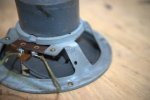
_IMG1856.jpg

Which isn't very helpful. But I was able to find a similar looking driver from JVC:
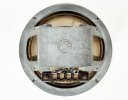
Victor 1012.jpg
They look way different at first, but once you look at the basket, it looks almost the same:
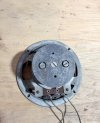
IMG_6867.JPG
That was really nice to find, confirming my thoughts that the driver is original. Even the brass brackets that the wires are soldered to are the same:
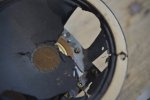
_IMG1825.jpg
I also noticed these shallow lines in the back of the front panel:
_IMG1836.jpg
Which I'm guessing are for some part of the process of making the cabinet? And I also confirmed that the feet are some kind of rubber, as I could make a dent in it with my fingernail. Here's two of them removed:
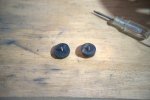
_IMG1847.jpg
And I even compared all the kinds of screws found throughout the cabinet. All are flathead, and they can be divided into 1: Domed top, found on the front panel, feet, and lower driver mounting. 2: Flat top, found attaching the output transformer and upper driver mounting. And 3: The ones used for the switch, which are different to the rest. I even compared a nut used on the binding posts to one from the driver:

_IMG1839.jpg
And they seem to be the same material, and both are similarly rounded on the edges, so I think they're from the same time. Both are Metric, as well.
Front of driver:
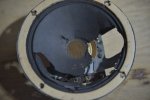
_IMG1829.jpg
Back of cloth that covers driver:
_IMG1833.jpg
I doubt any more info will ever surface, but I'm still hopeful that something may turn up. Especially since this will help someone if another one like it ever turns up. And I took as many pictures as I could, that way I don't have to keep taking it apart every time I want to look at something.

 
It's super likely that there was just a handful of driver makers that filled contracts for all the big companies, with minor variations.
Who knows, as all that info is likely lost to time, but then wouldn’t JVC likely be one of the OEMs? I can’t imagine they’d need to outsource with as big as they were. But I suppose it could be like how plenty of big companies build things in countries where it’s cheaperr. And I’ve only seen that basket style on drivers that are said to be JVC, including one postwar phonograph, but that one’s slightly different than the example I show, which I think is identical.
 
There's a bunch of "small" engineering shops around here (specifically the area I live) that specialise in slot cutting. Gear teeth basically. They fill contracts for whoever, and I'm sure some of the clients are big enough they could get their own shop. The fact there's more than one, probably tells a story.

I'm pretty sure that's been how things go here for quite a while. One of my friends family makes paint pots or something for Mazda. Pretty sure Mazda knows how to press metal, but they've obviously done the numbers and decided to buy them in....
 
Interestingly, I get Japan Denki Onkyo Co. as the company translation.
Yep, that was what JVC was called during the war. No 'foreign names'.

As for conjecture about OEMs and contract work, it's still very much that way in Japan today. Used to be that way pretty much all over the world. Most Danish furniture, for instance, was produced in small workshops on licensed or stock plans produced to a high standard but by many dozens of places all for one "OEM".
 
Yep, that was what JVC was called during the war. No 'foreign names'.

As for conjecture about OEMs and contract work, it's still very much that way in Japan today. Used to be that way pretty much all over the world. Most Danish furniture, for instance, was produced in small workshops on licensed or stock plans produced to a high standard but by many dozens of places all for one "OEM".
There seemed to be commingling of companies in those days. I guess the primary dude who started Onkyo was also associated with Matsushita (National/Panasonic).
 
After a bit of image searching today, I've found that the plate on the front matches pretty closely with other Japanese military things from the era, but I think that was the going theory anyway. And I've reached out to someone who might have seen something like this before, so hopefully that leads somewhere. I suppose one bit of information that's been staring me in the face the whole time is the serial number of 3153, which makes me think there were at least that many made, unless they did something like start from 3000 or similar. And another thing I found when researching the plate is the two square boxes were apparently used for stamps of things like arsenal, which I didn't know before. The left box has what looks similar (but not exact) to this with a circle around it (but that's probably just the stamp and not part of the character itself): ト, and the right has what looks like a T with the same circle around it, but that one's so faint I never noticed until now.
 
I suppose one bit of information that's been staring me in the face the whole time is the serial number of 3153, which makes me think there were at least that many made, unless they did something like start from 3000 or similar.
The Japanese military and their contractors did this ALL the time. It was to fool the Allies who came across abandoned or damaged war materiel. The Germans did this, too.

Factory plate production numbers had to be taken with a grain of salt.
 
The Japanese military and their contractors did this ALL the time. It was to fool the Allies who came across abandoned or damaged war materiel. The Germans did this, too.

Factory plate production numbers had to be taken with a grain of salt.

A lot of manufacturers STILL do this.

Unless it's a limited-availability item. Then, I've seen the opposite. Building a few with serial numbers like "001" to "009", then another serial number series with "0001" to "0009", or the like- but the exact same product. To try and make it seem more exclusive than it is.

Regards,
Gordon.
 
A lot of manufacturers STILL do this.

Unless it's a limited-availability item. Then, I've seen the opposite. Building a few with serial numbers like "001" to "009", then another serial number series with "0001" to "0009", or the like- but the exact same product. To try and make it seem more exclusive than it is.

Regards,
Gordon.
:thumbsup:

As an example, Fender amps... It's best to use Superior Music's great website.

The Fender Serial Number site.
 
Last edited:
I looked at the stampings in the boxes again, and based on a data plate that was already translated, I think the left box is the mark of the Tokyo Arsenal, and one the left is the anchor of the Imperial Japanese Navy, so that certainly is different from what I was thinking initially. I would've guessed it was used on land, not the sea. But based on the lack of corrosion on anything on the inside, I doubt it went to sea. But then again, it was made a maximum of 2-1/2 months before Japan surrendered, so maybe it wasn't at sea for long. And whoever stamped that anchor mark on there sure didn't make it easy to spot. I just can't believe I didn't see it before, because looking back at the closeup of the data plate, it's faintly there.
Edit: I completely forgot about the mounting plates on the back, so disregard my thoughts of it being too clean for going on a ship.
 
Last edited:
I looked at the stampings in the boxes again, and based on a data plate that was already translated, I think the left box is the mark of the Tokyo Arsenal, and one the left is the anchor of the Imperial Japanese Navy, so that certainly is different from what I was thinking initially. I would've guessed it was used on land, not the sea.
The Japanese had elite Naval Landing Force (Marine) regiments, much like the US Marines, during WW2. They were under Japanese Naval control.

They conducted many, many land operations.
 
Last edited:
The Japanese had elite Naval Landing Force (Marine) regiments, much like the US Marines, during WW2. They were under Japanese Naval control.

They conducted many, many land operations.
Interesting. Wasn't aware of that before, but makes sense Japan would've had something like that. And it doesn't make it easier that there's two sets of conflicting things. On one hand, you have the mounting brackets on the back, which would make me think it was wall mounted on a ship. And to contrast that, you have the binding posts on the front, plus the switch on the top. Maybe it was part of a radio setup that rode on a ship, but could be deployed to the land? This speaker can never give a simple answer, can it?
 
Interesting. Wasn't aware of that before, but makes sense Japan would've had something like that. And it doesn't make it easier that there's two sets of conflicting things. On one hand, you have the mounting brackets on the back, which would make me think it was wall mounted on a ship. And to contrast that, you have the binding posts on the front, plus the switch on the top. Maybe it was part of a radio setup that rode on a ship, but could be deployed to the land? This speaker can never give a simple answer, can it?
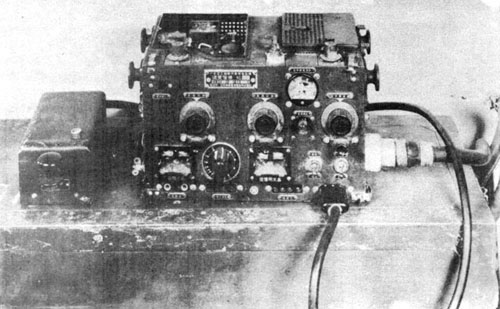
Perhaps — and this is a big wild-@ss guess on my part — the mounting brackets are to stow the radio during transport and landings. Then, as you said, they are removed and carried to be used as a portable radio on land.

cincpac-5-45-12.jpg

The Japanese tended to have cumbersome "portable" radio transmitters. Lots of big triodes and diode tubes. Their communication technology was far behind that of the US, the British, and the Germans during WW2.

US Intelligence "Know Your Enemy!" booklet.

:)
 
Last edited:
Back
Top Bottom