

You are using an out of date browser. It may not display this or other websites correctly.
You should upgrade or use an alternative browser.
You should upgrade or use an alternative browser.
Help identifying tone arm
- Thread starter tjmarrone
- Start date

Register to hide this ad


virgoprestig
New Member
The anti skate weight isn't such a big problem, if you use a piece of fishing line from someone you might know who is into course fishing, they'll not begrudge you of a few inches of `float' line? The weight? Well, a very short piece of 1/4 brass rod, drilled through with a fine drill (put that Black'n'Decker away and use a wheel brace!!). I'd guess not more than a couple of grams but that will depend on your stylus weight? Once you've got it setup, you need a plain uncut/grooved record and the deck absolutely level, start it turning at 33 1/3 and lower the stylus onto the mid track area of the platter and it should sit there and any other area too if its setup good. finding a plain uncut/grooved `LP' with possibly be the most difficult part of this exercise, usually they were on the flip-side of a `good' test record.
Incidentally, when setup for 33 1/3, it goes awry on 45 on `some' arms.
The arm's `lead outs' are infamous for screwing with the anti-skate!! Beware, always check the `in drift without the anti-skate applied, to make sure all is well with the arm's `lead-out' wiring. It should casually drift inwards (Don't let it collide with the spindle or the records label area!!) accelerating as it goes. With the arm in complete balance (zero stylus weight) the arm should stay where you put it until you set the anti-skate, when it will swing gently outwards.
I find that when I release the cuing lever on my deck, there is an infuriating tendency for the arm to swing out-wards before meeting the lead in groove, sometimes missing the edge of the record (GRRR!!) a piece of carefully trimmed gaffer tape stuck aesthetically across the `lifter' in exactly the right place the arm is supposed to sit next to while descending, arrests it's outwards swing while the lift descends. Might not work on all decks, but worth a try?
Good luck
Incidentally, when setup for 33 1/3, it goes awry on 45 on `some' arms.
The arm's `lead outs' are infamous for screwing with the anti-skate!! Beware, always check the `in drift without the anti-skate applied, to make sure all is well with the arm's `lead-out' wiring. It should casually drift inwards (Don't let it collide with the spindle or the records label area!!) accelerating as it goes. With the arm in complete balance (zero stylus weight) the arm should stay where you put it until you set the anti-skate, when it will swing gently outwards.
I find that when I release the cuing lever on my deck, there is an infuriating tendency for the arm to swing out-wards before meeting the lead in groove, sometimes missing the edge of the record (GRRR!!) a piece of carefully trimmed gaffer tape stuck aesthetically across the `lifter' in exactly the right place the arm is supposed to sit next to while descending, arrests it's outwards swing while the lift descends. Might not work on all decks, but worth a try?
Good luck

I thought so too, but while it is almost identical in most ways there are still some differences. This one is a toughie.Fidelity Research FR-54


Stanton681EEES
Addicted Member
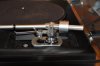
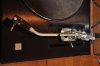
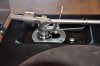
It is a Fidelity Research FR-54.
Yep
Here is what turned up on google.
http://www.google.com/imgres?imgurl...JWbUYSMOKO-0gH3jIDQDA&ved=0CDMQ9QEwAQ&dur=531
I guess there is some sort of special threaded ring assembly to mate the arm to the SME style mount then.It is a Fidelity Research FR-54.
Nice to see someone had a creative streak going!That ring looks like its off the Black Widow with an SME style base. Just like the BW.
KentTeffeteller
Gimpus Stereophilus!
Yes, definitely a Fidelity Research tonearm. A FR 54. Which is very well regarded and beloved of their enthusiasts.

Similar threads
- Replies
- 30
- Views
- 2K


